
A customer lands on your product page, seems interested, adds one item to the cart, then pauses. Maybe the price feels high on its own. Maybe they're not sure what else they need, or whether this single purchase will solve their problem. Then they close the tab.
That quiet moment of hesitation is where a lot of Shopify sales are lost, and it's also where bundling earns its keep. If you've asked what is a bundle and only heard that it's two or more products sold together, you've heard the shallow version. A good bundle changes how a customer judges value, completeness, and risk. It can make a purchase feel like a solved problem instead of an unfinished shopping list, and it can do that without relying only on a bigger discount.
Table of Contents
- Why Bundles Matter for Your Store
- What Defines a Bundle
- Pure vs Mixed Bundling
- Why Bundling Matters Beyond Discounts
- Bundle Types and Strategies for Merchants
- Measuring Whether Bundles Actually Work
- Common Mistakes and How to Avoid Them
- Building Your Bundle Strategy
Why Bundles Matter for Your Store
Think about a first-time buyer in your store who wants the main product but doesn't know your catalog well. They add the hero item, glance at shipping, and start doing mental math. Is this worth it alone? Will they need to come back later for refills, accessories, or a matching piece? Every unanswered question gives them a reason to wait.
A bundle answers several of those questions at once. Instead of asking the shopper to hunt through your store and build the right combination themselves, you present a ready-made solution at one combined price. That reduces decision effort, and it reframes the comparison. They're no longer judging one product against its price. They're judging a complete outcome against its price.
A sale you almost made
This is also why bundles help with discovery. A customer who came for one bestseller may never scroll far enough to find the complementary item you'd love them to try. Put that second item in a sensible set, explain why the pairing works, and you've introduced it at the moment it's most relevant. If you sell consumables, you can see this logic clearly when you compare PetScy product bundles, where related pet products are grouped so owners don't have to piece a routine together themselves.
Bundles can also give slower-moving inventory a fair chance. An item that struggles on its own product page may sell perfectly well as part of a kit, because inside the kit its job becomes obvious. The customer isn't buying a random add-on. They're buying the missing piece.
A bundle works best when it removes a decision for the customer, not when it simply adds more stuff to the cart.
That distinction matters. A discount gimmick trains shoppers to wait for deals. A thoughtful bundle trains them to see your store as the place that understands the full job they came to do. That's how you raise average order value while also making the purchase feel easier, not more expensive.
What Defines a Bundle
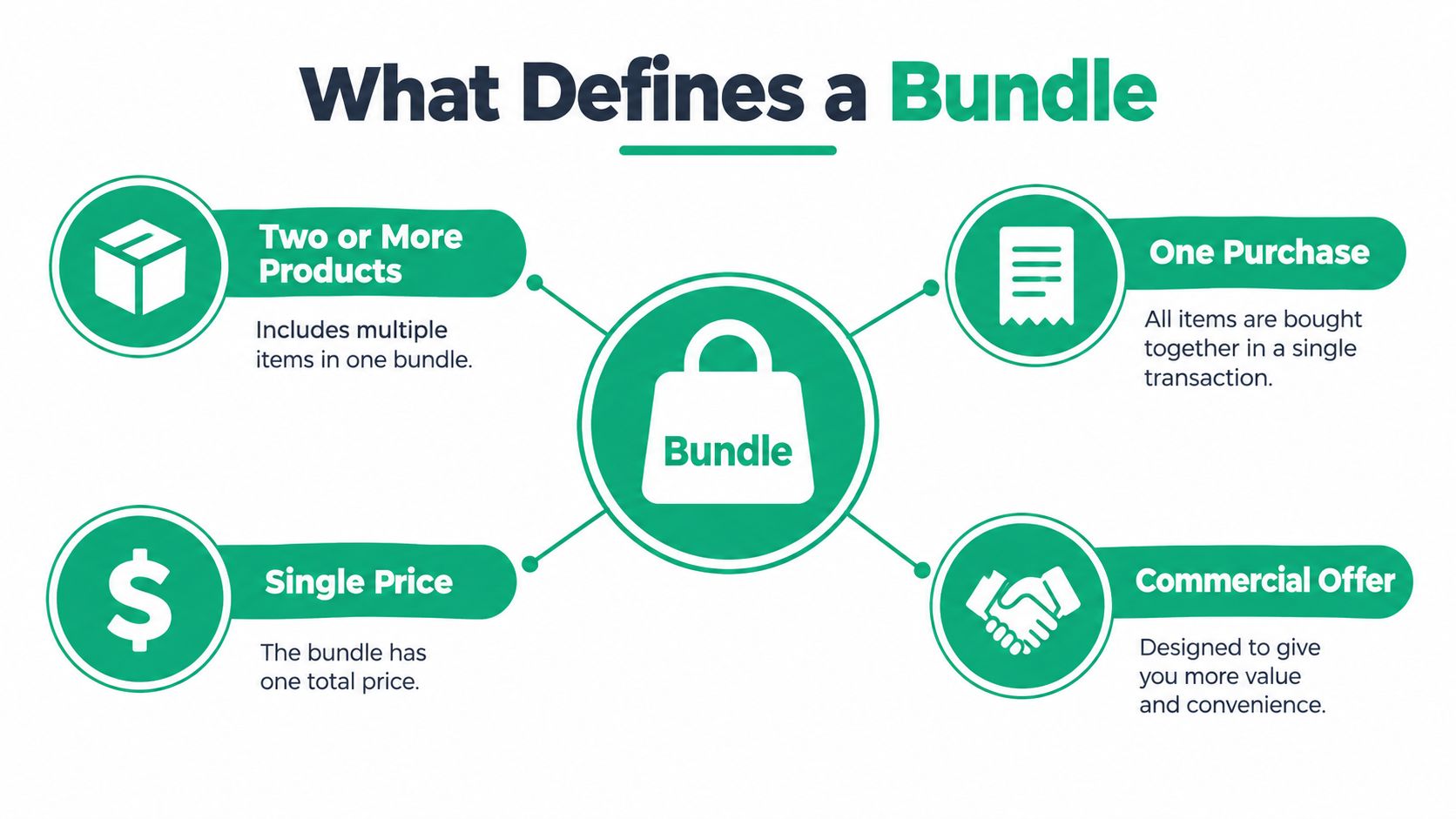
A product bundle is a commercial offer that combines two or more distinct products or services and presents them as one purchase, often at a discounted combined price. That's the core definition you'll find in research on bundling information goods published in Information Economics and Policy, and it's worth taking each part seriously.
Distinct matters. A three-pack of the exact same soap is a multipack, which can be useful, but a bundle usually combines different items that play different roles. One purchase matters too. The shopper makes one decision and pays one combined price, even though several products arrive in the box.
Why the economics work
Bundling has been studied for a long time because it can shift both sides of a transaction. For the buyer, a bundle may reduce the perceived price, simplify comparison between options, and make a set feel like better value than its parts. For the seller, it can increase the likelihood that lower-demand items get purchased and raise revenue per transaction.
There's another condition worth knowing. Firms have more reason to bundle when demand for the combined offer is more price-sensitive than demand for the individual products. In plain language, if a modest price incentive on the set moves a lot more buyers than the same incentive on a single item would, the bundle is doing real economic work.
Complements beat clutter
Effective bundles usually pair complementary items, not unrelated products gathered to inflate the unit count. Useful patterns include:
- Primary product plus accessory: The main item, plus the thing that makes it easier or better to use.
- Primary product plus replenishment: The starter item, plus the refill the customer will need soon anyway.
- Product plus service: The physical item, plus setup, protection, or guidance that lowers risk.
Occasion-based shopping shows the same principle. Couples planning a wedding don't want to assemble dozens of small items one by one, which is why curated bridal bundle collections make sense as a single, coordinated purchase.
So a bundle isn't a visual grouping on a product page. It's a pricing and merchandising mechanism designed to influence conversion, basket size, discovery, and perceived value at the same time. If your bundle doesn't change at least one of those things, you've probably just put products next to each other and hoped.
Pure vs Mixed Bundling
Two formats sit underneath almost every bundle you'll ever build, and choosing between them changes how much freedom your customer keeps.
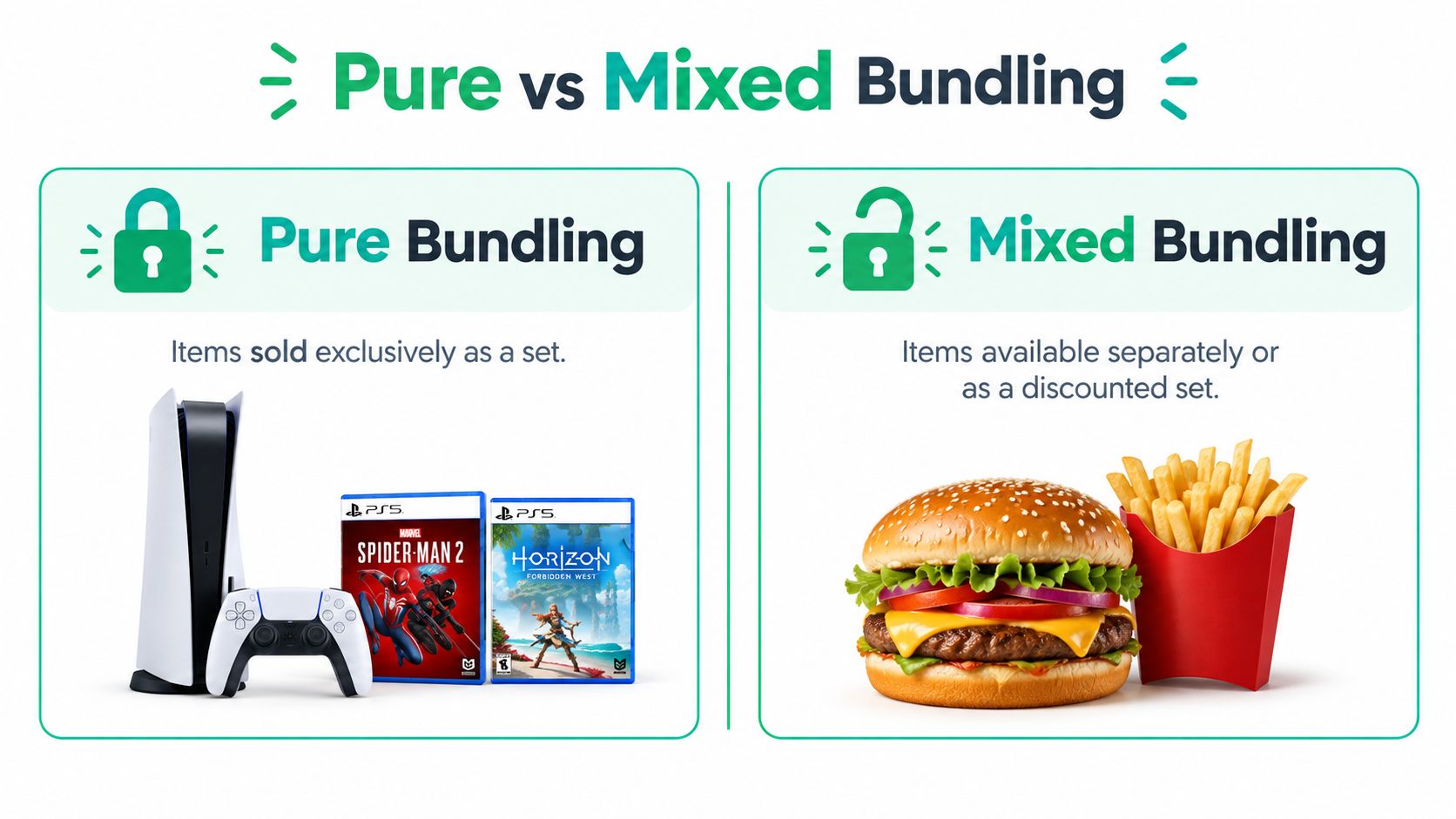
Pure bundling means the products are available only as a package. The customer can buy the set or buy nothing. Mixed bundling means the products are sold both separately and together, usually with the combined price set lower than buying each item alone. Mixed bundling preserves choice while still rewarding the bigger purchase, and research on digital information goods has found it can outperform both pure bundling and selling everything separately in terms of producer surplus.
The wholeness effect
The deeper difference is psychological, and it's the part most basic definitions skip. Research covered by Chicago Booth on how bundling affects how consumer products are valued points to an asymmetry that matters a lot in practice. Shoppers can react more negatively when an item is removed from a bundle than they react positively when an item is added to one.
Once a bundle looks complete, it feels whole. Take one piece away and the customer doesn't think, oh well, the rest is unchanged. They feel a loss, even though the remaining products are exactly the same as before. The same item gets judged differently depending on whether it's framed as part of a complete set or as a leftover from a broken one.
Practical rule: If you let customers build or edit a bundle, design removals, swaps, and out-of-stock substitutions as carefully as you design the original offer.
Choosing the right format
Pure bundling fits situations where the set is the product, like a starter kit that doesn't make sense in pieces. Mixed bundling fits most Shopify catalogs better, because customers can still buy the single item they came for while seeing a clear reason to upgrade.
There's no universally best format. Bundle effects depend on product relationships, what price information you show, and where the shopper is in their purchase journey. A first-time visitor comparing options needs a different presentation than a repeat buyer restocking. Your job is to match the format to that moment, not to copy whatever bundle style is fashionable.
Why Bundling Matters Beyond Discounts
If you still think of bundling as a promotional trick, the history of Microsoft will change your mind. Bundling became a major technology-market milestone with Microsoft Office, whose suite launched in late 1988 according to Investopedia's account of the Microsoft antitrust case. Word processors, spreadsheets, and presentation tools stopped being separate purchases and became one expected package.
A decade later, the same idea produced one of the biggest antitrust fights in business history. In 1998, the U.S. Department of Justice and attorneys general from 20 states filed charges alleging that incorporating Internet Explorer into Windows could unlawfully reinforce Microsoft's operating-system monopoly. The concern wasn't price. It was distribution.
What distribution power looks like
When a firm controls a powerful channel, adding a product into an established platform can change a market fast. Contemporary reporting described Netscape's browser share falling from as high as 90% several years earlier to below 60% by 1998, while Microsoft's share rose sharply. The DOJ's own 1998 account described a related shift from 5% to 30%, then approximately 42%, in about a year and a half.
Nobody had to persuade each Windows user to seek out a browser. The browser was already there, presented as part of the complete package. That's bundling operating as product architecture. It defined what customers treated as the natural, complete purchase.
The lesson for a Shopify merchant
You're not an operating-system monopolist, and that's fine. The principle scales down. Your product pages, cart, and post-purchase flow are your distribution channel, and the bundles you place there shape what shoppers discover and what they consider a complete order.
Ask yourself a few architectural questions:
- What's the default complete purchase in your store, and have you defined it?
- Which products deserve to ride along with your bestseller because they improve the outcome?
- Where does the bundle appear in the journey, on the product page, in the cart, or after checkout?
Merchants who treat bundles as isolated promotions get isolated results. Merchants who treat them as part of how the store is organized get something better. Their catalog starts to explain itself, attach rates improve because the pairings make sense, and customers get real convenience in return. Convenience and integration are legitimate value. The Microsoft case shows how powerful that value becomes when it's built into the structure.
Bundle Types and Strategies for Merchants
Theory only helps if you can translate it into offers your customers recognize. The formats below cover most of what works in ecommerce, and each one solves a different customer problem.
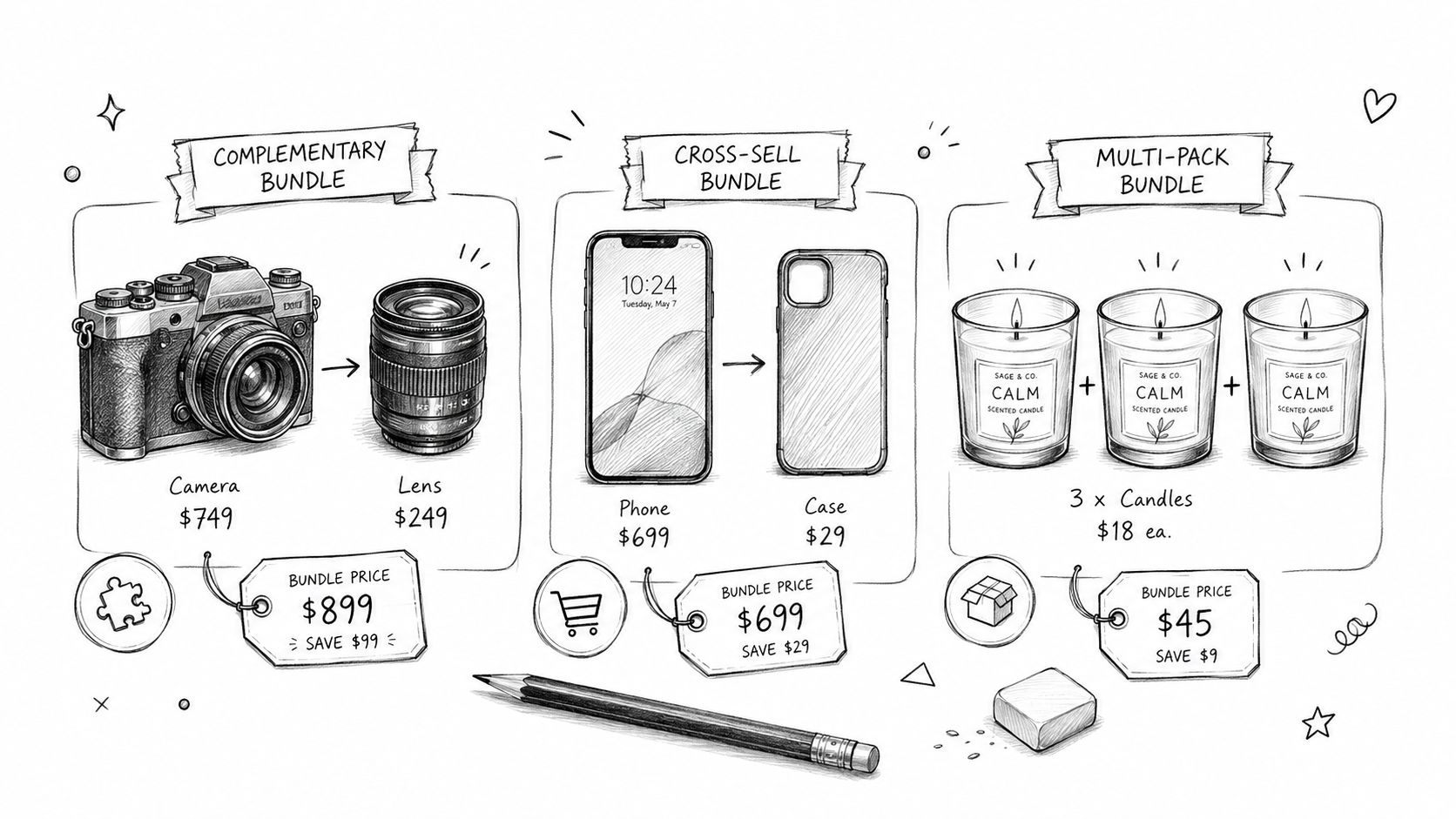
The most reliable starting point is the complementary bundle. A skincare brand pairs a cleanser with a moisturizer. A coffee store pairs beans with filters and a storage tin. The customer problem is obvious, they came for a result, and you're selling the items that produce it together.
Replenishment bundles work differently. They suit products customers use up, such as pet supplements, razor blades, or cleaning refills. The appeal isn't novelty. It's not running out, plus a combined price that rewards stocking up now instead of reordering later.
Giving customers controlled choice
A build-your-own bundle lets shoppers pick variants, flavors, or styles inside a set structure. You still set the basket size and the rules, but the customer feels ownership of the final combination. That sense of control can lift conversion, though you need clear rules for swaps and stock so the set never feels broken.
There's also the honest inventory play. Pair a slow seller with a popular product when the two belong together, and the weaker item finally gets context. Don't pair them just because you're overstocked. Customers can tell when a bundle is a warehouse-clearing exercise.
Pricing each format deserves its own careful pass, and worked examples help more than rules of thumb. You'll find concrete structures in these product bundling pricing examples for ecommerce stores.
The short video below walks through how merchants put these formats into practice, so you can see the mechanics before you build your own version.
Tooling matters once bundles live in your cart and upsell flows rather than only on product pages. ServeApps, for example, offers Shopify-native apps where CartServe supports bundle merchandising inside a configurable cart drawer and UpServe presents frequently bundled offers as add-to-cart popups. Whatever stack you choose, pick tools that keep bundle pricing, stock, and discounts consistent everywhere the offer appears.
Measuring Whether Bundles Actually Work
A bundle page can look successful while making you less money. If customers who would've bought three items at full price now buy the same three items at a discount, you've repackaged existing demand and paid for the privilege. Telling the difference between that outcome and real growth is the measurement job most stores skip.
There's a psychological wrinkle you need to know first. Research discussed in a Journal of Consumer Behaviour study on bundle perception covers controlled work on meal bundles showing that selecting bundles can increase overall purchases because shoppers perceive the products as one unified whole and underestimate the total number of items they're buying.
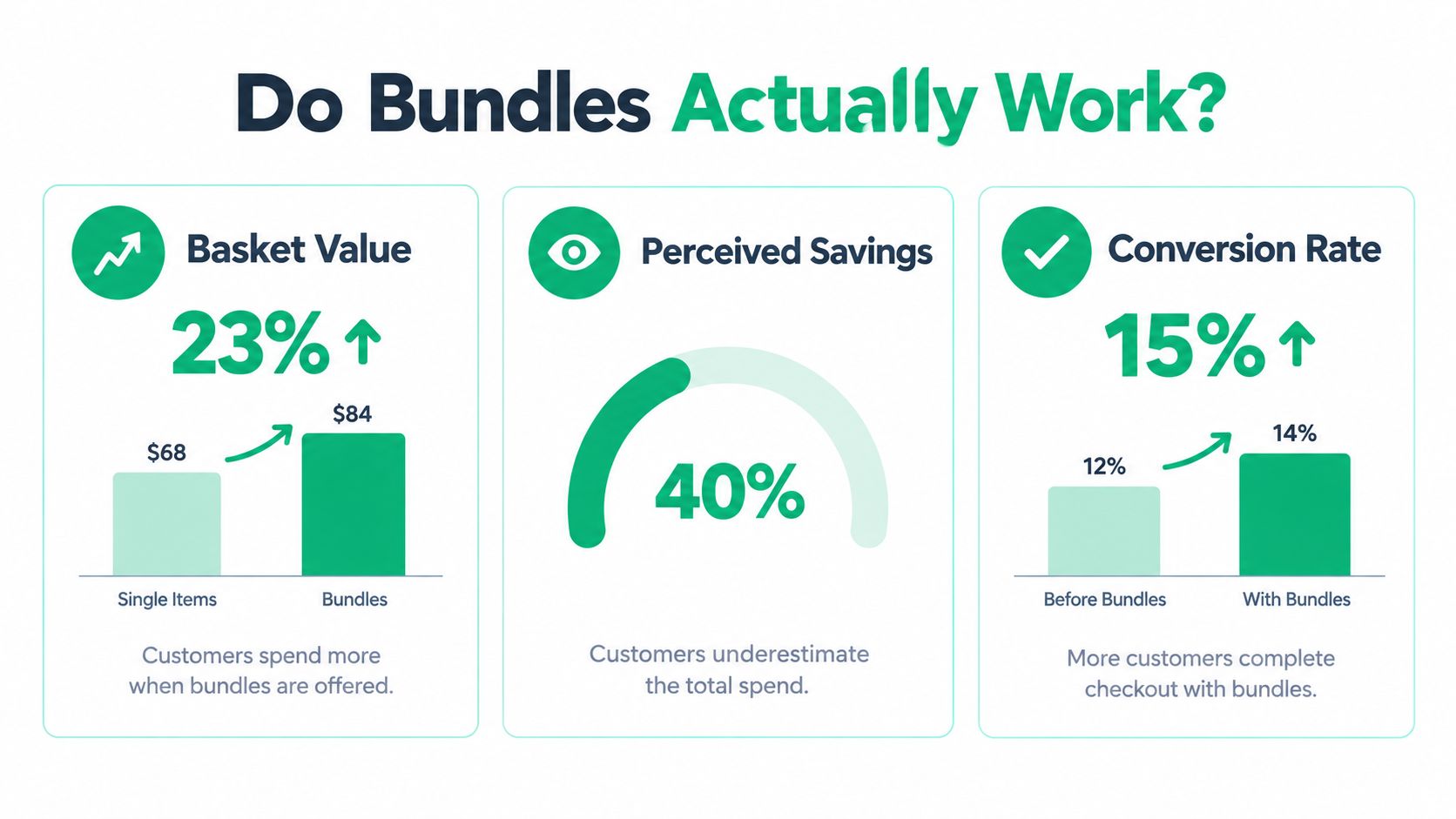
That finding cuts both ways. It helps explain why bundles raise basket size, but it also means conversion rate and discount uptake can't tell you whether customers valued the offer or just lost track of the pile. You need metrics that separate genuine incremental demand from repackaged demand.
A measurement framework that tells the truth
Track these separately for bundle buyers and non-bundle buyers:
- Incremental revenue: Are bundle orders worth more than comparable single-product orders, after the discount?
- Contribution margin: Does the bundle still make money once product costs and the price reduction are counted?
- Attach rate: How often does the secondary item sell with the primary one, compared with before the bundle existed?
- Refund and substitution behavior: Do bundle orders come back more often, or trigger more swap requests?
- Counterfactual check: Would these buyers likely have purchased the components individually anyway?
That last question connects directly to how you judge basket health overall, which is why it helps to understand your Shopify average order value and what drives it before you credit a bundle with growth.
Compatibility also shows up in the numbers. Bundling an unknown product with a substitute can improve or damage its perceived effectiveness depending on how the known product performs, and bundling it with a poorly performing complement can drag perceptions of the new product down. In other words, a bundle sends a quality signal about every item inside it. If one component disappoints, customers may blame the whole set, so measure satisfaction and returns at the bundle level, not just revenue.
Common Mistakes and How to Avoid Them
Most bundle failures aren't mysterious. Merchants make the same handful of errors, watch the offer underperform, and conclude that bundling doesn't work for their store. Usually the format is fine and the design is the problem.
The most common error is bundling unrelated products to increase unit count. A candle, a notebook, and a pair of socks in one box isn't a bundle. It's a clearance bin with a name, and customers price it like one.
Where bundles quietly break
Watch for these patterns in your own store:
- The broken set: A component goes out of stock and the bundle stays live, forcing substitutions that make the offer feel like a loss.
- The invisible math: You show a combined price but never show what the items cost separately, so the saving feels imaginary.
- The refund maze: A customer wants to return one item and nobody can tell them how the bundle price gets split.
- The vanity metric: You judge success by bundle conversion alone and never check margin or cannibalized full-price sales.
If removing one item from your bundle would upset customers more than adding one delights them, your substitution policy is part of the product.
Fixes are mostly unglamorous. Sync inventory so bundles can't oversell components. Write the partial-return rule before you launch, not after the first angry ticket. When something goes out of stock, pause the bundle or rebuild it as a new complete set instead of swapping in a weaker item.
Also check your pairings like a skeptic. A bundle communicates that these products belong together and vouch for each other. If you'd hesitate to recommend one component to a friend, it doesn't belong in the box, no matter how much stock you're carrying. Bundles reward honest merchandising and punish shortcuts, because the customer's sense of a complete, well-judged set is the entire mechanism.
Building Your Bundle Strategy
Start smaller than you think. Pick one bestseller, find the two products that most naturally complete it, and build a single mixed bundle so customers can still buy the hero item alone. Set the combined price so the saving is real and visible, then decide in advance which metrics will tell you whether the bundle created new demand.
Let customers personalize where it helps. A food brand that lets shoppers mix and match BBQ rubs keeps the structure of a set while handing flavor choices to the buyer. That balance of guidance and control is where bundling is heading, alongside broader personalization across the store.
Finally, place bundles inside your wider merchandising system instead of leaving them as one-off promotions. It helps to review the ecommerce merchandising tools that support this kind of catalog presentation and choose what fits your theme and team. Test one configuration, read the margin and attach numbers, adjust the pairing, and test again. A bundle strategy isn't a launch. It's a habit of asking what complete looks like for your customer, then proving your answer sells.
Ready to put thoughtful bundles into your cart and upsell flows instead of leaving them stranded on product pages? ServeApps builds Shopify-native apps for configurable cart drawers, contextual upsell popups with frequently bundled offers, and customer self-service order editing, so you can raise basket value while cutting support tickets. Visit ServeApps to see how the tools fit your store and start testing your first bundle placement.
Shopify Store Credits: Issuing, Redeeming and Accounting
Learn what Shopify store credits are, how they differ from gift cards and refunds, and how to issue, redeem and account for them.
Read more →
Can You Have Multiple Stores on Shopify? Plans and Limits
Can you have multiple stores on Shopify? Yes, through organizations or Plus expansion stores. Compare plan limits, eligibility and setup tips.
Read more →
Product Customizer App Shopify: Choosing the Right Tool
Compare native and third-party product customizer app shopify options on speed, theme support, variant mapping and SKUs before you install one.
Read more →