
The bundle price is only half the strategy. A lower combined price can increase order size, but it can also replace purchases customers would have made anyway, expose inventory constraints, complicate returns, or reduce contribution margin. The popular advice, “discount several products and watch AOV rise,” skips the decisions that determine whether the offer is additive or merely cheaper.
The strongest product bundling pricing examples start with individual-price math. Compare the standalone subtotal with the bundle price, calculate the saving, then check product cost, fulfillment, payment fees, returns, and the possibility that customers remove the most profitable item. A bundle should also have a job. Some bundles increase basket size, some introduce unfamiliar products, some create recurring revenue, and others use urgency or personalization to change timing.
The eight models below treat pricing as part of a wider Shopify workflow. Each example connects the calculation to merchandising, cart UX, analytics, inventory control, and post-purchase operations. ServeApps can be relevant here through cart merchandising, contextual upsells, bundle support, per-offer analytics, and controlled order edits, but the right implementation still depends on your catalog, margins, and fulfillment rules.
Table of Contents
- 1. Tiered Volume Bundling
- 2. Complementary Product Bundling
- 3. Subscription Bundle With One-Time Purchase Option
- 4. Loss Leader Bundle Strategy
- 5. Premium and Deluxe Bundle Upsell
- 6. Time-Limited Flash Bundle Promotion
- 7. Frequently Bought Together Algorithmic Bundling
- 8. Sample and Trial Bundle Strategy
- 8-Strategy Product Bundling Pricing Comparison
- Choose the Pricing Mechanism Before the Discount
1. Tiered Volume Bundling
Tiered volume bundling rewards customers as they add more units or move through spend thresholds. The math is simple, but the threshold design determines whether customers add another product or stop at the first level.
Consider an illustrative skincare ladder. One product costs $45. Two products normally cost $90, but a two-item bundle costs $75, creating a $15 saving, or about 17%. Three products normally cost $135, while the bundle costs $99, creating a $36 saving, or about 27%. The third unit therefore gives the shopper a stronger perceived deal, while the merchant earns a larger basket.
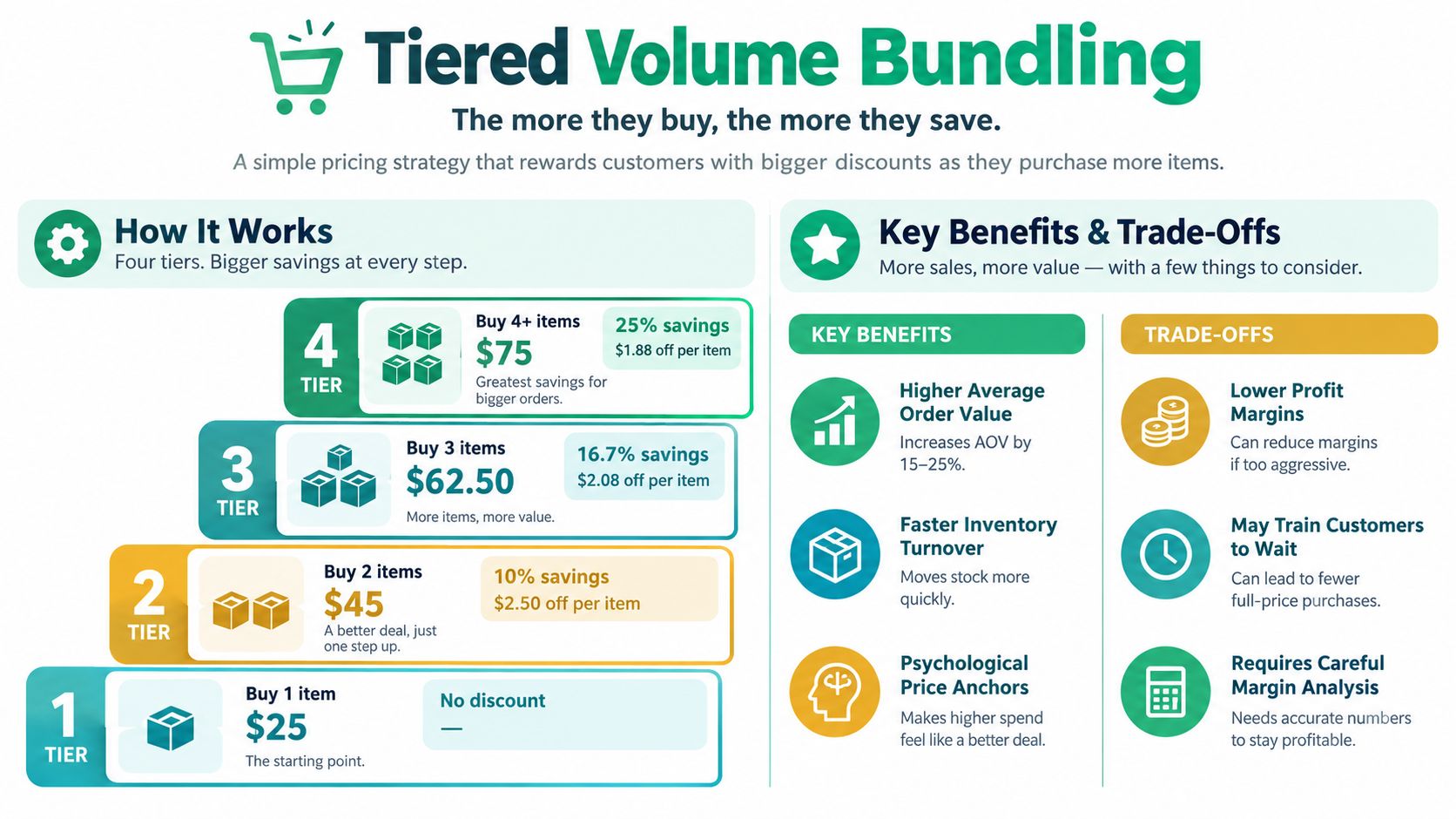
The danger is that the top tier may discount products customers already intended to buy. Protect the offer by setting thresholds around products with compatible demand and reliable stock. A progress bar in the cart can show the shopper how close they are to the next reward, while a contextual upsell can recommend one relevant item rather than displaying the entire catalog.
Practical rule: Calculate the bundle's gross profit at every tier, not only at the highest tier.
Use product-specific rules instead of applying the discount across an entire collection. A customer buying three premium products may need a different offer from a customer combining a core product with slower-moving accessories. Track the following separately:
- Tier movement: Measure how many orders stop at each level and how many customers cross the next threshold.
- Incremental units: Compare units per order with a non-bundle baseline to identify genuine basket growth.
- Order edits: Check whether customers add products to qualify, then remove them after the discount applies.
- Stock exposure: Prevent a popular tier from consuming inventory reserved for individual bestsellers.
Mixed bundling can preserve choice, which matters when customers have different willingness to pay. Research summarized in an ecommerce analysis of Nintendo's pricing found that offering products both together and separately produced better results than forcing the same products into a pure bundle, with standalone console sales rising by about 100,000 units and game sales rising by more than 1 million in the cited case (Charle Agency's bundling analysis). The lesson applies directly to tiered offers: let the hero product remain purchasable alone.
2. Complementary Product Bundling
Complementary bundling combines products that solve one use case together. A skincare routine, coffee setup, or workout kit feels more coherent than an arbitrary collection because the customer can understand what the set helps them do.
Take an illustrative skincare bundle containing shampoo, conditioner, and a hair mask. If the standalone subtotal is $60 and the bundle price is $48, the customer saves $12, or 20%. The merchant should then ask a less obvious question: how much of that saving comes from products the customer would have bought separately, and how much comes from introducing the mask?
A bundle can improve product discovery, but it can also hide weak product-market fit. If shoppers consistently remove one component, that item may not belong in the fixed set. Offer a swap option when the product roles remain equivalent, such as choosing among scents, colors, or compatible sizes. Avoid unlimited customization, which turns a clear offer into a configuration problem.
Make the cart explain the use case
Place the bundle in the cart drawer near the product that creates the need. A customer adding shampoo should see a routine bundle with the conditioner and mask, not a generic “complete your order” carousel. The message should explain the practical relationship between the products and show the standalone subtotal beside the bundle price.
Test several curated combinations rather than one all-purpose bundle. A coffee merchant might test beans with a mug and spoon, while a fitness store could pair resistance bands with gloves and a jump rope. The right combination depends on customer behavior, stock, shipping dimensions, and return compatibility.
A merchant should monitor:
- Attach rate: How often the complementary set is added after the anchor product appears.
- Removal rate: Which component customers delete before checkout.
- Margin per order: Whether the discount is offset by additional units and useful inventory movement.
- Return composition: Whether customers return the entire set or only one component.
Bundle pricing doesn't need to maximize the visible saving. Harvard Business Review notes that restaurant value meals often discount the combined items by only about 5% to 10%, yet the format remains effective because it simplifies choice and frames the offer as better value (Harvard Business Review on bundled pricing). For a Shopify merchant, clarity and completeness may matter more than the deepest possible markdown.
3. Subscription Bundle With One-Time Purchase Option
A subscription bundle uses the same product architecture for two different buying preferences. Recurring delivery serves customers who value convenience, while a one-time bundle gives cautious shoppers a way to test the offer without committing.
An illustrative coffee offer shows the logic. A subscription provides four bags for $15 per month, while a one-time purchase provides three bags for $60. The apparent comparison is not only “which price is lower?” The merchant must compare the quantity, delivery frequency, acquisition cost, payment fees, expected churn, and the operational cost of recurring fulfillment.
The subscription can have a lower effective unit price, but the one-time bundle may still be attractive to customers who want control. Show both options side by side, with the quantity and delivery terms visible. Don't make the recurring option look like a preselected trap. Customers who understand the commitment are less likely to cancel immediately or contact support to reverse the purchase.
The beginner's guide to Shopify subscription products can help merchants think through the product and customer experience before adding recurring billing.
Design for retention before acquisition
Subscription merchandising should answer four operational questions:
- Can customers skip or pause? Flexible controls can prevent a customer from cancelling because they temporarily have too much stock.
- Can customers adjust the bundle? Allowing a scent, flavor, or variant change can preserve the relationship without breaking the offer.
- What happens when one component is unavailable? Define substitutions or partial fulfillment before the first recurring order.
- What will the customer receive after the trial? Make renewal timing, quantity, and price easy to find.
Use post-purchase messaging to convert one-time buyers only after they have experienced the product. A one-time buyer who adds the same bundle repeatedly may be a better subscription prospect than a new visitor who sees an aggressive recurring discount.
The relevant analytics are subscriber conversion, skip rate, cancellation reason, failed payment rate, and the percentage of subscribers who change bundle contents. A subscription discount should be derived from the margin and fulfillment model, not copied from a generic promotion. The bundle earns its place when recurring convenience creates durable demand without turning support into a manual renewal desk.
4. Loss Leader Bundle Strategy
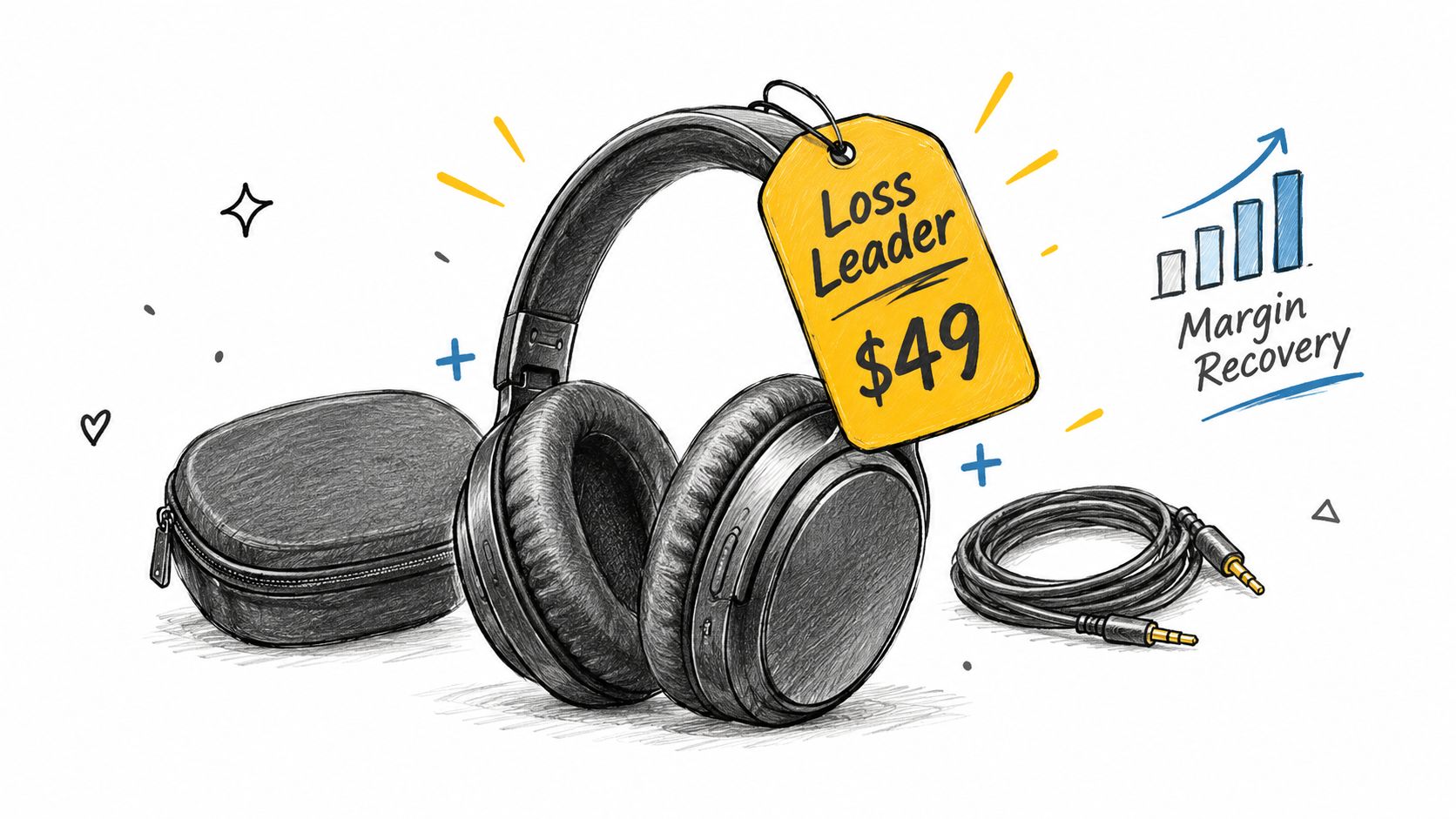
A loss leader bundle deliberately gives one product little or no margin, then relies on the rest of the offer to recover contribution. It can attract a new customer, move aging inventory, or make a higher-margin product easier to justify. It should never be treated as a permanent storewide discount.
Consider an illustrative apparel bundle. Clearance jeans sell for $9.99 and cost $8, while a trending T-shirt sells for $35 and costs $12. Together, the bundle price is $44.99. The merchandise cost is $20, leaving $24.99 before fulfillment, payment fees, returns, marketing, and any other variable cost. The jeans contribute only $1.99 on their own, but the bundle gives the merchant a larger profit pool to evaluate.
That calculation is useful only if customers keep both products. If the cart lets shoppers remove the T-shirt while retaining the jeans, the merchant has created a discounted clearance sale, not a profitable bundle. Use a fixed kit when the operational model requires both items, or use a rule that recalculates the price when a component is removed.
Restrict the offer deliberately
Target loss leader bundles to a defined audience, such as first-time buyers or customers who abandoned a cart. A new customer may justify a different acquisition cost from a repeat customer who would have purchased the full-price product anyway. Use a clear end date or inventory condition so the offer doesn't become the default price without notice.
The cart should display the value of the high-margin component without disguising the individual prices. It should also prevent an order edit from invalidating the economics. If customers can change size, color, or quantity after purchase, the merchant needs rules that recalculate payment differences and inventory.
Track revenue at the offer level, not only at the order level. Compare new-customer rate, contribution after fulfillment, repeat purchase behavior, and return rate. A loss leader that attracts many low-value orders may look successful in conversion reports while weakening the business.
The method is most defensible when the bundle has a clear commercial purpose. It can move an item that is difficult to sell alone, but it shouldn't train existing customers to wait for a bundle before purchasing a bestseller.
5. Premium and Deluxe Bundle Upsell
Premium bundle architecture presents several complete options at different prices. The entry tier establishes accessibility, the middle tier often becomes the practical recommendation, and the highest tier gives customers with greater willingness to pay a reason to spend more.
An illustrative skincare ladder might offer Essentials at $59, Deluxe at $99, and Premium at $149. The arithmetic alone doesn't make the middle tier compelling. Each level needs a meaningful product or service difference, such as a larger size, an exclusive item, faster delivery, or a more complete routine. Otherwise, the pricing merely creates confusion.
The premium tier also acts as an anchor, but anchoring works only when the top option appears credible. A premium bundle that contains low-demand filler can reduce trust. Use a clearly differentiated component, and explain why it belongs in the set.
Let shoppers compare outcomes
A comparison card or cart drawer can show the contents of every tier without forcing customers to open several product pages. Highlight one recommended option, but keep the other choices accessible. The recommendation should reflect the most common use case, not just the tier with the highest margin.
Test upgrades at two moments. On the product page, customers may still be deciding what they need. In the cart, customers have already committed to buying and may accept an upgrade if the additional value is obvious. Avoid replacing the selected tier automatically, especially for products with different sizes, shipping requirements, or recurring terms.
For each tier, measure:
- Tier mix: The share of bundle orders at each price point.
- Upgrade rate: How often shoppers move from entry to middle or middle to premium.
- Component profitability: The contribution of each included product after all variable costs.
- Return and exchange behavior: Whether premium components create more support or reverse logistics.
An important distinction is between a premium bundle and a simple discount. The former segments customers by need and willingness to pay. The latter gives the same value to everyone, including customers who would have paid more. Preserve the standalone purchase path where possible, then use the bundle to package additional value rather than only reducing the hero product's price.
6. Time-Limited Flash Bundle Promotion
A flash bundle compresses the buying window. The merchant offers a defined set for a defined period, often around a seasonal moment or event. Urgency can change purchase timing, but it also creates operational pressure and raises the cost of mistakes.
An illustrative seasonal bundle might offer three products at 40% off for 48 hours. The visible saving may attract attention, but the merchant must first calculate the lowest acceptable price from product cost, fulfillment, payment fees, expected returns, and campaign acquisition cost. A timer can't repair a bundle that was unprofitable before promotion.
The offer should use one clear scarcity mechanism. If the bundle ends at a specific time, say so. If inventory is limited, show the inventory condition accurately. Presenting both a countdown and an unexplained stock warning can make the promotion appear manipulative.
The guide to running flash sales without harming margins is relevant when the promotion needs a margin and fulfillment plan rather than a last-minute markdown.
Protect the fulfillment window
Flash promotions need operational controls before launch:
- Inventory reservation: Confirm that every component can support the advertised quantity.
- Pick-and-pack instructions: Tell the warehouse whether the bundle is kitted in advance or assembled per order.
- Edit policy: Decide whether customers can swap components and how the price changes.
- Customer messaging: State delivery expectations before payment, especially if demand may exceed normal capacity.
- Campaign reporting: Separate flash orders from normal orders so conversion and margin comparisons remain meaningful.
A merchant should inspect abandoned carts during and after the event. High abandonment can indicate that the discount isn't clear, the bundle includes an unwanted item, shipping is too expensive, or the checkout deadline feels artificial. Post-purchase, measure refunds, partial returns, support contacts, and repeat purchases. A flash bundle succeeds when it creates controlled urgency without creating a backlog of exceptions.
7. Frequently Bought Together Algorithmic Bundling
Frequently Bought Together, or FBT, uses purchase history to suggest products that shoppers often buy in the same order. Unlike a fixed merchandising bundle, the recommendation can change as the catalog and customer behavior change.
The calculation begins with a pairing, not a discount. If a store's data shows that customers who buy a hoodie often add socks, the system can present that pairing with the hoodie. The merchant then compares the incremental revenue and margin from the recommendation with the result for similar product views that did not receive it.
Historical frequency isn't proof of causation. Customers may buy both products because of a seasonal event, a campaign, or a common discount. A recommendation can also expose a product that is nearly out of stock or pair a high-return item with a bestseller. Review algorithmic output before allowing it to drive prominent cart merchandising.
The product recommendation engine approach is useful when a merchant wants recommendations to reflect observed product relationships rather than relying only on manually chosen collections.
Combine automation with judgment
Use FBT in several locations, but give each placement a distinct job. A product page can introduce the relationship, while the cart can offer a compact add-on with a clear price. A post-purchase message can recommend a consumable for the next order without reopening the current bundle.
Review these signals:
- Recommendation acceptance: The share of exposed shoppers who add the suggested product.
- Removal rate: How often customers add the recommendation and then delete it.
- Pair margin: The combined contribution after any discount.
- Stock and seasonality: Whether the pairing remains useful outside the period that generated the data.
- New-product exposure: Whether recommendations help customers discover items that lack enough history to rank naturally.
Algorithmic bundling is strongest when the data supports it and the merchant still controls exclusions. It isn't a substitute for merchandising strategy. A product may be frequently bought with another item because customers need it, but that doesn't mean a discount is necessary. Start with recommendation, then test whether a price incentive adds incremental value.
8. Sample and Trial Bundle Strategy
A trial bundle lowers the commitment required for a first purchase by combining smaller versions or limited quantities. It suits categories where customers need to test texture, flavor, scent, fit, or tolerance before buying full-size products.
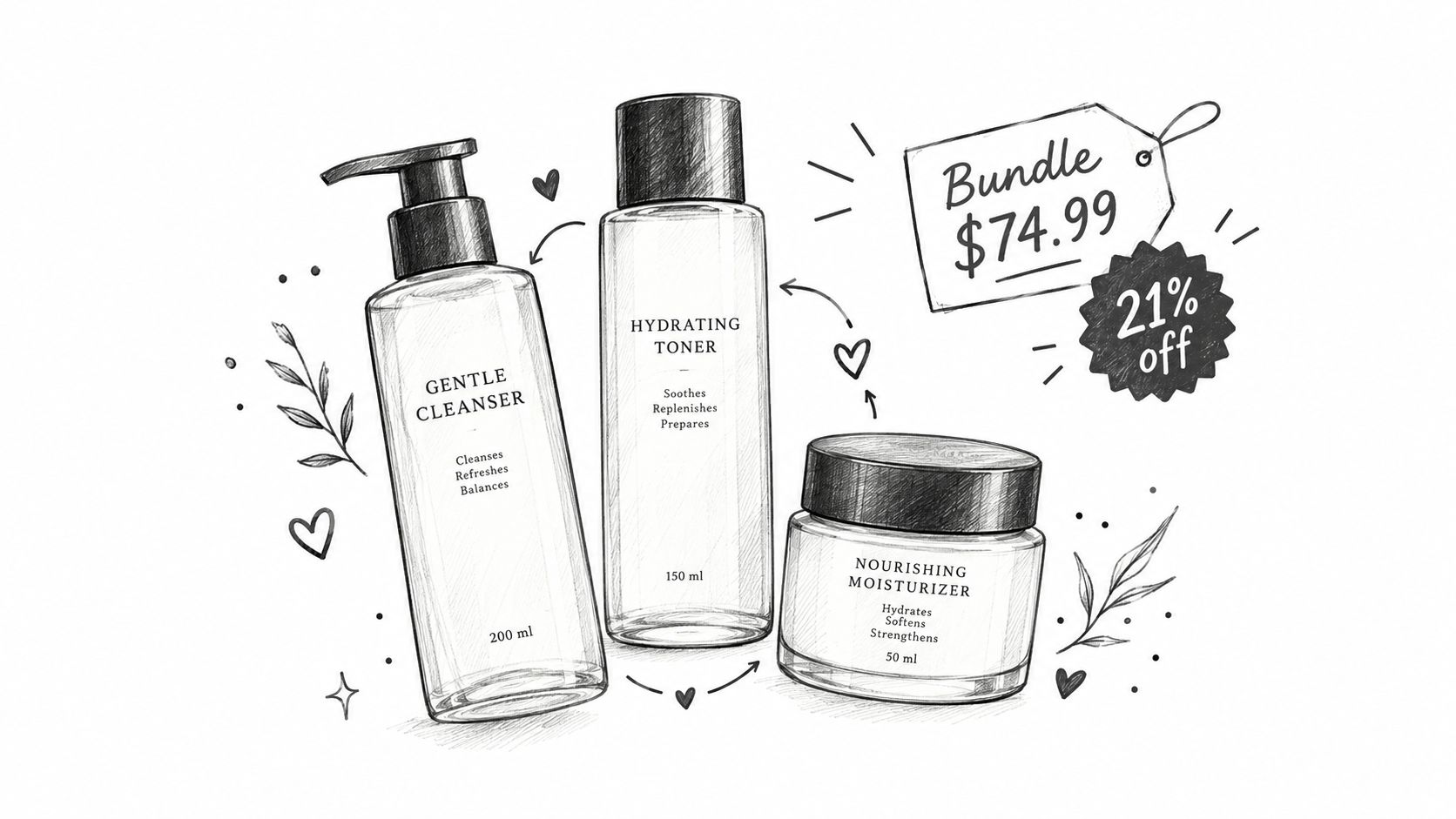
An illustrative routine might include cleanser, serum, and moisturizer minis for $18. A four-product travel kit at $24.99 provides a broader trial, while a seven-day vitamin pack at $12 limits the financial and product commitment. The merchant should compare the bundle price with packaging, sampling cost, pick-and-pack time, and the expected value of a later full-size purchase.
The sample bundle isn't automatically profitable as a standalone order. Its commercial role may be acquisition, product education, or conversion to a larger repeat purchase. That role needs to appear in the analytics. Track which sample combinations lead to full-size purchases, which products customers reorder, and how long the conversion takes.
Turn trial into a guided next step
Build the bundle around proven products rather than using it as a dumping ground for leftover samples. Include a clear path to the next purchase, such as a code for the full-size version or a product-specific follow-up message. The code should have rules that protect margin and prevent it from stacking with incompatible offers.
The post-purchase sequence can be more useful than the sample discount itself. Ask for feedback after the customer has had time to use the products, then recommend the full-size item associated with the strongest signal. If one sample is repeatedly ignored, replace it with a product that helps customers understand the broader range.
Use the cart to frame the offer as a low-risk introduction, but don't imply that every customer needs it. Promote it to new visitors, customers comparing products, or shoppers who abandoned a full-size purchase. Monitor:
- Trial conversion: The rate at which sample buyers purchase a full-size product.
- Product-level progression: Which sample leads to which later purchase.
- Refund and complaint patterns: Whether the sample creates unrealistic expectations.
- Shipping economics: Whether a low-price bundle becomes unprofitable when shipped alone.
A good trial bundle creates information for both sides. The customer learns which product fits, and the merchant learns which composition deserves a larger, recurring, or premium bundle.
8-Strategy Product Bundling Pricing Comparison
| Strategy | Implementation complexity 🔄 | Resources & setup ⚡ | Expected outcomes 📊⭐ | Ideal use cases 💡 | Key advantages ⭐ |
|---|---|---|---|---|---|
| Tiered Volume Bundling | 🔄 Moderate, define tiers, UI & margin rules | ⚡ Low–Medium: pricing engine, progress bar, margin monitoring | 📊 AOV ↑ 15–25%; ⭐ Boosts basket size; margin risk if too deep | 💡 DTC consumables, apparel, fast-moving goods | ⭐ Clear incentives; improves turnover; easy to communicate |
| Complementary Product Bundling | 🔄 Low–Moderate, curate pairings and set discounts | ⚡ Low: inventory coordination, analytics for combos | 📊 AOV ↑ 20–35%; ⭐ Moves slow SKUs, introduces products | 💡 Skincare, accessories, cross-sell scenarios | ⭐ Reduces decision fatigue; promotes discovery |
| Subscription Bundle with One-Time Option | 🔄 High, subscription UX, billing, churn controls | ⚡ High: subscription platform, logistics, customer portal | 📊 LTV ↑ 3–5x; ⭐ Predictable revenue; churn risk | 💡 Consumables (coffee, supplements, pet supplies) | ⭐ Recurring revenue; improved cash flow predictability |
| Loss Leader Bundle Strategy | 🔄 High, tight margin modeling & targeted rules | ⚡ Medium–High: pricing analytics, targeted marketing, inventory control | 📊 Drives acquisition & AOV; ⭐ Clears inventory if balanced | 💡 New-customer acquisition, clearance, promotional events | ⭐ Strong acquisition and buzz; clears obsolete stock |
| Premium/Deluxe Bundle Upsell | 🔄 Moderate, design tiers and anchor pricing | ⚡ Medium: design, copy, analytics, exclusive SKUs | 📊 AOV ↑ 25–40%; ⭐ Monetizes high-intent buyers | 💡 SaaS, beauty, electronics, higher-ticket goods | ⭐ Anchoring increases mid-tier uptake; higher margins on premium |
| Time-Limited Flash Bundle Promotion | 🔄 Moderate–High, timing, countdown, scarcity controls | ⚡ High: marketing blitz, fulfillment scaling, inventory prep | 📊 Conversions ↑ 20–35% short-term; ⭐ Rapid stock clearance | 💡 Black Friday, seasonal clearance, anniversary sales | ⭐ Urgency-driven spikes; strong short-term revenue lift |
| Frequently Bought Together (FBT) Algorithmic Bundling | 🔄 High initially (data/ML), low ongoing maintenance | ⚡ High: data infrastructure, recommendation engine, historical data | 📊 Highest conversion lift (often 2–3x curated); ⭐ Improves over time | 💡 Mature catalogs with ample purchase history | ⭐ Personalized, self-learning recommendations; low merchant curation |
| Sample/Trial Bundle Strategy | 🔄 Low–Moderate, create sample SKUs & packaging | ⚡ Medium: sourcing mini sizes, fulfillment, promo codes | 📊 New-customer conversion ↑ 30–50%; ⭐ 25–35% convert to full-size | 💡 Beauty, skincare, supplements, discovery-driven products | ⭐ Low-risk trial; drives repurchase and long-term LTV |
Choose the Pricing Mechanism Before the Discount
The right bundle begins with the commercial problem, not the percentage shown beside the price. Use tiered volume bundling when customers already have a reason to buy multiple units and the next threshold can increase basket size. Keep the anchor product available individually so the offer adds units rather than forcing every shopper into a package.
Choose complementary bundling when products solve one recognizable task together. The merchant should make the relationship visible in the product page and cart, then watch removals and returns to confirm that the set feels coherent. A bundle that moves a slow product only because customers don't notice it is not a durable merchandising win.
Use a subscription bundle when replenishment is predictable and the customer benefits from regular delivery. Show the one-time option alongside it, explain the renewal terms, and give subscribers practical controls such as skips, pauses, and item adjustments. Measure churn alongside subscriber acquisition, because a heavy initial incentive can hide a poor recurring experience.
A loss leader bundle belongs in an acquisition or inventory plan. Put the low-margin product beside a profitable or strategically important component, restrict the audience or duration, and calculate contribution after fulfillment and returns. For a store with sufficient historical data, algorithmic FBT can recommend relationships at the right moment, but the merchant still needs to review stock, seasonality, and poor pairings.
A premium and deluxe structure helps segment willingness to pay. Make each tier materially different and use the cart to explain the upgrade. A flash bundle is appropriate when the merchant can coordinate promotion, inventory, warehouse capacity, and customer communication around a specific window. A trial bundle is the better choice when first-purchase risk is the main obstacle and later full-size conversion matters more than immediate order profit.
The evidence supports restraint. For brands with gross margins above 50%, one ecommerce benchmark recommends a bundle discount of 10% to 20% off the combined retail subtotal, with bundle attach rates of 15% to 25%, an AOV lift of at least 20% on bundle orders, and gross margin per order kept within about 5% of non-bundle orders (Shopify's bundling benchmark). Treat those figures as testing reference points, not universal targets. Your own baseline and economics decide whether the offer works.
Before launch, validate the offer in this order:
- Individual-price math: Record every standalone price and calculate the exact combined subtotal.
- Total bundle margin: Include COGS, packaging, fulfillment, payment fees, expected returns, and acquisition cost.
- Inventory availability: Check every component, substitution rule, and replenishment risk.
- Discount eligibility: Define whether the bundle can combine with codes, rewards, shipping incentives, or subscriptions.
- Attachment and conversion metrics: Track exposure, add rate, checkout conversion, removal rate, revenue per visitor, and contribution per order.
- Post-purchase edit controls: Decide which products and quantities customers may change, when edits close, and how payment differences or refunds are handled.
ServeApps can support parts of this workflow without being a universal fit for every store. CartServe supports configurable cart merchandising, spend-tier goals, bundles, subscriptions, stock, and market-aware previews. UpServe supports contextual upsell popups for frequently bundled offers and provides per-offer impression, conversion, and revenue analytics. SelfServe supports merchant-controlled order changes, including product swaps, quantity changes, additions, and payment reconciliation within defined editing rules. Used together or independently, these capabilities can help a Shopify team connect bundle pricing with cart UX and post-purchase operations.
The decision is practical. Choose the mechanism that matches the job, calculate the economics before publishing the saving, and keep enough control to learn whether the bundle creates incremental value or merely discounts demand you already had.
ServeApps provides Shopify-native tools for bundle merchandising, cart goals, contextual upsells, offer analytics, and controlled post-purchase order changes. Visit ServeApps to evaluate which workflows fit your bundle strategy and store operations.
Shopify Average Order Value: The Practical Guide
Learn what Shopify average order value really measures, how to calculate it accurately, and which benchmarks actually matter for your store in 2026.
Read more →
Product Recommendations Shopify: Best Practices 2026
Learn how to set up and optimize product recommendations Shopify in 2026. Increase average order value and drive more sales with proven strategies.
Read more →
Free Shipping Bar Shopify: How to Set One Up That Works
Free Shipping Bar Shopify. Learn how to set up a free shipping bar in Shopify that converts. Covers thresholds, messaging, placement, and currency tips
Read more →