
Most advice about ecommerce merchandising tools starts with the wrong question: which app has the most features? Search, recommendations, bundles, cart incentives, checkout offers, and post-purchase retention solve different merchandising jobs, and each introduces a different operational burden. A fast search layer won't replace collection controls, while an attractive upsell widget won't fix unclear delivery costs or a weak checkout.
The practical comparison is therefore broader than conversion claims. Look at catalog complexity, Shopify fit, control depth, analytics, implementation effort, pricing model, and the place each product should occupy in a working stack. Shopify Search & Discovery is the sensible baseline for native search, filters, and basic recommendations. Specialized tools become more relevant when a merchant needs stronger rules, behavioral personalization, coordinated cart and upsell experiences, or support for complex markets and catalogs. Shopify operators can also use a dedicated help desk for Shopify apps when implementation or app selection becomes an operational issue.
Table of Contents
- 1. UpServe
- 2. Shopify Search & Discovery
- 3. Rebuy Personalization Engine
- 4. Nosto
- 5. Algolia
- 6. Klevu
- 7. Searchspring
- 8. Constructor.io
- 9. LimeSpot
- 10. Boost AI Search & Filter
- Top 10 Ecommerce Merchandising Tools Comparison
- Build the Stack Around Your Bottleneck
1. UpServe
UpServe is the strongest fit here when the merchandising job is narrow and immediate: show a relevant offer after a shopper adds a product to the cart. It's a free, Shopify-native popup upsell app that can present a specific product or variant, apply an optional discount, and match the storefront through detailed controls for colors, corners, shadows, spacing, and templates. That makes it more useful than a generic popup when the offer needs to feel like part of the store rather than an interruption.
The Shopify theme app extension approach matters operationally. UpServe avoids the render-blocking scripts and layout shift associated with heavier injected experiences, while merchants can install the feature without building a full recommendation system. Trigger and audience conditions also let teams control when an offer appears, which product was added, and which variant should be suggested.
Why UpServe stands out
The important distinction is measurement. Each offer reports impressions, conversions, and revenue, so a merchant can compare offers rather than judge success by clicks or the visual appeal of a popup. That aligns with Baymard's finding that merchandising experiments should separate low purchase intent from preventable checkout friction, then evaluate completed orders, average order value, and profit rather than interaction alone. Baymard's cart-abandonment research provides the broader measurement logic, although it isn't evidence of UpServe's performance.
Practical rule: Treat every popup as an experiment with a control group, not as permanent decoration.
UpServe also fits a broader ServeApps workflow. It can work alongside CartServe for cart-drawer goals and SelfServe for controlled post-purchase order changes, allowing merchants to connect incremental sales with order retention and operational follow-through. That matters because an upsell with high attachment can still create avoidable edits, refunds, or support contacts if the offer conflicts with inventory, subscriptions, or fulfillment conditions.
The limitation is platform access. Checkout upsells are available for Shopify Plus stores, so non-Plus merchants should evaluate UpServe mainly as an add-to-cart experience. Highly customized themes may need manual wiring or support, despite the Shopify-native installation. For a focused, design-sensitive upsell job with clear attribution and no app charge, UpServe's Shopify upsell approach is difficult to ignore.
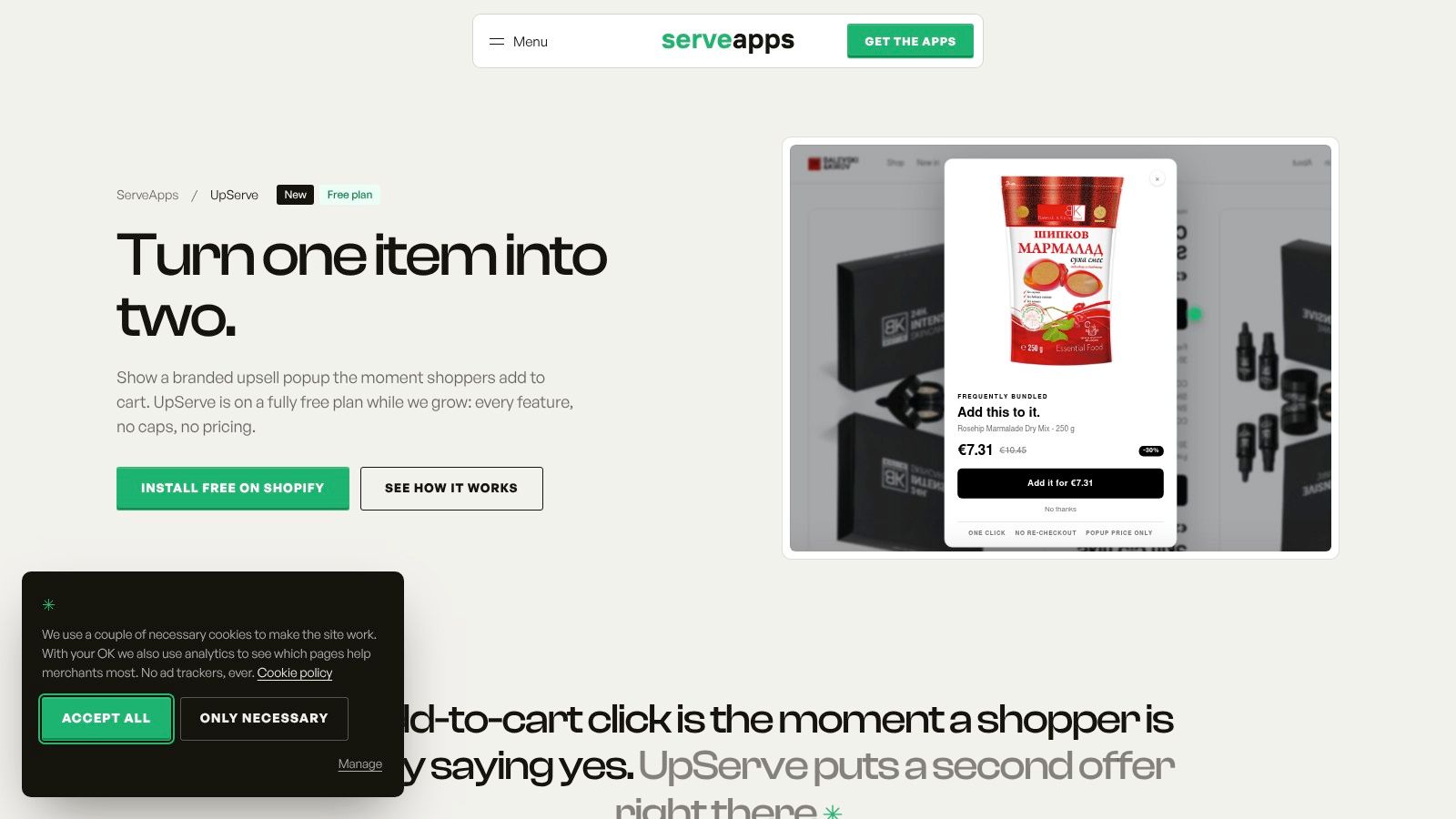
Visit UpServe to review its current capabilities and installation details.
2. Shopify Search & Discovery
Shopify Search & Discovery should be the starting point for most Shopify stores because it solves the baseline discovery job without adding an external search stack. The app supports faceted filtering, synonyms, query rules, basic search relevance controls, and product recommendation blocks on product pages. Its close connection with Online Store 2.0 themes also keeps implementation and maintenance comparatively simple.
That native fit is its main advantage. Merchants can improve how shoppers find products, correct vocabulary mismatches through synonyms, and apply basic boost or bury controls without introducing another hosted search service or external script. For a small or moderately complex catalog, that can be enough.
Where the baseline stops
Search & Discovery isn't designed as a full merchandising operating system. Its rule logic and analytics are lighter than those found in paid discovery suites, so teams with complex category priorities, multiple markets, or business-keyword requirements may outgrow it. It also doesn't coordinate advanced cart, checkout, and post-purchase offers.
Use it when low overhead matters more than advanced control. A merchant should first audit search queries, zero-result terms, filter usage, and product-page recommendation placement. If the store's problem is missing synonyms or weak filtering, adding a larger platform may create unnecessary implementation work.
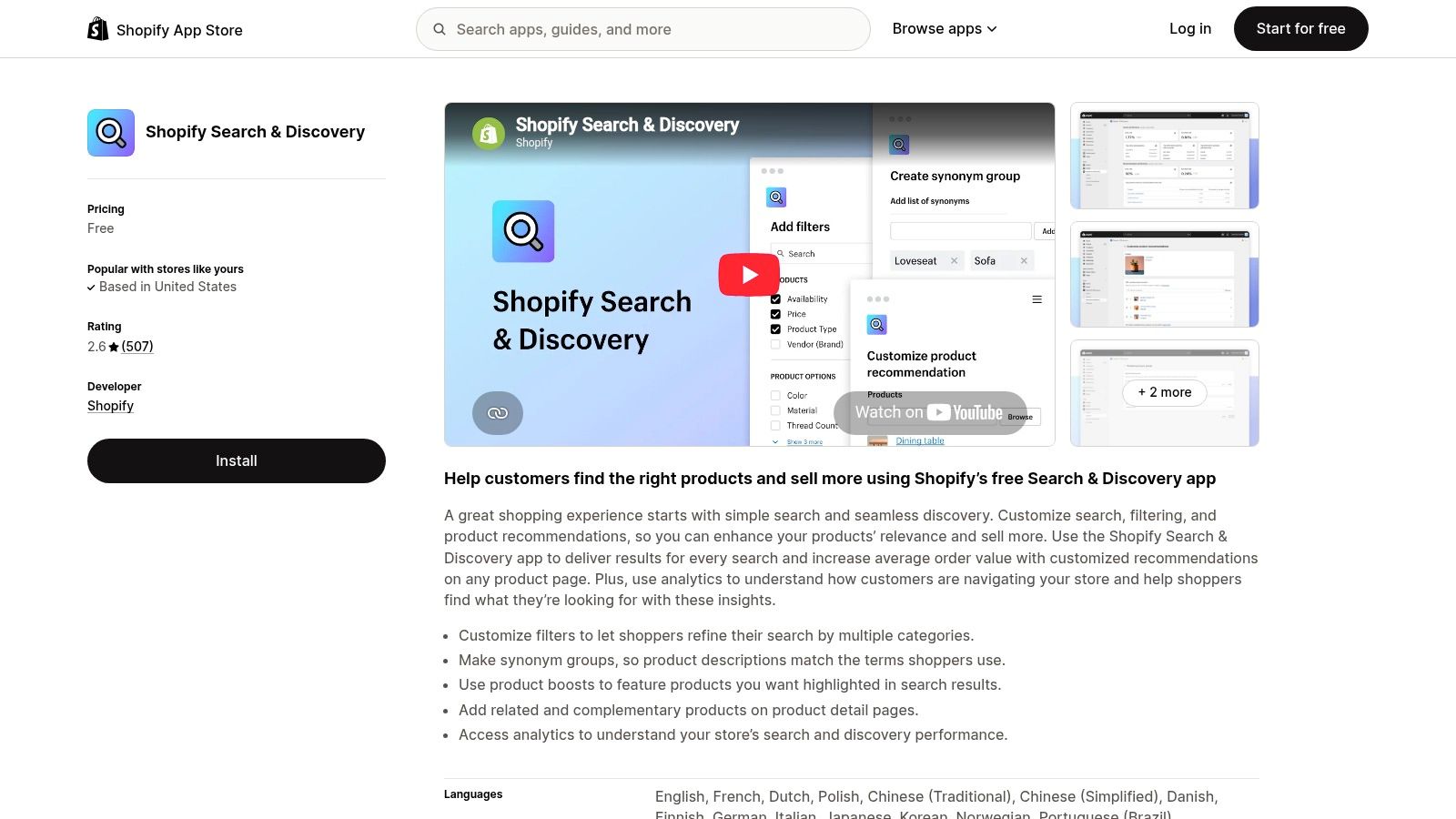
The platform is also a useful control condition for later tests. Keep native search in place long enough to understand the existing baseline, then compare a specialized tool against defined outcomes such as search-to-product-view rate, add-to-cart behavior, and completed orders. Its Shopify app listing is the right place to verify current compatibility and availability because app features can change.
3. Rebuy Personalization Engine
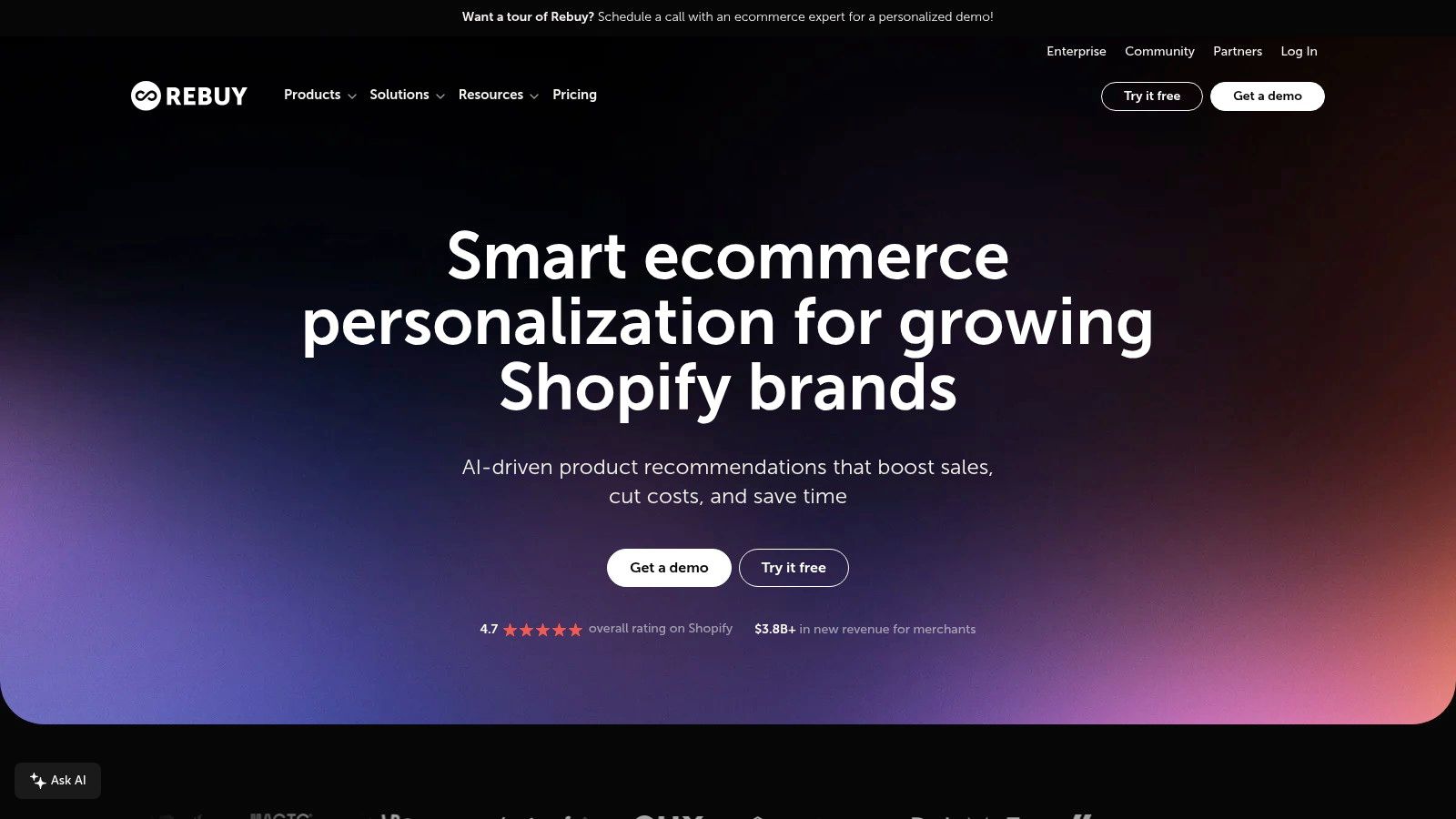
Rebuy is built for merchants that want one personalization layer across several parts of the buying journey. It combines AI recommendations, rules-based merchandising, bundles, and upsells across product pages, cart, checkout, and post-purchase flows. That breadth makes it less like a single widget and more like a coordinated AOV stack.
The advantage is consistency. A merchant can define related products, frequently bought together offers, and other recommendation logic without separately managing a product-page tool, cart app, and post-purchase system. No-code and low-code widgets support quick deployment, while developer controls provide room for more customized storefronts.
Coverage creates responsibility
The same surface-area breadth raises implementation questions. Teams need to decide which rules control which placement, how product availability affects offers, and whether multiple widgets compete for the same shopper. The tool also requires a broader data-permission scope than a lightweight popup, which makes privacy review and internal ownership more important.
Shopify Plus stores gain access to checkout and post-purchase extensions, while other merchants should assess the available storefront placements carefully. The product's value is highest when a team has enough catalog and customer data to coordinate recommendations across contexts, not when it only wants one additional product block.
Relevance isn't the same as complexity. A clear bundle can be more persuasive than an opaque recommendation if the customer immediately understands the benefit.
Rebuy is worth comparing with a more focused product recommendation engine guide when the main problem is choosing between a broad personalization suite and a narrower recommendation layer. Merchants evaluating personalization should also consider consent, explainability, and fallback behavior, concerns discussed in Shopify's overview of personalization in ecommerce. Visit Rebuy for current plan and integration information, since pricing and Shopify feature access require verification before purchase.
4. Nosto
Nosto is aimed at merchants whose merchandising decisions depend on business context, not just shopper similarity. Its collection and category controls can weight products according to operational and commercial priorities such as margin, inventory, price, or returns. That makes it especially relevant for larger catalogs where a simple boost or bury rule can't express the actual trade-off.
Its Shopify integration also supports Shopify Markets-aware localization, including price, currency, and availability considerations. For stores selling across markets, that distinction is important. A recommendation that looks relevant in one region can become misleading if the product isn't available, the price differs, or fulfillment conditions change elsewhere.
A platform for coordinated complexity
Nosto combines AI recommendations and content personalization with backend synchronization through its Shopify app. The implementation is more substantial than installing a single theme block, but the additional effort can be justified when merchandisers need repeatable rules tied to business KPIs.
The trade-off is commercial and organizational. Pricing requires a sales conversation, so a merchant can't easily model total cost from a public plan page. Smaller stores with straightforward catalogs may pay for control they won't use, while multi-market teams may value the ability to manage localized merchandising from a more central system.
The operational test should be simple: can Nosto's rules incorporate stock, margin, availability, and market conditions more reliably than the native baseline? If the answer is yes, its sophistication has a purpose. If the team only needs related products on product pages, the implementation may be excessive. Review Nosto's platform for current Shopify Markets support and commercial terms.
5. Algolia
Algolia is primarily a high-performance search and discovery platform, with recommendations and merchandising available as modular additions. It suits Shopify merchants that need advanced relevance controls, headless flexibility, or a search layer capable of supporting a more technically demanding storefront.
The search tooling supports rules, synonyms, ranking controls, and AI-assisted relevance features. Recommend can support product recommendations and bundles, while the Merchandising interface and analytics give teams a place to manage and inspect ranking decisions. Shopify connectors, data pipelines, and crawlers help move catalog information into the service, but they don't eliminate the need for implementation ownership.
Modular power, variable cost
Algolia's modular design is useful when a merchant wants to buy only the capabilities it needs. A store can prioritize search first and add recommendation or merchandising functions later. That avoids adopting a broad suite prematurely, although it also means the team must understand which modules, usage levels, and integrations are included in the proposed architecture.
Usage-based pricing requires monitoring. Search volume, recommendation calls, and analytics usage can all affect the economic model, so finance and engineering should review expected traffic patterns before launch. The implementation effort is also higher than a plug-and-play Shopify app, particularly for headless or heavily customized interfaces.
Choose Algolia when search quality and technical flexibility are the bottleneck, not when the merchant wants only a quick cart upsell. The Algolia Shopify solution should be evaluated with an event-volume model, a front-end ownership plan, and clear expectations for analytics instrumentation.
6. Klevu
Klevu occupies the middle ground between native Shopify discovery and enterprise search architecture. It combines AI search, recommendations, and visual merchandising, with features such as natural-language processing and typo tolerance. Merchants also get controls for category and collection ordering through a user interface intended for day-to-day tuning.
That balance makes Klevu practical for brands whose catalog or search vocabulary has outgrown Shopify Search & Discovery, but whose team doesn't want to construct a highly custom search platform. A merchandiser can adjust collection priorities and boosts without routing every change through engineering.
The mid-market trade-off
Klevu's public positioning emphasizes quick Shopify integration, but advanced customizations may still require developer support. Pricing is typically handled through a sales process, and published plan detail is limited, so the merchant should request a proposal that separates search, recommendation, analytics, onboarding, and support costs.
The correct evaluation isn't whether Klevu has more features than the native app. It's whether the team will use the extra controls often enough to justify the added vendor relationship and data integration. Test difficult search terms, typo-heavy queries, filter combinations, and collection rules against the existing baseline before committing.
Klevu's Shopify integration provides the current product and connector details. Ask specifically how changes move from the merchant interface to the storefront, how inventory conditions are handled, and which reporting dimensions are available by device, market, and traffic source.
7. Searchspring
Searchspring is designed for teams that treat search and category pages as managed commercial surfaces. Its strengths are granular boost and bury logic, dynamic faceting, visual merchandising, recommendations, reporting, and APIs for custom front ends.
That makes it a better fit for a mature merchandising team than for a founder who wants to improve search with minimal administration. Merchandisers can encode more nuanced decisions about category ordering and query results, while reporting helps connect those interventions to business outcomes.
Reporting is part of the product
Searchspring's value depends on the team using its insights, not just its rules. Before implementation, define who reviews search performance, who owns collection changes, and how experiments are recorded. Without that process, advanced controls can produce a more complicated version of manual merchandising.
Custom pricing and enterprise onboarding add commercial uncertainty. The platform may be inappropriate for a small catalog or a store with limited merchandising capacity, even if the feature list looks attractive. Conversely, a large catalog with frequent range changes can benefit from the rule depth and support model.
Use Searchspring when the business needs detailed searchandising governance and thorough reporting. Treat onboarding effort as part of the purchase decision, not as an incidental setup task.
8. Constructor.io
Constructor.io targets larger retailers that need AI-driven search, browse, recommendations, collections, and experimentation. Its Shopify connector is intended to speed catalog synchronization and provide theme-level interface elements, while behavioral signals inform ranking and discovery decisions.
The central appeal is experimentation. A retailer can use AI ranking and collection merchandising alongside analytics to evaluate how changes affect the path from discovery to purchase. That is a different proposition from just adding related products to a product page.
Where implementation becomes strategic
Constructor.io is aimed at mid-market and enterprise organizations, and pricing is available through sales. The connector can shorten time to value, but it doesn't remove the need for clean product data, event tracking, ownership of search rules, and a plan for interpreting experiments.
Merchants should avoid evaluating case-study claims as guaranteed outcomes for their own store. Instead, ask for a test design that separates search exposure, recommendation exposure, device, market, and catalog segment. A useful measurement plan should include completed orders and contribution margin, not only clicks or add-to-cart activity.
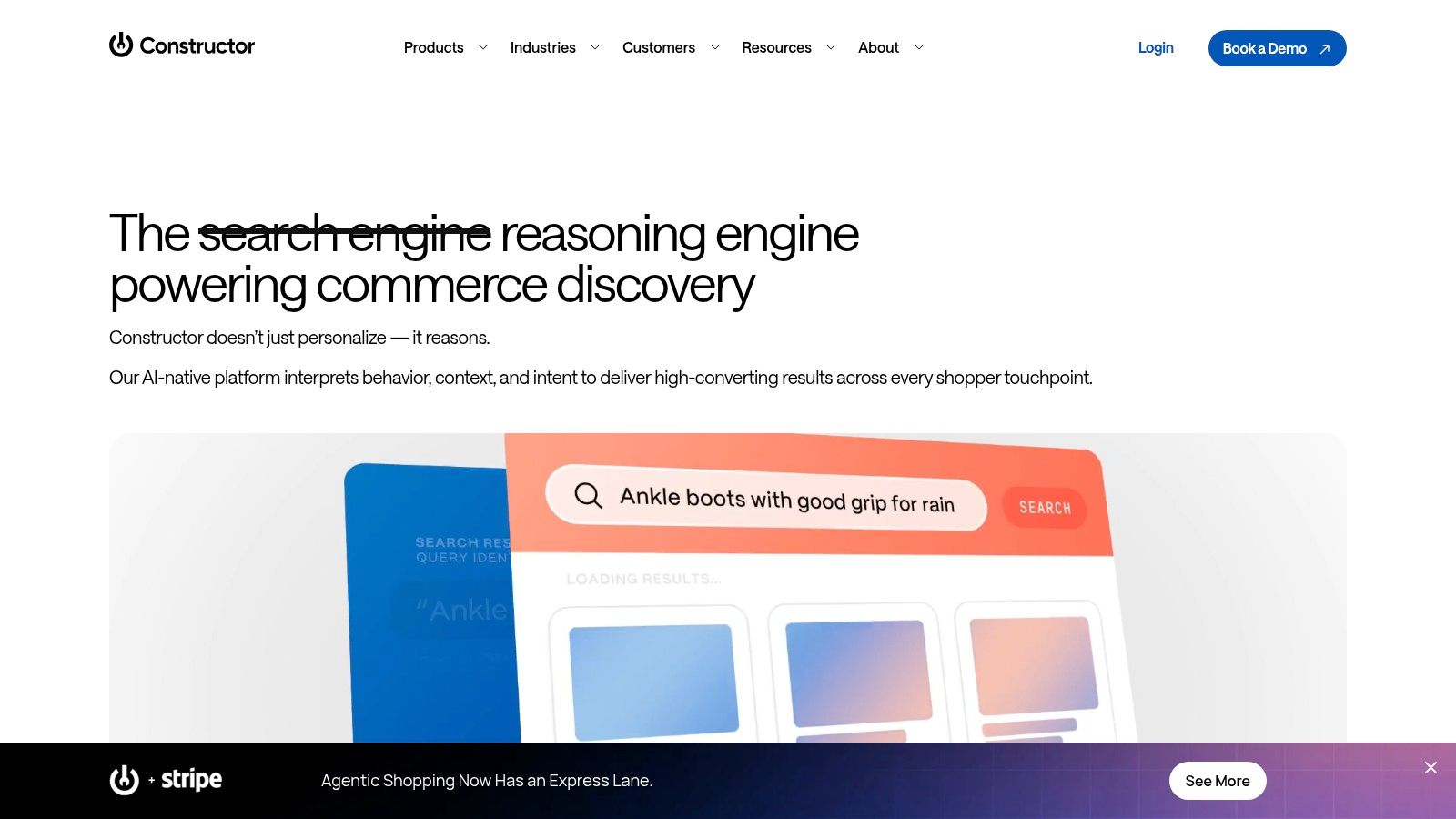
Constructor.io is most appropriate when discovery is a strategic growth system and the team can support implementation. Stores seeking a lightweight improvement should compare the operational cost against Shopify Search & Discovery, Klevu, or Boost before selecting an enterprise platform.
9. LimeSpot
LimeSpot focuses on Shopify-native personalization for product recommendations, bundles, offers, cart experiences, checkout, and post-purchase placements. It also supports audience segmentation on its Max plan, giving merchants a route from broad recommendations toward more targeted experiences.
Its main advantage is speed. The platform is positioned for quick setup, with structured plan tiers and trial options that make initial evaluation easier than a sales-only enterprise purchase. That can suit small and mid-market brands that want to test recommendations without assembling several separate apps.
Watch the pricing architecture
Revenue or order-scaled pricing can become more expensive as the store grows, so the merchant should model the fee against expected order volume and not only the initial trial period. The Turbo plan's compatibility limitation for Shopify Plus also deserves attention. A Plus merchant should confirm whether the desired checkout and post-purchase functions are available in the selected plan.
LimeSpot's broad placement coverage also creates the familiar coordination problem. Recommendations, bundles, cart offers, and post-purchase messages need priority rules so the customer isn't presented with conflicting incentives or repetitive products.
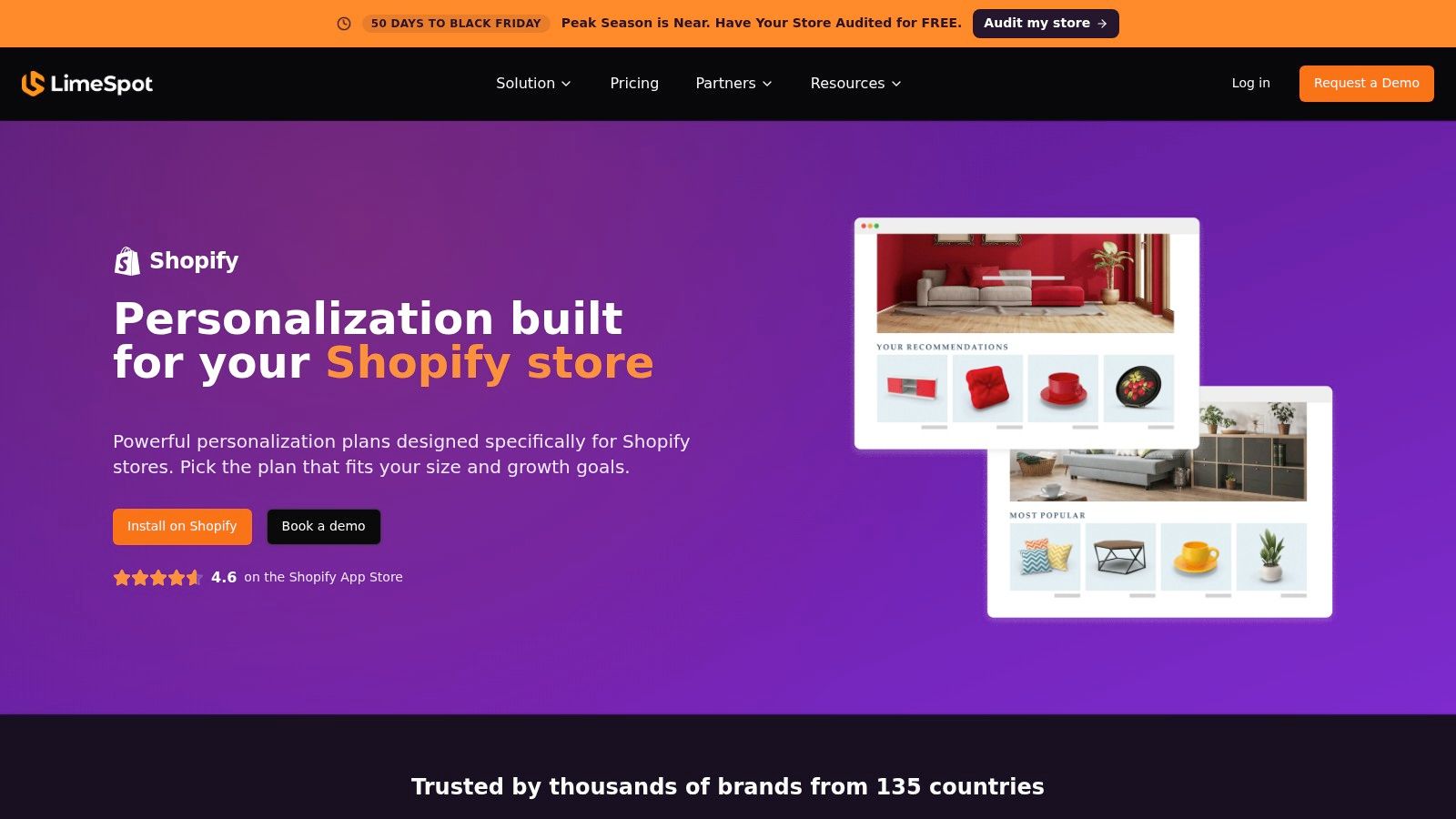
For merchants focused on profitable AOV growth, compare recommendation revenue with discount cost, refunds, cancellation effects, and support contacts. The Shopify AOV guide offers a useful commercial lens, while LimeSpot's Shopify page provides current plan and compatibility details.
10. Boost AI Search & Filter
Boost AI Search & Filter is a practical step up from Shopify Search & Discovery for stores that need deeper faceted filtering, search tolerance, and visual control over collection pages. Its feature set includes AI search, synonyms, typo tolerance, filter trees, boost and bury rules, analytics, and Shopify Markets support.
The product's value is clearest in large or attribute-heavy catalogs. A merchant can give shoppers more specific paths through product data while maintaining visual control over product-list-page ordering. That makes Boost a discovery and collection-merchandising tool first, not a substitute for a dedicated cart or checkout offer system.
A scalable starting point with constraints
Boost is purpose-built for Shopify, which reduces the integration burden compared with an enterprise API-first platform. However, pricing scales with GMV, so the cost can rise as the business grows. Some feature limits, including constraints around filters per tree, may also affect stores with complex taxonomy requirements.
The implementation should begin with a catalog audit. Identify which attributes shoppers use, where filters produce empty or misleading results, and which collection rules are genuinely commercial rather than cosmetic. Then measure search engagement, product discovery, add-to-cart behavior, and revenue separately by device and market.
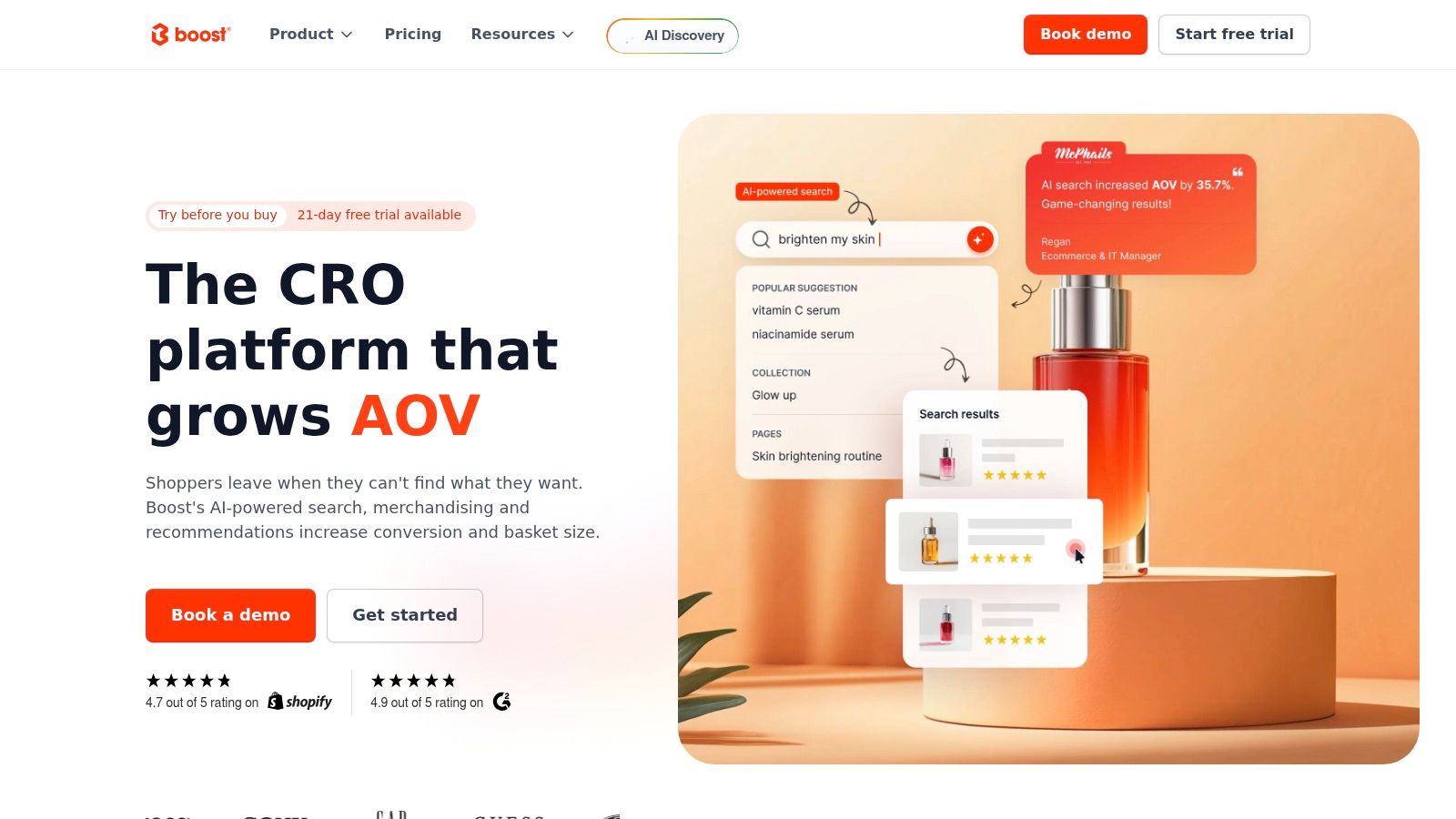
Boost Commerce is a strong candidate when the native baseline is too limited but a full enterprise discovery implementation would be excessive. Confirm the current pricing model, Markets behavior, filter limits, and theme compatibility before rollout.
Top 10 Ecommerce Merchandising Tools Comparison
| App | Core features ✨ | UX / Quality ★ | Price / Value 💰 | Target 👥 | USP / Strengths 🏆 |
|---|---|---|---|---|---|
| UpServe, Popup upsells for Shopify | ✨ Context‑aware popup upsells, pixel‑level design, per‑offer analytics | ★★★★☆ (Shopify theme app ext, low perf impact) | 💰 Free plan (paid tiers available) | 👥 SMB → mid‑market merchants focused on AOV | 🏆 Pixel control + measurable per‑offer ROI |
| Shopify Search & Discovery | ✨ Faceted filters, synonyms, basic recommendations | ★★★★☆ (native, minimal overhead) | 💰 Free | 👥 Stores needing low‑overhead, integrated search & filters | 🏆 Free, deep Online Store 2.0 integration |
| Rebuy Personalization Engine | ✨ AI recommendations, bundles, rules across cart/checkout/post‑purchase | ★★★★☆ (broad coverage; onboarding needed) | 💰 Sales‑based / enterprise tiers | 👥 Brands wanting unified full‑funnel personalization | 🏆 End‑to‑end personalization across journey |
| Nosto | ✨ AI recommendations, category merchandising, Markets‑aware localization | ★★★★☆ (enterprise‑grade controls) | 💰 Sales‑conversation (enterprise pricing) | 👥 Large / multi‑market retailers | 🏆 Merchandising weighted by business KPIs |
| Algolia (Search, Recommend & Merchandising) | ✨ High‑performance search, Recommend API, merchandising UI & analytics | ★★★★☆→★★★★★ (fast, scalable, headless ready) | 💰 Usage‑based pricing (modular add‑ons) | 👥 Headless or high‑traffic stores / dev teams | 🏆 Speed, modularity & advanced relevance controls |
| Klevu | ✨ AI search (NLP, typo tolerance), recommendations, PLP merchandising | ★★★★☆ (merchant UI, quick integration) | 💰 Sales‑based (plan details via sales) | 👥 Mid‑market brands wanting stronger discovery | 🏆 Balanced feature set with merchant‑friendly tuning |
| Searchspring | ✨ Advanced search & dynamic faceting, visual merchandising, deep reporting | ★★★★☆ (mature rule engine, heavy analytics) | 💰 Custom / enterprise pricing | 👥 Enterprise merch teams needing fine‑grained control | 🏆 Granular rules + comprehensive analytics |
| Constructor.io | ✨ AI search & browse, recommendations, experimentation & analytics | ★★★★☆ (conversion‑focused; Shopify connector) | 💰 Sales‑based (enterprise) | 👥 Large retailers seeking measurable lifts | 🏆 Experimentation + behavioral ranking for conversion lift |
| LimeSpot | ✨ AI recommendations, bundles, checkout & post‑purchase offers | ★★★★☆ (fast setup, Shopify‑native workflows) | 💰 Tiered plans (revenue/order‑scaled) | 👥 SMBs & mid‑market brands seeking quick ROI | 🏆 Clear plans, quick time‑to‑value |
| Boost AI Search & Filter (Boost Commerce) | ✨ AI search, advanced faceted filters, visual merchandising | ★★★★☆ (built for large Shopify catalogs) | 💰 Pricing scales with GMV | 👥 Large catalogs needing deeper filters & faceting | 🏆 Robust filter trees & visual rule interface |
Build the Stack Around Your Bottleneck
The right choice depends on the merchandising job and the operational cost you can absorb. Start with Shopify Search & Discovery when the store needs a low-overhead baseline for search, filters, synonyms, and basic recommendations. It keeps the architecture simple and gives the team a reference point for later tests.
Choose Boost AI Search & Filter or Klevu when search relevance, typo tolerance, faceting, and collection ordering need more control than the native app provides. Boost is a Shopify-focused step up with visual rules and Markets support. Klevu offers a balanced discovery suite with a merchant-facing tuning interface, but both require a closer review of pricing, customization, and catalog complexity.
Move toward Searchspring, Algolia, Constructor.io, or Nosto when the store needs advanced rules, APIs, experimentation, business-KPI weighting, multi-market coordination, or a more scalable discovery architecture. These tools can support advanced teams, but their value depends on data quality, implementation ownership, analytics, and ongoing merchandising discipline. Their commercial models also create uncertainty, whether through sales-led pricing, usage-based costs, or broader platform scope.
For recommendations, bundles, cart, checkout, and upsell merchandising, compare Rebuy, LimeSpot, and UpServe by placement and operational burden. Rebuy offers broad journey coverage, LimeSpot emphasizes Shopify-native personalization and structured plans, and UpServe focuses on targeted add-to-cart upsells with per-offer analytics. Shopify Plus access is particularly important for checkout and post-purchase features, so don't assume a storefront feature is available at checkout for every plan or Shopify tier.
A controlled rollout reduces risk:
- Define the bottleneck: Decide whether the problem is discovery, collection ranking, relevance, AOV, cart clarity, checkout friction, or post-purchase retention.
- Audit compatibility: Check the theme, Online Store 2.0 support, Shopify Markets behavior, subscriptions, inventory logic, checkout access, and existing app conflicts.
- Launch one placement: Start with one collection, search surface, product-page module, cart offer, or add-to-cart popup rather than changing the full journey.
- Measure exposure and economics: Track impressions, exposed sessions, accepted offers, completed orders, revenue, discount cost, refunds, cancellations, and contribution margin.
- Expand selectively: Add another surface only when the first intervention shows incremental value and the team can operate the added rules.
Cart design deserves particular discipline. Baymard's aggregation of 50 studies reports an average documented abandonment rate of 70.22%, so the benchmark is useful for diagnosis, not as a universal target. Baymard's research also distinguishes shoppers who are merely browsing from those who encounter a long or complicated checkout, which means an upsell shouldn't distract from delivery clarity, payment options, and friction reduction.
Operational costs belong in the final decision. Online returns were estimated at 19.3% of U.S. online sales in 2025, compared with 15.8% across retail, according to the supplied research brief's ecommerce order-support analysis. That makes post-purchase effects relevant to merchandising evaluation. The most profitable offer may be the one that increases gross profit without creating extra order edits, returns, cancellations, or support contacts.
For Shopify merchants, the best stack is rarely the one with the most AI or the largest feature list. It is the smallest set of tools that solves the current bottleneck, produces trustworthy evidence, and remains manageable when catalog, market, inventory, and customer-service demands change.
ServeApps connects Shopify-native merchandising with cart and post-purchase operations through UpServe, CartServe, and SelfServe. Use ServeApps to explore targeted upsells, configurable cart experiences, and controlled order changes that help turn incremental revenue into a more manageable customer journey.
Shopify Average Order Value: The Practical Guide
Learn what Shopify average order value really measures, how to calculate it accurately, and which benchmarks actually matter for your store in 2026.
Read more →
Product Recommendations Shopify: Best Practices 2026
Learn how to set up and optimize product recommendations Shopify in 2026. Increase average order value and drive more sales with proven strategies.
Read more →
Free Shipping Bar Shopify: How to Set One Up That Works
Free Shipping Bar Shopify. Learn how to set up a free shipping bar in Shopify that converts. Covers thresholds, messaging, placement, and currency tips
Read more →