
Most Shopify advice treats average order value as a profit metric. It isn't. A larger basket can conceal lower contribution margin, weaker conversion, higher fulfillment expense, and more refunds. If your AOV rises while profit per order falls, you haven't improved the business. You've made the dashboard look healthier.
The right way to increase average order value on Shopify is to treat every bundle, free-shipping goal, and upsell as a margin-adjusted experiment. The offer must earn its place by producing incremental profit without creating enough friction to damage checkout. Start with the tactic that has the clearest customer benefit, measure the complete economics, and remove anything that increases revenue while reducing cash contribution.
Table of Contents
- The AOV Trap Most Shopify Stores Fall Into
- How to Calculate and Read Your Real AOV
- Setting a Free Shipping Threshold That Lifts AOV Without Killing Margin
- Building Bundles and Frequently Bought Together Offers
- Pre-Cart, In-Cart, and Post-Purchase Upsells Compared
- Turning One-Time Buyers Into Subscription Revenue
- Measuring AOV Experiments the Way a CFO Would
The AOV Trap Most Shopify Stores Fall Into
A higher AOV can make a Shopify dashboard look healthier while making each order less profitable. A larger bundle, a free-shipping subsidy, or a discount may increase the basket total, yet leave less contribution profit after product, fulfillment, payment, and support costs. Treat AOV as a test result, not a business objective.
Conversion is the first constraint. Baymard Institute's analysis of 50 ecommerce studies found a 70.22% average documented cart abandonment rate, with 40% of U.S. online shoppers citing extra costs, 20% citing slow delivery, 19% citing a lack of trust in the site with payment information, and 17% citing a checkout that was too long or complicated (Baymard's cart abandonment research). An AOV offer that adds steps, obscures the updated total, or makes delivery costs unclear can trade a few larger orders for fewer completed purchases.
That trade is rarely worth it. Make the customer benefit obvious, show the new total immediately, and test the offer against a control. A tactic that raises basket size but lowers completed orders or revenue per visitor has failed, even if the app reports more upsell revenue.
The three traps that inflate the wrong metric
Aggressive bundles often pair a high-margin product with an item the customer does not need. The order value rises, but the discount can consume the margin that made the original product profitable. Bundle products customers already buy together, and set the discount only after checking contribution profit.
Free-shipping thresholds work when they prompt an incremental item. They fail when the threshold ignores shipping zones, product margins, or how many existing orders would have qualified without changing their baskets. Set the threshold around a realistic next purchase, then verify that the extra margin exceeds the shipping subsidy.
Post-purchase upsells avoid interrupting the original checkout, but they are not cost-free. Extra picking, packing, shipping, cancellations, and returns can erase the apparent gain. An add-on that looks profitable in an app report is not a win if fulfillment leaves little or no contribution profit.
Practical rule: Approve an AOV test only when contribution profit improves and conversion and refund performance remain within an acceptable range. A larger basket alone proves nothing.
Review AOV beside gross margin per order, conversion rate, fulfillment cost, refund rate, and revenue per visitor each week. Compare treatment with control over the same period. Ignore an isolated before-and-after AOV increase until the complete economics confirm that customers are buying more profitably.
How to Calculate and Read Your Real AOV
The standard calculation is simple:
AOV = total revenue ÷ completed orders
Use the same revenue definition and order-status rules every time. Decide whether discounts, refunds, shipping revenue, and taxes belong in the calculation, then keep that treatment consistent. A changing formula can create a false trend even when customer behavior hasn't changed.
The mean is useful, but it isn't enough. One unusually large order, a wholesale purchase, or a discount-led promotion can pull the average upward and make the typical customer look more valuable than they are. Review the median order value to understand the midpoint and the modal order value to identify the basket size that occurs most often. The modal value is particularly useful when setting a spend goal because it represents the next common basket step, not an abstract mathematical average.
Read the profit behind the basket
AOV should sit inside a wider diagnostic view:
- Gross margin per order: Revenue after product cost, before the rest of the variable order expenses you choose to include.
- Contribution profit per order: Margin after discounts, shipping subsidy, payment costs, fulfillment, returns, and other directly attributable costs.
- Revenue per visitor: A useful check when an AOV tactic affects both basket size and conversion.
- Units per transaction: Helps distinguish a genuine cross-sell from a price increase or a high-value product mix change.
- Refund and return rate: Shows whether customers are accepting offers that later create dissatisfaction or sizing problems.
Segment the dashboard by new versus returning customers, traffic source, device, market, currency, subscription status, and product category. A cart-drawer offer may perform well for returning customers but distract first-time mobile visitors. A threshold that makes sense in one market may be uneconomic in another because delivery costs and product margins differ.
| Metric | Formula | What It Reveals | When It Misleads |
|---|---|---|---|
| Mean AOV | Revenue ÷ completed orders | Overall revenue per order | Large or wholesale orders distort the result |
| Median order value | Middle order value after sorting orders | The typical midpoint | It doesn't show the most common basket step |
| Modal order value | Most frequently occurring order value | The next attainable spend level | Sparse data can produce an unstable mode |
| Contribution profit per order | Revenue minus variable order costs | Whether the order creates economic value | It depends on accurate cost allocation |
| Revenue per visitor | Revenue ÷ visitors | Combined effect of conversion and basket size | It can hide rising support or fulfillment costs |
A practical dashboard should show the current period, a comparable prior period, and the treatment-control difference for every test. Don't let the Shopify analytics AOV card become the decision-maker. It reports what happened to order value, not whether the tactic earned the right to stay.
Setting a Free Shipping Threshold That Lifts AOV Without Killing Margin
Free shipping is not a gift. It's a variable cost that must be funded by incremental margin.
Start with your current AOV, modal order value, average gross margin per order, and realistic shipping cost by market. Shopify's AOV guidance recommends calculating AOV as total revenue divided by completed orders, reviewing the modal order value, and testing an initial threshold approximately 15% to 30% above current AOV. The same guidance gives an example where an $80 AOV leads to a $104 threshold as a reasonable initial test.
That isn't a universal answer. It's a starting hypothesis.
Build the threshold around attainable baskets
Use this process:
- Calculate the baseline. Use completed orders and a consistent revenue definition.
- Find the mode. Identify the order value customers reach most frequently, not only the mean.
- Map the margin. Estimate the contribution left after the added product margin, shipping subsidy, fulfillment, payment cost, and likely returns.
- Set a test threshold. Begin above the current AOV or the modal value, but keep the goal attainable with products customers already consider relevant.
- Expose the goal early. Show a cart-drawer message such as “Add $X for free shipping” as soon as the shopper has a cart. Don't hide the threshold at checkout.
- Test against a control. Compare incremental gross profit, conversion rate, shipping cost, refund rate, and contribution profit per session.
The progress message should update as the cart changes. It should also reflect market, currency, subscription status, inventory, and products that qualify. A mixed cart needs clear eligibility rules. If a heavy item, remote delivery zone, or subscription shipment changes the economics, don't pretend one global threshold fits every order.
The threshold should cover more than the orders that cross it because of the incentive. It must also account for qualifying orders that would have received free shipping anyway. If added product margin doesn't cover the subsidy and fulfillment cost, a higher AOV can reduce contribution profit.
Use this video as a practical reference for how a cart-level shipping goal can be presented without forcing shoppers into a separate discovery journey.
Don't optimize for the highest threshold you can persuade customers to reach. Optimize for the threshold that produces the strongest profit per session after conversion loss, shipping cost, refunds, and discounts. If the bar feels unreachable, it won't create a useful next action. If it's too close to the existing basket, it will just subsidize orders that already qualified.
Building Bundles and Frequently Bought Together Offers
Bundles should fix a buying problem, not hide excess stock. Start by sorting products into high-margin anchors, natural complements, and items that need more velocity. Only bundle items when the customer can instantly understand why they belong together.
A skincare routine works because the pieces belong together. A camera body with a compatible memory card works. A coffee maker with filters works. Two versions of the same hero product usually do not. Stacking a popular item twice can lift unit count while creating discount dependence and more buyer confusion.
Choose the bundle structure by economics
| Bundle Type | Avg. Margin Lift | Conversion Impact | Build Complexity |
|---|---|---|---|
| Pure complementary bundle | Can be positive when the discount is funded by combined margin | Usually strongest when the use case is obvious | Moderate |
| Mix-and-match bundle | Depends on which combinations customers choose | Can reduce hesitation through customer control | High |
| Frequently bought together offer | Depends on true incremental attachment | Relevant offers can support conversion, irrelevant ones create friction | Low to moderate |
| Inventory-led bundle | Often weak unless the secondary item has a credible role | May appeal to price-sensitive shoppers but can dilute the offer | Moderate |
Model the bundle from combined contribution margin, not from a single product discount. Check stock availability, fulfillment compatibility, package dimensions, return handling, and whether the bundle can stack with sitewide promotions. If an item is unavailable, exclude it. If a customer already has the item in cart, do not offer it again.
Use co-purchase data together with product taxonomy. A pair that appears in the same order can be a substitute, a one-time promotion artifact, or a wholesale pattern, not a good cross-sell. Separate complementary products from alternatives, then filter out products that are out of stock or expensive to ship together.
Put the offer where intent already exists
Product pages and cart drawers beat the homepage because the shopper has already shown product interest. Use one or two offers, keep the value proposition plain, and make the add action optional. Choice overload is not merchandising.
Start with recent order data and look for recurring product pairs, then validate each pair with margin and inventory data. Do not rely on the platform default just because it takes no setup. Recommendation systems work best as controlled cross-sell tests, with impressions, add-to-cart rate, incremental conversion, attach rate, incremental revenue, gross margin, refunds, and total AOV measured against a holdout.
A published academic study reported a 23.5% AOV increase for a hybrid cross-selling recommendation model versus single-method baselines. Treat that as a reason to test recommendation quality, not as a promise for your store.
For practical bundle structures and pricing logic, review these product bundling pricing examples. Keep bundle discounts separate from broad promotions, set sensible per-customer limits, and cut any offer once its incremental margin disappears after returns or fulfillment.
Pre-Cart, In-Cart, and Post-Purchase Upsells Compared
Upsell placement should follow buyer intent, not app convenience. The fastest install is often the wrong place to ask for more money.
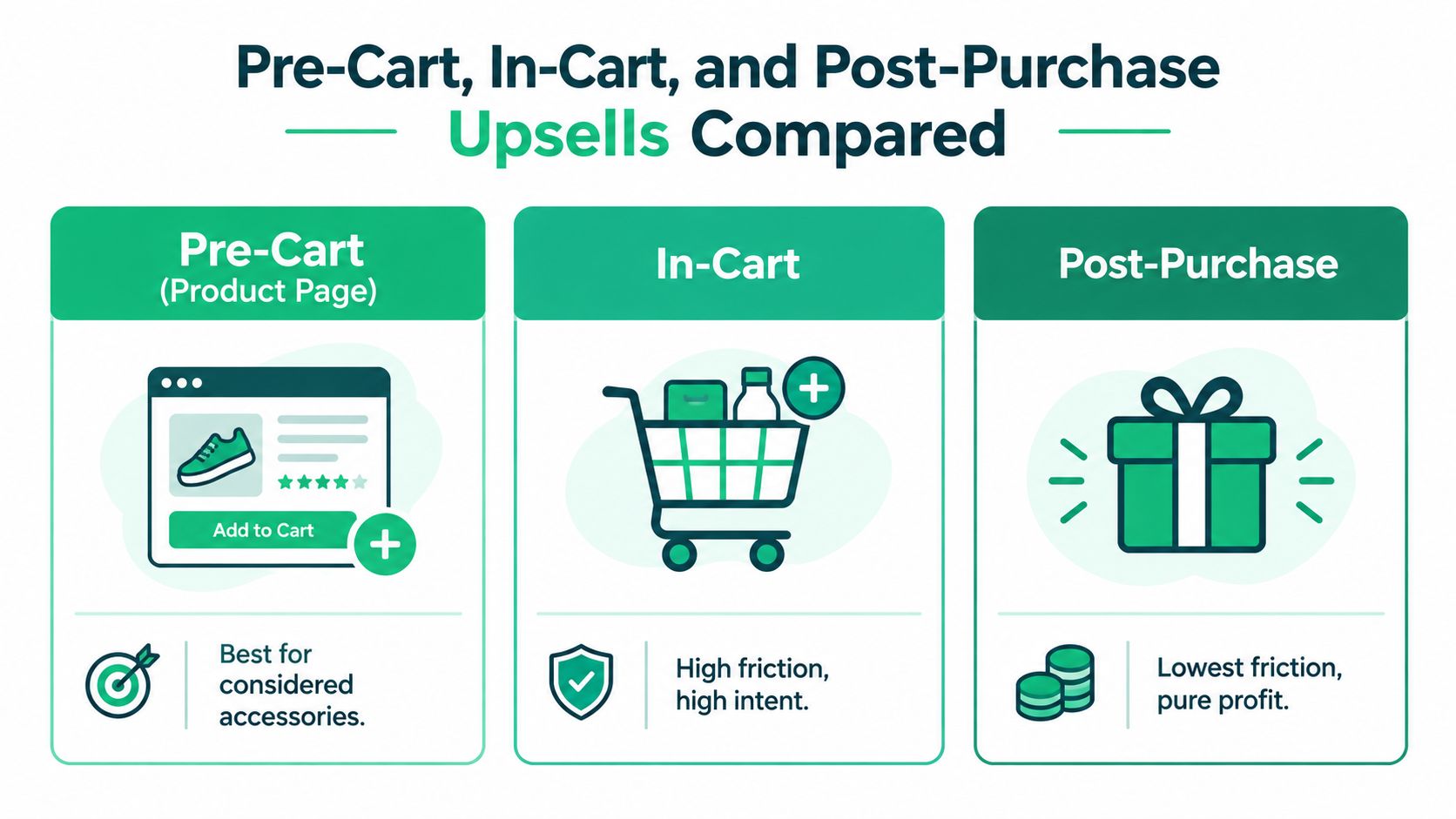
Pre-cart offers belong on product pages when the shopper is still evaluating accessories, upgrades, or a complete use case. They work best when the link between the main item and the add-on is obvious. They also slow impulse buying, because the shopper has to make another decision before reaching the cart.
In-cart offers fit stronger intent. The shopper has already committed to an item, so a practical add-on can close a real gap, such as batteries, a protective case, a warranty, or a compatible refill. Keep the offer small relative to the cart, and make the decline path obvious.
Post-purchase offers preserve checkout because the order is already complete. Use them for a one-click add-on, a replenishment item, or a product that ships through the same operational flow. If the add-on needs a separate warehouse, an extra shipping charge, or manual support, the extra revenue usually gets eaten by exceptions. For a deeper implementation guide, use this guide to Shopify post-purchase upsells.
Select one placement before adding more
Start with the placement that matches your biggest measurable gap.
- Use pre-cart when accessory discovery is weak and the product page already gets attention.
- Use in-cart when customers often need a low-complexity add-on to finish the purchase.
- Use post-purchase when the product has a natural replenishment or companion item and fulfillment stays simple.
Test one placement at a time. Track impressions, offer conversions, incremental revenue, margin, cancellations, refunds, and total AOV. Industry guidance cites checkout upsell conversion ranges from 3% to 8%, with optimized campaigns sometimes reaching 10% to 15%, but those figures are directional and need validation by category and traffic source (the Shopify upsell guidance from Skai Lama).
A converted offer is not automatically incremental. Some shoppers would have bought the item through normal browsing, so raw upsell revenue can overstate the result. Use a holdout group and compare the full order economics.
The best test is the one that protects contribution profit. Pre-cart offers can increase consideration, in-cart offers can rescue cart value, and post-purchase offers can add clean revenue after the sale. Pick the placement that matches your inventory, shipping, and margin profile, then cut anything that raises AOV while weakening profit or increasing refunds.
Turning One-Time Buyers Into Subscription Revenue
Subscriptions can increase customer value, but discounting the first order is a lazy way to introduce them. If the first subscription order is materially cheaper than the normal purchase, you may lower the very AOV you're trying to improve and teach customers to wait for a deal.
Start with products customers naturally replenish. Consumables, refills, and routine-based products are stronger candidates than items bought irregularly. The subscription pitch should answer three questions immediately: what arrives, when it arrives, and how the customer can change or cancel it.
Match the cadence to actual usage
Use a short usage question to recommend a delivery interval. A customer who uses a product slowly shouldn't receive automatic shipments that create excess inventory and future cancellations. A customer who runs out quickly shouldn't face a gap that pushes them to another retailer.
Keep the initial price close to the standard product price, then consider a later subscriber benefit once the customer has demonstrated repeat demand. The offer should reward continuity rather than purchase hesitation. Make skipping, changing, and cancelling accessible from the account experience, because a subscription that produces support tickets and unwanted shipments isn't healthy recurring revenue.
Measure subscription performance over the customer's relationship with the store, not only on the conversion order. Review trailing revenue per subscriber, second-order completion, cancellation timing, refund rate, support contacts, and contribution profit. Compare subscribers with customers buying the same product one time, while controlling for acquisition source and product mix.
Don't force subscriptions into every product page. A recurring option can distract a buyer who only needs a one-time purchase, particularly when the product's consumption cycle is uncertain. Start with the SKUs where replenishment is intuitive, then expand only after the first cohort demonstrates durable behavior.
This beginner's guide to Shopify subscription products can help with the operational foundation. The commercial decision still belongs in your margin model. Pause a subscription flow if it lowers first-order economics, creates avoidable refunds, or fails to produce repeat contribution before the discount and fulfillment costs accumulate.
Measuring AOV Experiments the Way a CFO Would
A CFO doesn't ask whether the basket got bigger. The question is whether the test created more contribution profit after all the costs required to produce and support the order.
For every experiment, define the treatment, control, eligible customers, offer window, and success rule before launch. A clean holdout can split eligible traffic, randomly assign customers, or alternate comparable periods when technical constraints prevent user-level assignment. Don't change the offer halfway through or declare a winner after watching the first encouraging result.
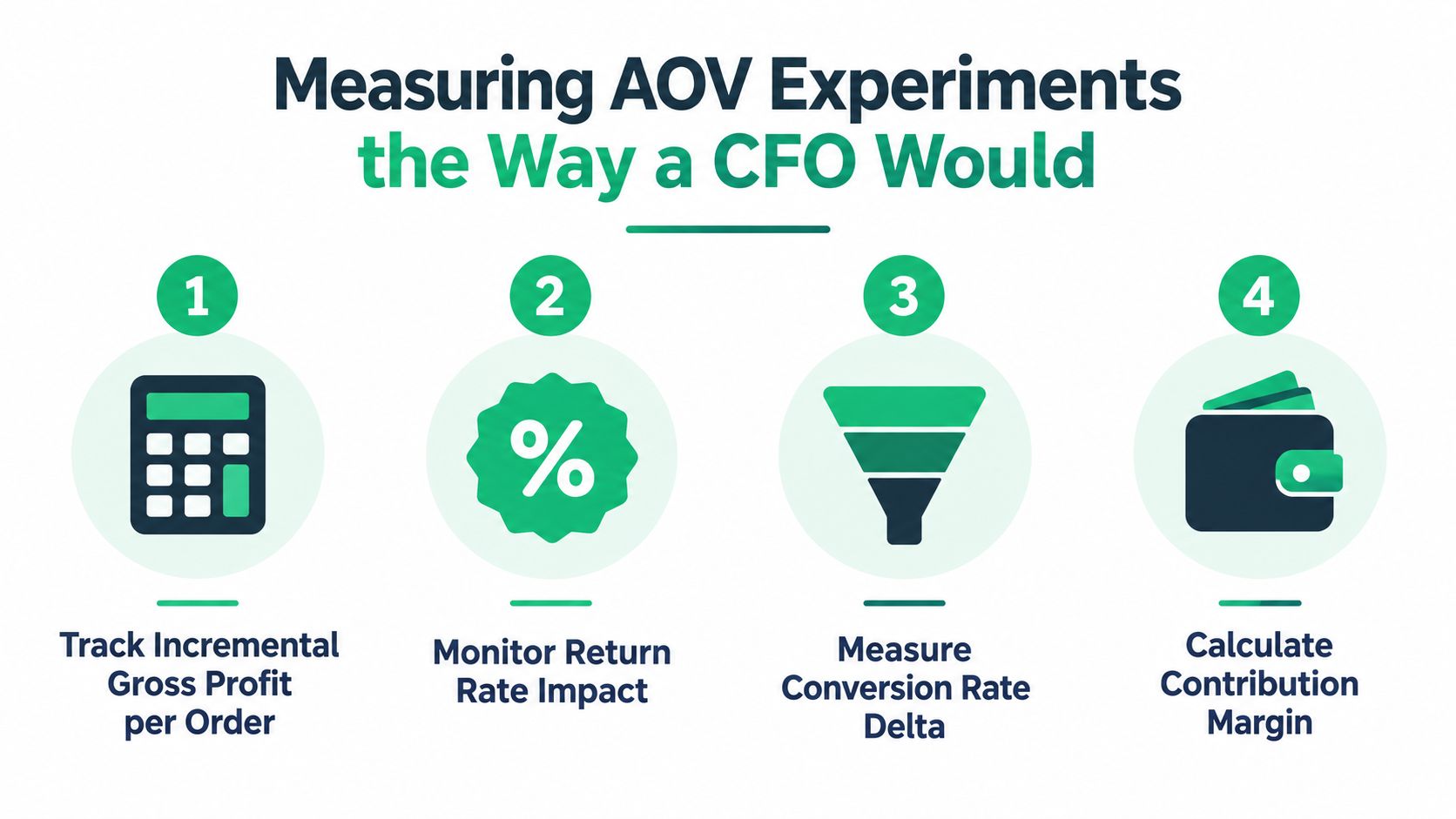
Track these outcomes together:
- Incremental gross profit per order: Did the added revenue leave enough margin after product cost and discount?
- Contribution profit per session: Did the store make more from the traffic after shipping, fulfillment, payment, support, and returns?
- Conversion rate delta: How many otherwise likely buyers disappeared after the offer appeared?
- Refund and return rate: Did the promotion attract unsuitable purchases or create expectation problems?
- Support cost: Did the new bundle, subscription, or order change generate manual work?
- Revenue per visitor: Did the complete funnel improve, rather than only the checkout basket?
Use a decision matrix, not a single winner metric
Score each test against four outcomes:
- Margin lift: Contribution profit improved meaningfully.
- Conversion protection: Conversion stayed stable or improved.
- Operational safety: Refunds, cancellations, fulfillment expense, and support work stayed controlled.
- Repeat value: The offer supports replenishment or future purchasing without training customers to wait for discounts.
A test with higher AOV and lower contribution profit fails. A test with slightly lower AOV but stronger profit per session may be the better permanent rule. Set a stop condition before launch, document the result, and then convert the winning logic into a stable Shopify setting or app rule. Remove losing offers instead of leaving them live because they look harmless.
Prioritize the next three experiments from observed customer behavior:
- First, test the clearest cart gap. Use order data to identify a relevant complementary product.
- Second, test a margin-led shipping goal. Keep the message visible in the cart and segment it by market.
- Third, test a low-friction repeat purchase path. Use a replenishment product where the delivery cadence is understandable.
CartServe provides configurable cart-drawer goals and market-aware previews, while UpServe provides contextual add-to-cart offers with impression, conversion, and revenue analytics. ServeApps offers these Shopify-native cart and upsell tools as independent applications, so merchants can evaluate the merchandising workflow alongside their own holdout and contribution-margin reporting.
Use ServeApps to configure cart goals, contextual upsells, and post-purchase add-ons while keeping each offer measurable. Start with one margin-led experiment, connect its results to conversion and refund data, and use the winning rule to build a more profitable Shopify basket.
Shopify Store Credits: Issuing, Redeeming and Accounting
Learn what Shopify store credits are, how they differ from gift cards and refunds, and how to issue, redeem and account for them.
Read more →
Can You Have Multiple Stores on Shopify? Plans and Limits
Can you have multiple stores on Shopify? Yes, through organizations or Plus expansion stores. Compare plan limits, eligibility and setup tips.
Read more →
Product Customizer App Shopify: Choosing the Right Tool
Compare native and third-party product customizer app shopify options on speed, theme support, variant mapping and SKUs before you install one.
Read more →