
The most repeated cross-sell advice is that any relevant add-on beats no add-on. That's the advice I'd challenge first. Plenty of stores install a "frequently bought together" module, watch it for a month, and see nothing in the data but noise. The tactic isn't broken. The offer arrived after the shopper had already stalled, the pairing was a guess, or the result got judged on clicks instead of incremental revenue.
Treat the eight patterns below as diagnostics, not trophies. For each one, ask three questions. Does the offer arrive after the purchase decision is made? Is the pairing verified by real order data or a hard compatibility rule? And can you see per-offer impressions, conversions and revenue, rather than one blended AOV number? If the third answer is no, you're guessing.
The mechanics matter more than the merchant. McDonald's script works because it's one prompt at one decision point, not because it's McDonald's. Amazon's bundle works because it's built from co-purchase data, not because it's Amazon. Copy the mechanism and the friction-free cross selling on Shopify that makes each accept path a single click.
Table of Contents
- 1. Amazon-Style "Frequently Bought Together" Recommendations
- 2. Free-Shipping Threshold Nudge in the Cart
- 3. Quick-Service Restaurant Add-On Prompt ("Would You Like Fries With That?")
- 4. Accessory and Protection Plan Cross-Sell at Point of Purchase
- 5. Complete-the-Look Outfit and Beauty Bundles
- 6. Post-Purchase One-Click Upsell Offer
- 7. Exchange or Self-Service Upgrade Offer
- 8. Subscription and Replenishment Add-On Cross-Sell
- Cross-sell tactics compared by trigger, effort, and best fit
- Turning Cross-Sell Examples Into a Repeatable Playbook
1. Amazon-Style "Frequently Bought Together" Recommendations
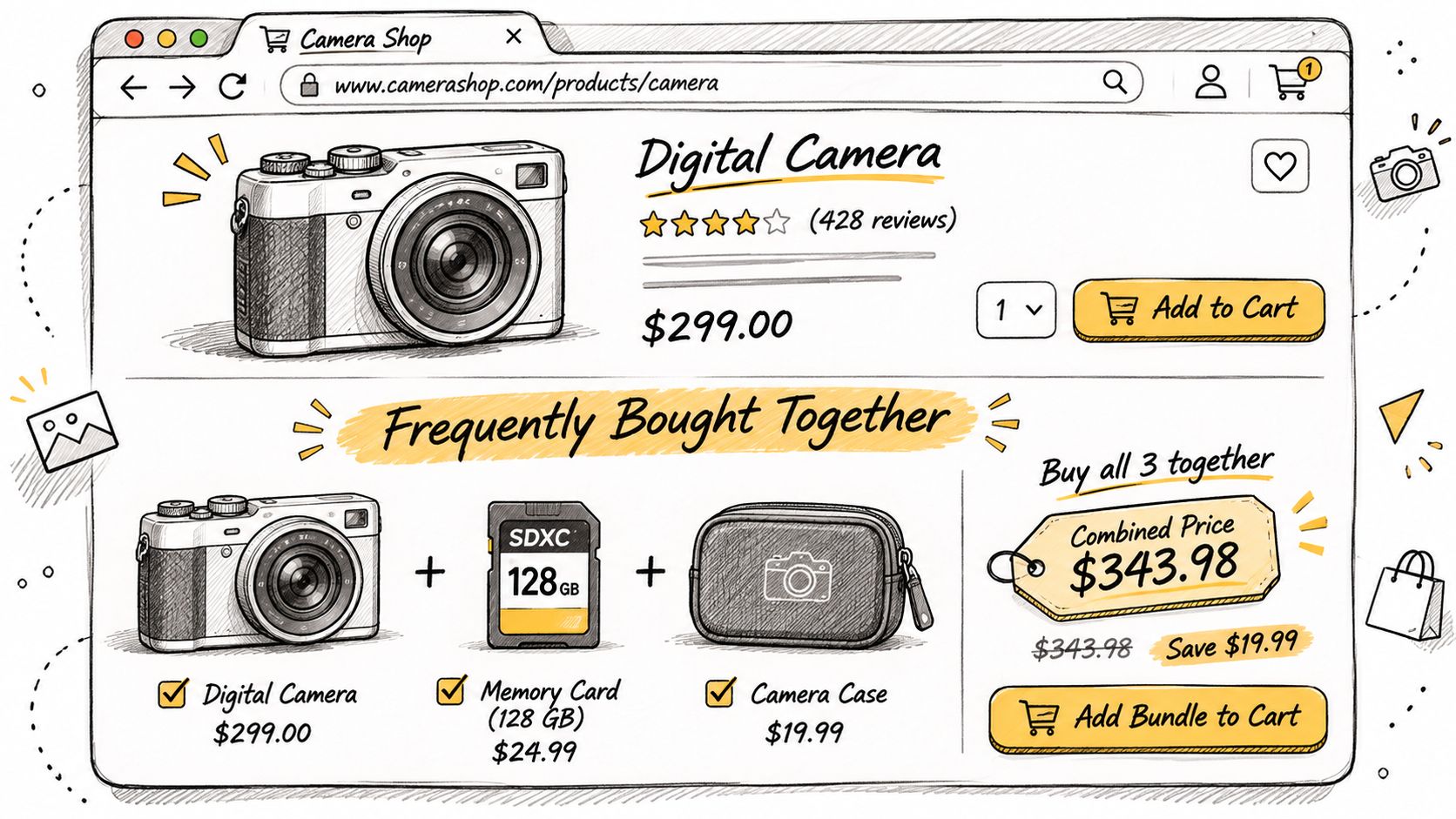
A frequently bought together block does one job: it turns past order combinations into a single click. Amazon's version is the reference. Three items with checkboxes, a combined total, and one add-to-cart button. The shopper stays in control, the bundle price is explicit, and nothing new is asked of them.
The machinery is item-to-item collaborative filtering. You count which SKUs land in the same orders, score the pairs by co-occurrence, and surface the strongest matches for whatever product is on screen. No browsing history required, which is why it also works on low-traffic stores.
Build the pairing before the engine
A large online retailer ran this sequence properly, using historic transactional data across markets to identify category and SKU-level purchase associations before deploying a recommendation engine. Its UK pilot delivered a 32% conversion-rate uplift and 23% revenue uplift (Econsultancy's retail case study). Affinity first, engine second.
- Seed with five to ten pairs: hand-check the combinations in your own order data before you automate anything.
- Show the combined total and the saving: bundle value has to be visible at a glance.
- Keep every checkbox live: forced bundles convert worse than editable ones.
- Measure per placement: add-to-cart rate and AOV lift for this module, not store-wide AOV.
It fails in one predictable way. When the module shows bestsellers instead of co-purchases, shoppers learn to ignore the block, and you've spent the slot for nothing.
For the follow-up side of the same idea, personalized product recommendations covers how to sequence email and SMS around what was bought.
Do this next: export 90 days of order line items, rank SKU pairs by co-occurrence, and launch your top ten as a manual bundle this week.
2. Free-Shipping Threshold Nudge in the Cart
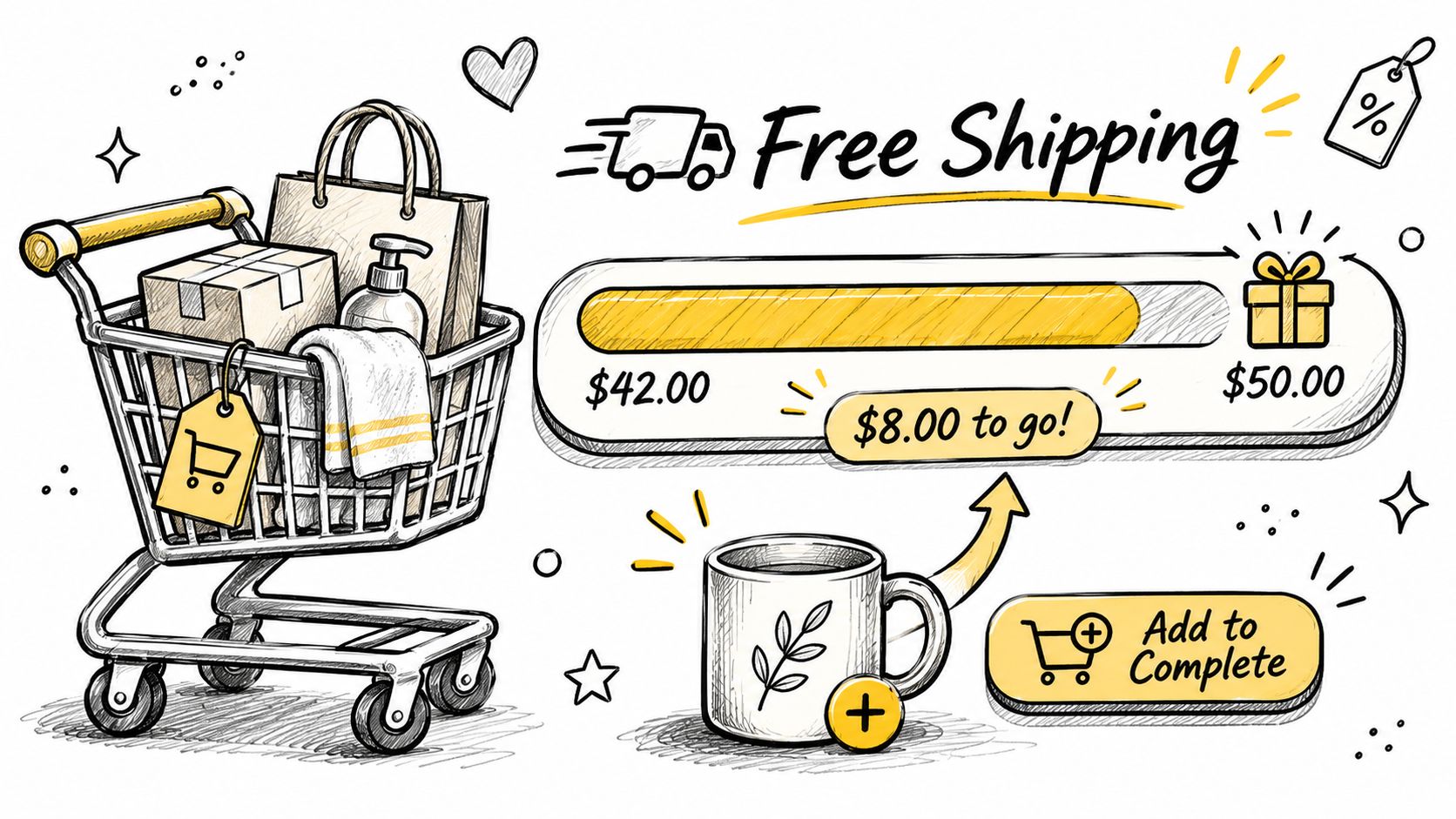
The threshold nudge is the cheapest cross-sell in ecommerce and the easiest to get wrong. A cart drawer shows a progress bar, "$12 away from free shipping," and suggests an add-on that closes the gap. The shopper has already decided to buy, so you're adding a rational reason to add one more item rather than interrupting a decision.
Cost is the classic abandonment trigger. Baymard Institute's cart abandonment research calculated an average abandonment rate of 70.19% across 49 published studies, and its reasons research found 48% of shoppers had abandoned because additional costs such as shipping, taxes or fees were too high. A free-shipping goal removes that objection at the moment it appears.
Set the threshold against your real AOV
If your average order value and your free-shipping threshold sit close together, the gap is small and a modest add-on closes it. An add-on priced at a fraction of that gap reads as a discount. An add-on priced near the gap itself reads as a shove. Price two or three add-ons specifically to sit under the gap, and put the progress bar in the drawer where the shopper is already looking.
- Cap suggestions at two: a wall of "you may also like" turns a nudge into a decision.
- Test thresholds by market: shipping costs and currencies move, so one global number leaks margin.
- Check margin after the giveaway: free shipping plus a discount can wipe out the added revenue.
- Keep the bar honest: a threshold that excludes bulky items needs to say so.
The implementation details for the drawer and the progress bar live in this guide to a free shipping bar on Shopify.
Start here: pull the median cart value for the last 60 days, set the threshold about 15 to 20 percent above it, and stock two add-ons priced under that gap.
3. Quick-Service Restaurant Add-On Prompt ("Would You Like Fries With That?")
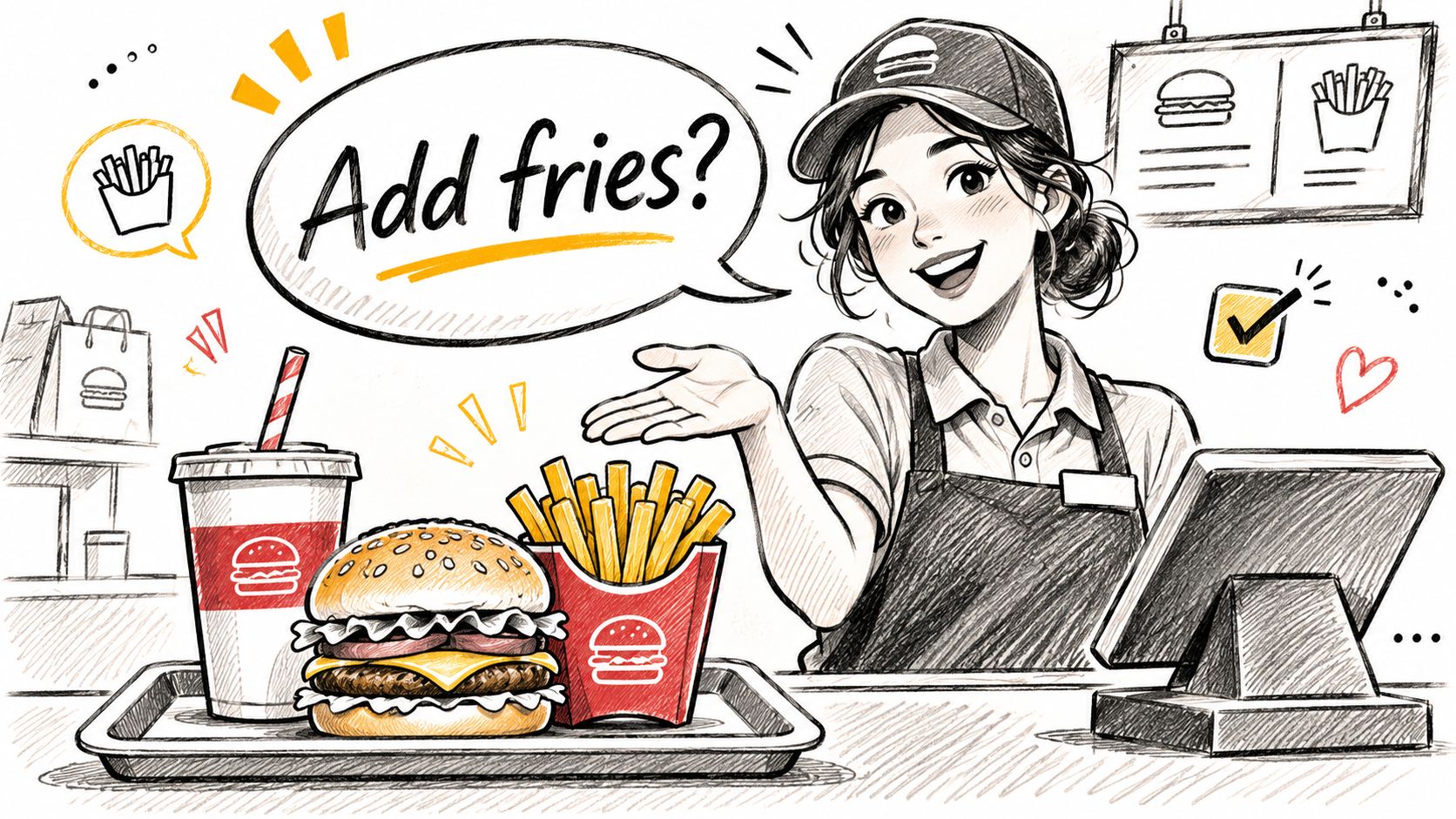
The fries prompt is the most copied cross-sell line in retail and the least copied properly online. Its power isn't the fries. It's that the offer is scripted, tied to a meal the customer is already assembling, and delivered at one decision point by someone who reads the answer instantly.
Two things make it work. The add-on completes the meal, and the ask happens once. Staff who chain three prompts ("fries? drink? dessert?") see compliance drop and irritation rise, which is exactly what a popup on add-to-cart, a second in the drawer and a third at checkout does to an online shopper.
Translate the script, not the sentiment
Online, the equivalent is a single add-on offered in the cart drawer at the moment the main item is confirmed. What transfers:
- Anchor to the bundle: offer the side that completes what's already in the cart, not a random popular item.
- One prompt per session: a popup plus a drawer block plus a checkout offer is three asks, not one.
- Keep the no easy: a one-click decline keeps the interaction cheap for the shopper.
- Measure attach rate by segment: traffic source and device tell you where the script works.
Practical rule: an add-on prompt is a script, not a campaign. Write one sentence, test it, and never stack a second ask on the same decision.
The first move: find the single item that most often appears in multi-item orders alongside your bestseller, and offer it once in the cart drawer for two weeks.
4. Accessory and Protection Plan Cross-Sell at Point of Purchase
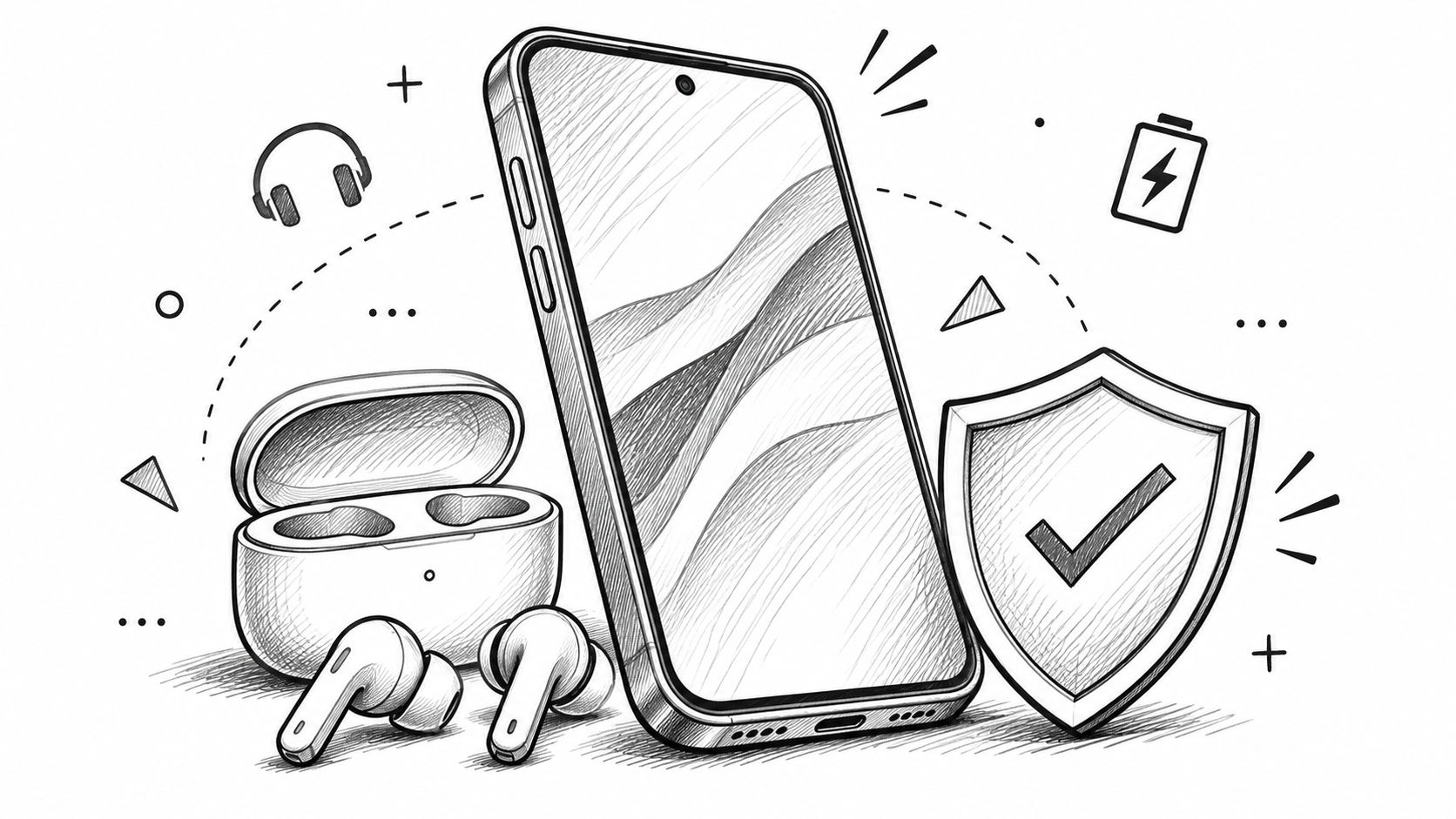
Say a customer has just configured a phone and is one click from paying. They need a case, and they haven't yet decided about coverage. Apple and Best Buy both build that offer into configuration and checkout rather than bolting it on afterwards, because the decision is still open.
The trade-off is pushiness. Protection plans carry commission-style incentives in physical retail, and that pressure leaks into digital experiences as pre-checked boxes and buried declines. Pre-checking a plan is the fastest route to refunds and complaints.
Compatibility is the whole game
- Filter accessories by verified fit: a case for last year's model is worse than no recommendation at all.
- Present coverage as an option: a short, plain summary of what's covered beats a paragraph of terms.
- Show the total difference: "$9 more per month" is easier to judge than a standalone price.
- Follow up after delivery: a second, relevant accessory offer lands better once the device is in hand.
A useful reference for how accessories get merchandised around a handset is this breakdown of protecting and powering your phone.
Do this next: list every accessory that is technically incompatible with your top three devices, strip them from all recommendation rules, then test one coverage option at checkout for 30 days.
5. Complete-the-Look Outfit and Beauty Bundles
Bundles sell a finished outcome, not a product list. A top with the matching trousers. A cleanser, serum and moisturiser as a routine. The shopper stops assembling and starts choosing, which is the entire value of the format.
The failure mode is a bundle that looks like a warehouse shelf. Five items with no styling logic and a token discount reads as a clearance tactic, and shoppers treat it that way.
Here's how a styled set behaves when it's built on the product page rather than buried in a separate collection.
Placement decides the result
Personalisation and cross-selling are different jobs at different stages. In a controlled test on its homepage, Bandier compared behaviour-based recommendations with bestseller recommendations, and the personalised variant produced a 9.7% higher conversion rate and a 2% revenue uplift over the first 18 days. The more useful result for cart work came from a separate cart-page test that placed recommendations below the checkout buttons, where exposed customers generated 10.2% higher average order value and 8.5% higher revenue per visit over 25 days (Nosto's Bandier case study). Placement, not the algorithm, drove the cart result.
- Cap the set at three to five items: beyond that, the bundle becomes a second catalogue.
- Allow swaps: size, shade and variant flexibility stops the bundle dying on a stockout.
- Sync component inventory: a bundle that oversells a component creates support tickets.
- Test product page against drawer: the same bundle can behave very differently in each spot.
A bundle earns its discount by removing a decision, not by being cheaper.
Ship this first: take your three best-selling items, write down the one product a first-time buyer always needs next, and launch that pair as a two-item bundle with a swap option.
6. Post-Purchase One-Click Upsell Offer
The thank-you page is the least contested real estate in ecommerce. The customer has paid, trust is at its peak, and a single relevant add-on costs them one click because the payment method is already on file. This is the cleanest cross sell example in the article, and the one most stores still leave empty.
The evidence behind it is unusually strong. A compilation of cross-selling statistics citing a survey of more than 1,400 sales professionals found cross-selling accounted for 21% of total company revenue on average, and reported that sellers using a one-click post-purchase upsell saw a 68.1% increase in average order value, based on more than $7 billion in processed sales (CartFlows cross-selling statistics). Read that as a mechanism benchmark, not a forecast for your store.
Where it goes wrong
- Two offers maximum: one relevant item and a clear decline. A grid of six is a second storefront.
- Keep the decline prominent: an easy "no thanks" protects the experience and reduces refunds.
- Check the plumbing: combined orders must sync to inventory, shipping and tags, or support costs eat the gain.
- Measure per offer: impressions, conversion rate and revenue per offer beat a blended AOV figure.
One caveat on attribution. Post-purchase revenue is easy to overstate because every order passes through the page, so compare exposed orders against a holdout instead of crediting all lift to the offer.
For the build itself, this walkthrough of a one-click upsell on Shopify covers placement rules and where checkout restrictions apply.
Test it this week: add one complementary item to the confirmation page, run it for 14 days against a holdout, and keep it only if revenue per visitor rises.
7. Exchange or Self-Service Upgrade Offer
Order changes get treated as support work. That framing wastes the one moment when a customer is already inside their order, already motivated, and already talking to you. A size swap request is a cross-sell opportunity with a built-in reason to talk.
The stakes go beyond revenue. Independent reporting citing Radial research found nearly 80% of consumers would not buy again after a poor post-purchase experience (ZigZag on post-purchase upsells). The same report cites Adobe's 2025 retail research, which found 87% of surveyed consumers expect retailers to handle personal data responsibly, while 42% of retailers were prioritising AI-based suppression of irrelevant messages.
The rule that separates help from harm
A recommendation placed inside the order-edit flow converts at 3 to 5 times the rate of a static thank-you page upsell, because the customer is already changing something. The same logic tells you when to stay quiet.
- Suppress offers for items already purchased: recommending the same filter twice signals nobody is paying attention.
- Never interrupt support tasks: address changes, cancellations and delivery questions get a clean path with no pitch.
- Limit edit windows by time and product type: 30 days on apparel and 7 days on perishables protects margin.
- Settle the difference automatically: a manual invoice for a $6 upgrade kills the conversion.
Suppression is a cross-sell decision. Deciding what not to offer is how you keep the offers that remain credible.
The pattern to copy is simple: swap a variant, show one matching accessory, add it in a single click, and collect the difference automatically inside the same flow. Real store examples of that flow are collected in these self-service store examples.
The first move: pull last month's "change my order" tickets, count how many were size or variant swaps, and turn the top one into a self-serve flow with one upgrade suggestion.
8. Subscription and Replenishment Add-On Cross-Sell
Replenishment is the most natural cross-sell in commerce because the timing is already decided. The customer buys coffee every month, so the filter is a companion, not a pitch.
Smaller merchants worry they lack the data for this. They usually have enough. Qualtrics' 2025 global consumer research, based on more than 23,000 consumers, found people are most comfortable with personalisation using purchase history (45%) and website visits (42%), while 53% were extremely or very concerned about personal-data privacy. You don't need an identity graph. You need one completed purchase and a clear value exchange.
Start with the signals you already own
- Order contents: what shipped together is the strongest pairing signal you have.
- Replenishment timing: offer the companion at the refill, not on the first order.
- Declared preferences: a chosen grind size or scent is stated intent, not an inference.
- Compatibility rules: filter, pod, cartridge. Fit is verifiable without any tracking at all.
Then measure it properly, because subscription revenue hides weak offers.
- Attach rate per eligible order: the share of refills that took the add-on.
- Incremental revenue per eligible order: not total subscription revenue.
- Gross margin after discount: a 20% add-on discount can erase the gain.
- Churn alongside attach: an add-on that raises cancellations isn't growth.
Do this next: take your best-selling consumable, identify the one accessory that always runs out first, and offer it on the second delivery only.
Cross-sell tactics compared by trigger, effort, and best fit
| Tactic | When the offer appears | Setup effort | Best fit | Main risk |
|---|---|---|---|---|
| Amazon-Style “Frequently Bought Together” Recommendations | Product page or cart | Requires co-purchase data and recommendation setup | Stores with sufficient order volume and complementary products | Sparse data or irrelevant pairings |
| Free-Shipping Threshold Nudge in the Cart | Cart, before checkout | Requires threshold settings, shipping calculations, and cart messaging | Stores with clear shipping costs and low-cost add-ons | Thresholds that feel too high can cause abandonment |
| Quick-Service Restaurant Add-On Prompt (“Would You Like Fries With That?”) | Point of order | Requires a short script or kiosk flow and staff consistency | Restaurants with complementary meal add-ons | Repetitive prompts can feel pushy |
| Accessory and Protection Plan Cross-Sell at Point of Purchase | During or just after the primary purchase | Requires compatibility data and clear plan details | Electronics and device retailers | Confusing coverage or irrelevant offers can erode trust |
| Complete-the-Look Outfit and Beauty Bundles | Product page or merchandising experience | Requires curation, creative work, and inventory coordination | Fashion and beauty stores with complementary products | Rigid bundles or discounts can hurt conversion or margins |
| Post-Purchase One-Click Upsell Offer | Order confirmation or thank-you page | Requires post-purchase checkout and payment integration | DTC stores with relevant complementary products | Compliance, fulfillment, or intrusive offers |
| Exchange or Self-Service Upgrade Offer | During an order change or exchange request | Requires order-editing rules, inventory, and payment handling | Retailers supporting self-service exchanges | Can feel unfair or pressuring during a customer problem |
| Subscription and Replenishment Add-On Cross-Sell | Around a subscription or replenishment cycle | Requires subscription billing and inventory coordination | Consumable-product businesses with recurring customers | Added complexity or customer subscription fatigue |
Turning Cross-Sell Examples Into a Repeatable Playbook
The eight patterns share a structure that has nothing to do with which app you install. The offer arrives after the purchase decision is made. The pairing is verified by order data or a compatibility rule, not by a merchandiser's instinct. The value is visible, either as a bundle saving or as a solved problem. And the accept path is one click, with an equally easy decline.
Pick one tactic, not eight. Match it to your catalogue. Pairs for electronics and accessories, styled bundles for apparel and beauty, replenishment for consumables, threshold nudges for anything with a shipping cost worth mentioning, order-edit offers for stores with heavy exchange volume.
Then instrument it before you scale it. Per-offer impressions, conversions and revenue from day one, plus a holdout group so you can separate incremental revenue from attributed revenue.
The sequence that works: one tactic, one placement, 30 days, a control group, then a decision. Expand only after the baseline holds.
Most stores skip the control group and end up arguing about whether the module worked. A two-week holdout costs a fraction of the revenue and settles the question permanently.
There's a second discipline that separates the operators who compound results from the ones who plateau: suppression. Track unsubscribe rate, support contacts, refunds and repeat purchase alongside AOV. When an offer lifts AOV and also lifts refunds, you haven't found a cross sell example worth scaling. You've found a future problem.
A short checklist before you launch anything:
- Timing: does the offer land after the buy decision, or before it?
- Relevance: is the pairing backed by orders or by a compatibility rule?
- Value: can the shopper see what they gain in one line?
- Friction: is accepting one click, and is declining just as easy?
- Measurement: will you know by day 30 whether it worked?
For Shopify merchants, the tooling is rarely the constraint. ServeApps builds three apps that cover the placements above: SelfServe for order edits and in-flow upgrade offers, CartServe for the cart drawer and free-shipping goals, and UpServe for add-to-cart popups and post-purchase offers. Each installs independently, so you can test one placement without rebuilding your theme.
Start where you already have traffic and intent. That's usually the cart drawer or the order confirmation page, not a new landing page.
ServeApps builds Shopify-native apps for exactly the placements covered here: CartServe for cart drawers and free-shipping progress bars, UpServe for add-to-cart and post-purchase upsells with per-offer analytics, and SelfServe for order edits that carry a relevant upgrade. If you want to run one of these tactics without a developer, you can install a single app, pick one placement, and measure it against a holdout. Visit ServeApps to see which app fits your store.
Address Change Email Template: Copy, Fill, Send in 2026
Copy a ready-to-use address change email template, plus a situation table and rules for customizing it when an order is packed, shipped, or cross-border.
Read more →
Free Gifts with Purchase: How to Plan Them Well
Free gifts with purchase explained: how they work, which gift types convert, and how to set rules that avoid refund disputes and margin loss.
Read more →
How to Update Customer Information in Shopify
Learn how to update customer information in Shopify: contact details, addresses, order changes and the checks that keep records accurate.
Read more →