
Ask a merchant why they run a free gift with purchase and the answer comes back quickly: it lifts conversion. Ask what the gift costs per order, what happens when the shopper returns the qualifying item and keeps the gift, and whether a store credit of the same value would have retained that customer, and the conversation stalls. A free gift with purchase is two things at once. It's a line item with a landed cost, and it's a promise with terms attached. Most guides price one and ignore the other, which is how stores end up with a promotion that looks generous on a banner and expensive in a returns inbox. This walks through the format choice, the valuation, the fit rules, and the wording that survives checkout, in the order you'll make those decisions.
Table of Contents
- Gift Formats Compared at a Glance
- Why Free Gifts Still Persuade Shoppers
- What a Free Gift Is Worth Against a Discount
- Choosing a Gift That Fits the Order
- Rules and Disclosure That Hold Up After Checkout
- Pairing Gifts With Gift Cards and Loyalty Tiers
- Set Up Your First Gift With Purchase Offer
Gift Formats Compared at a Glance
Six formats cover almost every gift offer a Shopify store runs. Scan the table before you read further, because the format you pick decides your margin exposure, your fulfillment complexity and your disclosure burden.
| Format | Trigger | Best use | Main risk |
|---|---|---|---|
| Single threshold gift | One free item when the cart reaches one spend level | Stores with a clear average order value | Threshold set too low gives away margin |
| Tiered gift ladder | A bigger gift at each higher spend tier | Wide spread of order values | Shoppers stop just below the next tier |
| Mini or deluxe sample | A travel-size product added to a qualifying order | Product launches and trial | Sample cost and parcel size add up |
| Consumable refill | A small replenishment item that pairs with the main product | Repeat-purchase categories | Gift can look like a substitute for the main item |
| Digital reward or store credit | A code or credit applied to the next order | Low-inventory or high-margin stores | Credit may feel less tangible to shoppers |
| Random surprise gift | A gift drawn from a set at checkout | Limited campaigns with clear terms | Highest disclosure and complaint risk |
The risk column is the part worth reading twice. A single threshold gift fails without drawing attention, by giving away margin on orders that would have converted anyway. A tiered ladder fails visibly, because shoppers park their cart just below the next threshold. A surprise gift fails loudly, because the shopper who receives the least desirable item in the set now has a reason to complain in public.
The quick pick rule. Start with one single threshold gift, plus a sample or a refill if your category supports either. Run it for two to four weeks and watch the attach rate against a control segment. Move to tiers only when your higher-spend shoppers ignore the first threshold, which tells you the first threshold is set below where your best customers already shop.
Cost the gift before you design the banner. A light, low-unit-cost item keeps your parcel weight and your pick-and-pack time flat, while a bulky one can turn a $6 gift into a $9 gift. If the gift needs to be cheap and easy to post, a stock line of low-cost branded goods such as Custom Pens is worth pricing before you commit to something heavier that changes your packaging.
Why Free Gifts Still Persuade Shoppers
American merchants were handing out gifts alongside purchases in the early 1850s, when direct gift distributions, prize packages and access to gift-book establishments ran in parallel with the mid-nineteenth-century consumer revolution, as the historical research on premium promotions describes. The channel changed. The mechanism didn't.
Break that mechanism into three parts and you can see exactly what you're buying.
- Merchandising. The gift shows the main product in use. A travel-size cleanser next to a moisturiser demonstrates the routine, and the shopper pictures step two before they've bought step one.
- Persuasion. An extra item makes the same spend feel like more than the sum of its parts, without cutting the shelf price. Nothing on the product page says "discount", which matters if you sell on price discipline.
- Reciprocity. The shopper reads the gift as something the store gave back, not something the store conceded. That's a different feeling from a markdown, even at identical cost to you.
Think about a boxed set. Buy the same four items loose and it feels like a shopping list. Put them in one box with a ribbon and it feels like a gift, and buyers pay more for the box. A free gift with purchase borrows that effect at the cart level. The underlying motives are the same ones behind any add-on purchase, which is worth reviewing in this breakdown of what drives buying decisions.
The history carries a warning too. The same scholarship notes that these schemes could push shoppers into buying products they didn't initially want or need, which is a short-term win and a long-term return-rate problem. So apply one test before you approve any gift.
The cart-completeness test: does this gift make the cart feel finished for this specific customer, or does it only look generous on the banner?
If the answer is the second one, the gift is decoration. The numbers in the next section are how you check the feeling against a hard cost.
What a Free Gift Is Worth Against a Discount
Start with what shoppers say the gift is worth. In a reported series of consumer studies, shoppers buying an $8.95 jar of organic tomato sauce were offered spaghetti either free or for $0.50. The group that received it free estimated its value at $2.95 on average, while the group offered it at $0.50 estimated $1.83, a gap of $1.12, or roughly 61% above the paid-offer estimate for an identical product, as the comparison of free items and paid products reports.
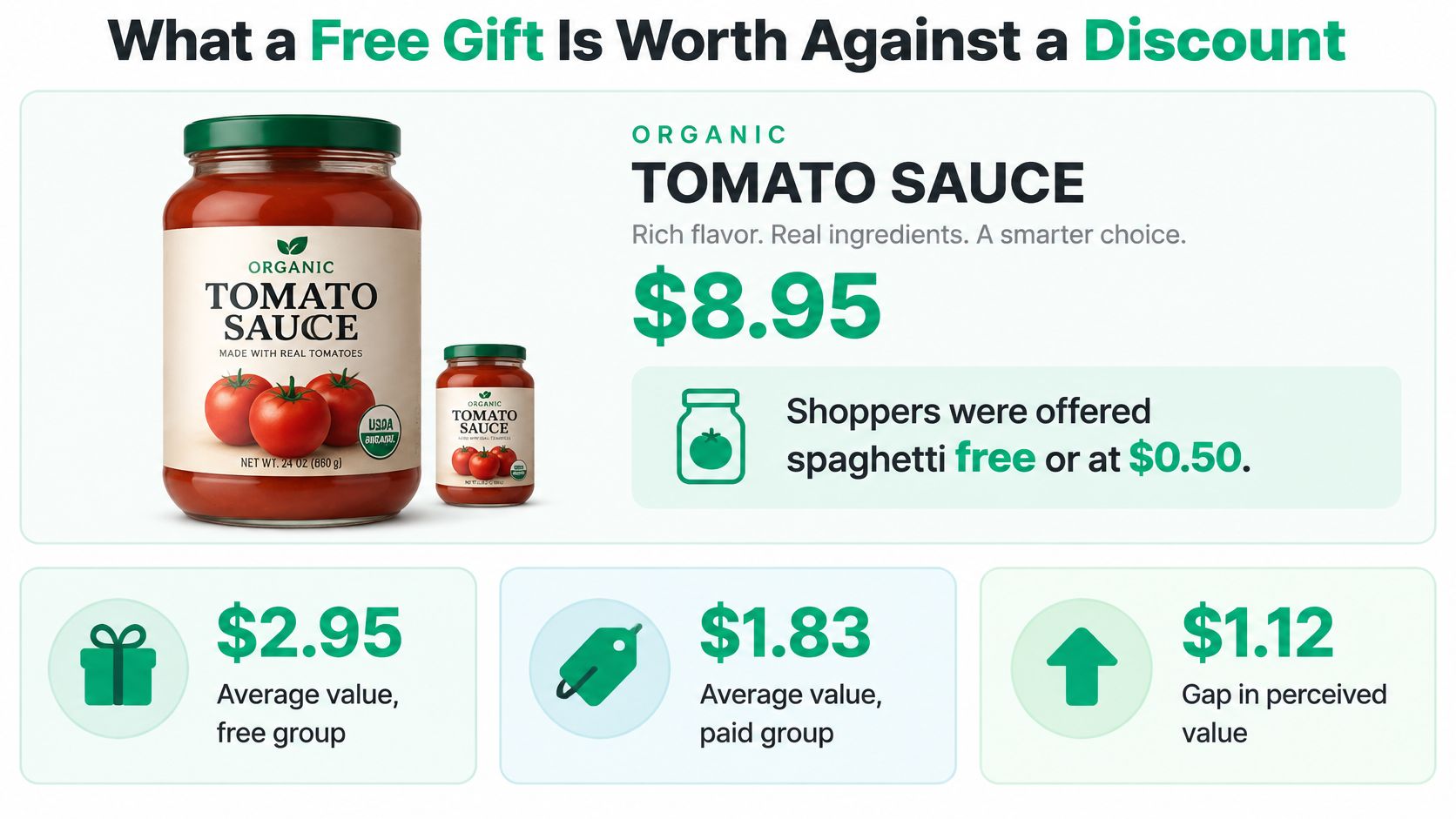
Zero pricing triggers its own response. The word "free" doesn't just remove a number, it changes how the shopper reads the item, and that inflated perceived value is what lets a small gift do the work of a bigger discount.
Then the limit. The same body of work reports a separate online shopping simulation with more than 2,000 participants in which premium promotions generally produced a weaker purchase effect than equivalent price cuts. So the free item wins on perceived value and can still lose on conversion. Offer design decides which effect dominates.
The post-purchase hierarchy
First-order conversion isn't the only cost to weigh. A survey of 1,376 online shoppers in March, plus 525 holiday shoppers in May, asked what drives repeat purchasing, and the ranking is uncomfortable for anyone planning a physical freebie by default, according to the ecommerce survey on value and sustainable packaging.
| Driver | Share of respondents | What it means for gift planning |
|---|---|---|
| Coupons, discounts or future-purchase credits | 47% | Credits and discounts are the strongest retention lever |
| Free samples | 24% | Samples work best as an add-on to a credit or threshold offer |
| Sustainable packaging | 16% | Green messaging does not offset a weak gift |
Read that as a hierarchy, not a verdict. A credit beats a physical sample for bringing someone back, and a green story attached to a poorly chosen gift won't rescue it. If your retention plan leans on eco-friendly packaging language, the survey suggests direct economic incentives rank higher with shoppers.
Costing the gift against a credit
Run the comparison as three steps, in this order.
- Cost the gift landed. Item cost, plus any packaging it needs, plus the extra parcel weight, plus the seconds it adds to pick-and-pack. A gift that pushes an order into the next shipping band is not a cheap gift.
- Compare three rates against a credit of the same cost. Attach rate on the first order, return rate, and repeat-purchase rate in the months that follow. The credit usually loses the first and wins the last.
- Test the pair, not the theory. Say a store pays $1.20 landed for a sample and offers a $5 credit as the alternative. The sample often wins first-order attach because it's tangible in the box. The credit often wins retention because it carries a reason to come back. Which one you keep depends on whether you're buying a first order or a second one.
Decision rule: keep the gift only when it is genuinely incremental and earns more contribution margin than a discount of the same cost. If it can't clear that bar, you're buying revenue with margin you already had.
Threshold design interacts with all of this, so it's worth reading how bundling and free shipping thresholds move average order value before you set the number. And if you're layering a gift on top of a time-limited sale, these notes on running flash sales without wrecking margins keep the two from compounding into a loss.
Choosing a Gift That Fits the Order
A gift should work like a small supporting actor, not a second lead. It needs to make the main product easier to use, more complete, or more memorable without making the shopper question the price. Three between-subject studies found that a low-fit gift, compared with a high-fit gift, undermined evaluations of the promoted product according to the research on when free gifts hurt the promoted product. The mechanism is persuasion knowledge: when the mismatch feels obvious, shoppers suspect the offer is doing the selling instead of the product.
Pairing the main product with a distinct item can make the order feel more valuable, while giving away an identical second unit can read as a pricing trick, so an adjacent product reads as a bundle. This is the practical difference between a useful add-on and a thinly disguised discount. A skincare shopper may accept a travel-size cleanser with a moisturiser because it fits the routine. A second moisturiser can raise a different question: was the first one priced to cover the giveaway?
The three-question test
Put every candidate gift through this before it reaches a product page.
- Does it help the buyer use the main product? A refill, a compatible accessory, or a tool that the main item needs answers yes. An unrelated clearance item answers no.
- Would the buyer want it without the purchase? If nobody would pay for it on its own, it is packaging, not a gift, and shoppers recognise the difference.
- Would it survive a return? If the customer sends back the main item and the gift is a consumable they have already opened, you need a rule, and you need it written before launch.
The cleanser example passes because it completes the routine, has value outside the offer, and creates a return question that can be settled cleanly. A duplicate moisturiser fails because the shopper starts comparing the bundle with the regular price. That confusion is costly: the gift was meant to add certainty, and instead it adds doubt.
Eligibility and the metrics that settle arguments
Segment eligibility by product category, subscription status, market and inventory availability. Suppress the offer automatically when the gift is out of stock or when no qualifying product sits in the cart. Persist the gift condition through checkout, so edits, cancellations and returns do not create unintended free units.
Track five numbers per gift, and split them by fit cohort so a good gift and a bad one do not average into a misleading result: impression-to-acceptance rate, qualifying-cart lift, attach rate, gross-margin impact, and repeat purchase. Relevance moves perceived value, not just uptake. The margin line shows whether the gift earned its place, and the repeat-purchase line shows whether it built a reason to return. A gift that looks generous but weakens contribution margin has failed its first job.
Rules and Disclosure That Hold Up After Checkout
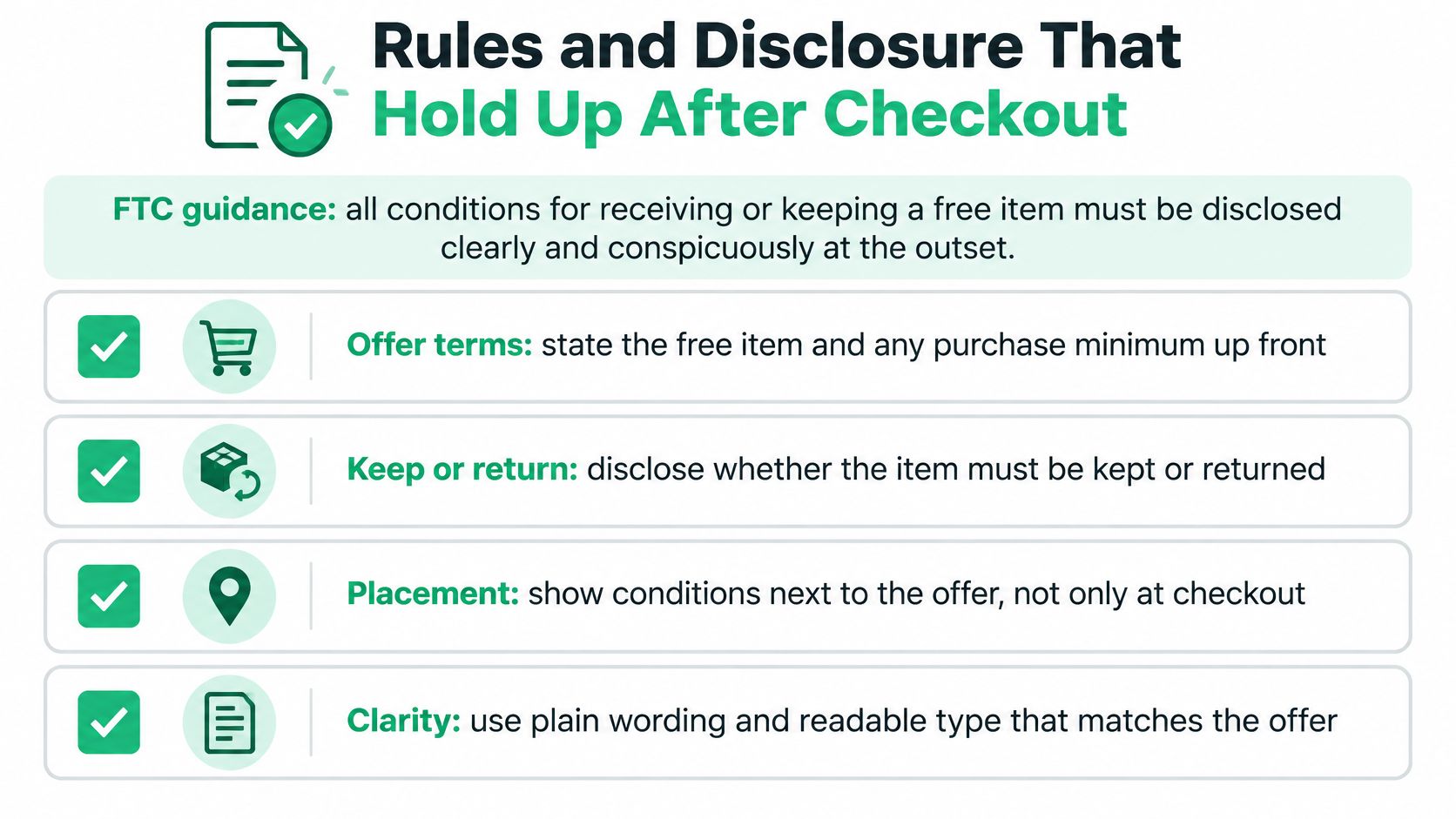
In the United States, Federal Trade Commission guidance on free offers is blunt about conditions. Everything attached to receiving or keeping a free item has to be disclosed clearly and conspicuously at the outset, so shoppers aren't likely to misunderstand the offer. That single sentence creates work at every touchpoint, and it's the part of gift planning most stores skip.
Where the terms have to appear
- Product page: the threshold, the exclusions, and the one-per-order limit, in the same block as the price.
- Cart drawer: progress toward the threshold and the gift's name, so the shopper knows what's coming before they reach checkout.
- Checkout: the final gift line, priced at zero, plus any substitution rule if the named gift runs out.
- Order confirmation email: gift shipping terms and the return rule, while the customer still has the order in front of them.
- Influencer and affiliate posts: the same conditions as the store. A creator who says "free gift with any order" when the threshold is $75 has created your problem.
Write the wording once and reuse it. A line like 'Spend $75 before tax to get a free travel-size serum. One per order. While stocks last.' covers the threshold basis, the limit and the stock condition in three sentences.
Enforcement beats wording. A clearly written banner above a checkout that adds the gift to a $60 cart is still a broken promise. Test the cart logic, not just the copy.
Edge cases and the rule to set for each
| Situation | Rule to set | Why it matters |
|---|---|---|
| Qualifying product returned | Gift returned or threshold rechecked before refund | Stops a free unit being kept without the qualifying purchase |
| Partial refund drops cart below threshold | Recalculate eligibility and reverse the gift if needed | Prevents an unearned free item |
| Gift out of stock at checkout | Suppress the offer or name an approved substitute before payment | Avoids a broken promise and a complaint |
| Order edited after purchase | Keep the gift condition attached to the order | Stops edits from creating unintended free units |
| Order cancelled | Void the gift line with the order | Keeps stock and accounting accurate |
| Shipping or tax included in threshold? | State whether the threshold uses product subtotal before tax and shipping | Removes the most common dispute |
| Sales in another country | Check local consumer-protection and tax rules for that market | Terms that are legal in one market may not be in another |
The last row deserves attention if you sell across borders. Consumer-protection rules and tax treatment differ by jurisdiction, and a threshold that's compliant in one market may need rewording in the next. Check each country you ship to rather than assuming your home-market terms travel.
Pairing Gifts With Gift Cards and Loyalty Tiers
Gift demand isn't confined to the cart. In 2024, 45% of consumers said they would like to see more free gifts while shopping in stores, according to GWI as reported by ADM Indicia's look at gift-with-purchase demand. That makes the gift a physical-retail draw as well as an ecommerce one, and it argues for a gift at click-and-collect rather than only at checkout.
Two placements carry the strongest stated demand. Gift cards first: Fiserv's Gift Card Gauge survey of more than 1,000 U.S. adults found 44% said they would be more likely to purchase gift cards when they came with free or discounted store merchandise, per the 2024 Gift Card Gauge findings. A $5 item attached to a $50 gift card is the same mechanic with almost no inventory risk.
Loyalty comes second, and it's where the same gift earns more. A Snappy survey reported by HuffPost's coverage of free gifts with purchase found more than 70% of consumers said exclusive items or quality gifts from a loyalty program made them view the brand more favorably. A gift that runs on every order is a cost. The same gift restricted to a tier is a status signal, and status signals don't need to ship with every parcel.
Three placements worth testing, each already covered by the margin test and the disclosure rules above.
- Gift card plus sample at the $50 card level. Low inventory risk, high perceived value, and the sample introduces a product the recipient might buy later.
- A tier gift earned at the third order. Rewards the behaviour you want, which is repeat purchase, not first-order conversion.
- An in-store pickup gift for online orders. Converts a fulfillment choice into a small reward and pulls the shopper into the store.
Treat all three as stated-preference signals rather than proven conversion lifts, because that's what the surveys measure. If you're wiring a gift into a points structure, this guide to loyalty program integration covers how the tiers and the reward logic connect.
Set Up Your First Gift With Purchase Offer
Here's the sequence, in the order that avoids rework.
- Choose one format. Start with a single threshold gift from the comparison table. Tiers, ladders and surprise sets can wait until you have attach-rate data.
- Pick an adjacent gift that's in stock. Run it through the three-question test, confirm inventory covers the promotion window, and set a substitution rule in case it runs dry.
- Set the threshold near your current average order value. Close enough that most shoppers are one item away, high enough that the gift isn't subsidising orders that were already going to happen.
- Write the disclosure at every touchpoint and the edge-case rules. Product page, cart drawer, checkout, confirmation email, and any creator brief. Then test a return, a partial refund and a cancellation on a staging order.
- Launch to one segment and measure for two to four weeks. Attach rate, margin impact and return rate by cohort. Expand only when the gift clears the margin test against a credit of the same cost.
Where tooling helps
A cart drawer that shows progress toward the threshold does part of the persuasion work for you, because the shopper can see how close they are. CartServe includes a rewards bar with free-shipping and spend-tier goals for exactly this. Both CartServe and UpServe run on fully free plans, with no trial clock and no card required, so you can test the offer without a billing commitment, and UpServe popups can use a frequency cap so shoppers don't see the same offer repeatedly.
Present that as one way to run the steps, not a requirement. Plenty of stores launch a first gift with a native discount rule and a clear product page notice.
When you announce the offer, borrow structure from proven creative rather than inventing a format. These gifting campaign creative examples show how other brands frame a gift visually, which is faster than starting from a blank canvas.
Readiness check before you publish: a threshold you can defend, a gift in stock for the full window, written terms at all five touchpoints, edge-case rules tested on a live order, and a measurement plan for the first month.
ServeApps builds Shopify-native tools for the parts of a promotion that happen after the shopper decides to buy, including cart drawers with spend-tier and free-shipping goals that show customers how close they are to a gift threshold. If you're planning your first free gift with purchase, start with the free plan, wire the threshold into your cart drawer, and watch the attach rate for a month before you add a second tier. You can see the full app suite and install any of them independently at ServeApps.
How to Update Customer Information in Shopify
Learn how to update customer information in Shopify: contact details, addresses, order changes and the checks that keep records accurate.
Read more →
Rules of Editing: When Customers Can Change an Order
Rules of Editing for orders explained: eligibility windows, permitted changes, payment safeguards and when to hand off to support.
Read more →
Updating Address on Shopify Orders: How to Do It Safely
A practical guide to updating address on Shopify orders: what you can change, when edits lock, and how to avoid misdelivery and fraud.
Read more →