
Two shoppers land on the same product page at the same moment. Same price, same photos, same stock level. One buys in under two minutes. The other fills a cart, rereads the returns policy, and closes the tab.
Nothing about the product separated them. What separated them was the question each was asking. The first wanted the item. The second wanted reassurance about what happens if the item goes wrong, and the page never answered it.
That gap is where most buying-motive advice fails. Lists of motives are accurate and hard to act on, because they don't say which motive is winning at the moment a shopper hesitates. Read the motives as trade-offs instead: each one carries a buyer question, leaves a signal you can measure, and does its damage at a particular stage of the funnel.
Table of Contents
- Buying Motives at a Glance
- What a Buying Motive Actually Is
- Price, Delivery and the Total Cost Question
- Trust, Information and Friction at Checkout
- Which Motive Blocks the Sale at Each Stage
- When Sustainability and Quality Decide
- Motive Scenarios in Everyday Purchases
- Audit Your Store Against Each Motive
Buying Motives at a Glance
Eight motives decide most ecommerce purchases. Read the table as a negotiation, not a personality quiz: the shopper is balancing several of these at once, and the one you leave unanswered is the one that ends the session.
| Motive | Buyer's question | Typical signal | Merchant response |
|---|---|---|---|
| Price and value | Is this worth what I pay? | Price, promotions, perceived quality | Show concrete value, not promotional noise |
| Cost and delivery certainty | What will I pay in total, and when will it arrive? | Shipping, taxes, fees, delivery dates | Show total cost and delivery options before payment |
| Trust and risk reduction | Can I rely on this seller? | Reviews, policies, retailer credibility | Publish accurate details, authentic reviews and clear policies |
| Convenience and low effort | How hard is it to finish this order? | Checkout length, payment options | Shorten checkout and offer preferred payment methods |
| Relevance and fit | Does this solve a real need for me? | Context, cart contents, past purchases | Make recommendations contextual and easy to ignore |
| Control after purchase | Can I fix a mistake without losing the order? | Size, variant or address errors | Offer self-service changes within clear rules |
| Quality and durability | Will this last and perform? | Materials, specifications, warranty | State specifications and warranty terms plainly |
| Sustainability (conditional) | Does this fit my values without a price or performance penalty? | Eco claims, refill or resale options | Tie claims to durability, price and logistics choices |
Motives rarely act alone. A shopper can be sold on quality, comfortable with the price, and still walk away because the only delivery option arrives after the birthday. One unmet motive outweighs five satisfied ones at the moment of payment.
That's the part most guides skip. They treat price, quality and convenience as separate chapters when a real cart is a weighing scale. The motive that blocks is the one with no answer on the page, not the one with the loudest marketing.
Use the table as a diagnostic rather than a checklist. Find the stage with the biggest drop-off, match it to the row that explains it, then test the response in the last column against a baseline. The sections that follow take each motive in turn and show the evidence behind the fixes.
What a Buying Motive Actually Is
A buying motive is the reason a shopper decides the purchase is worth making. It isn't a product feature and it isn't a demographic label. The product is the vehicle, the motive is the destination, and the same vehicle carries people to very different places.
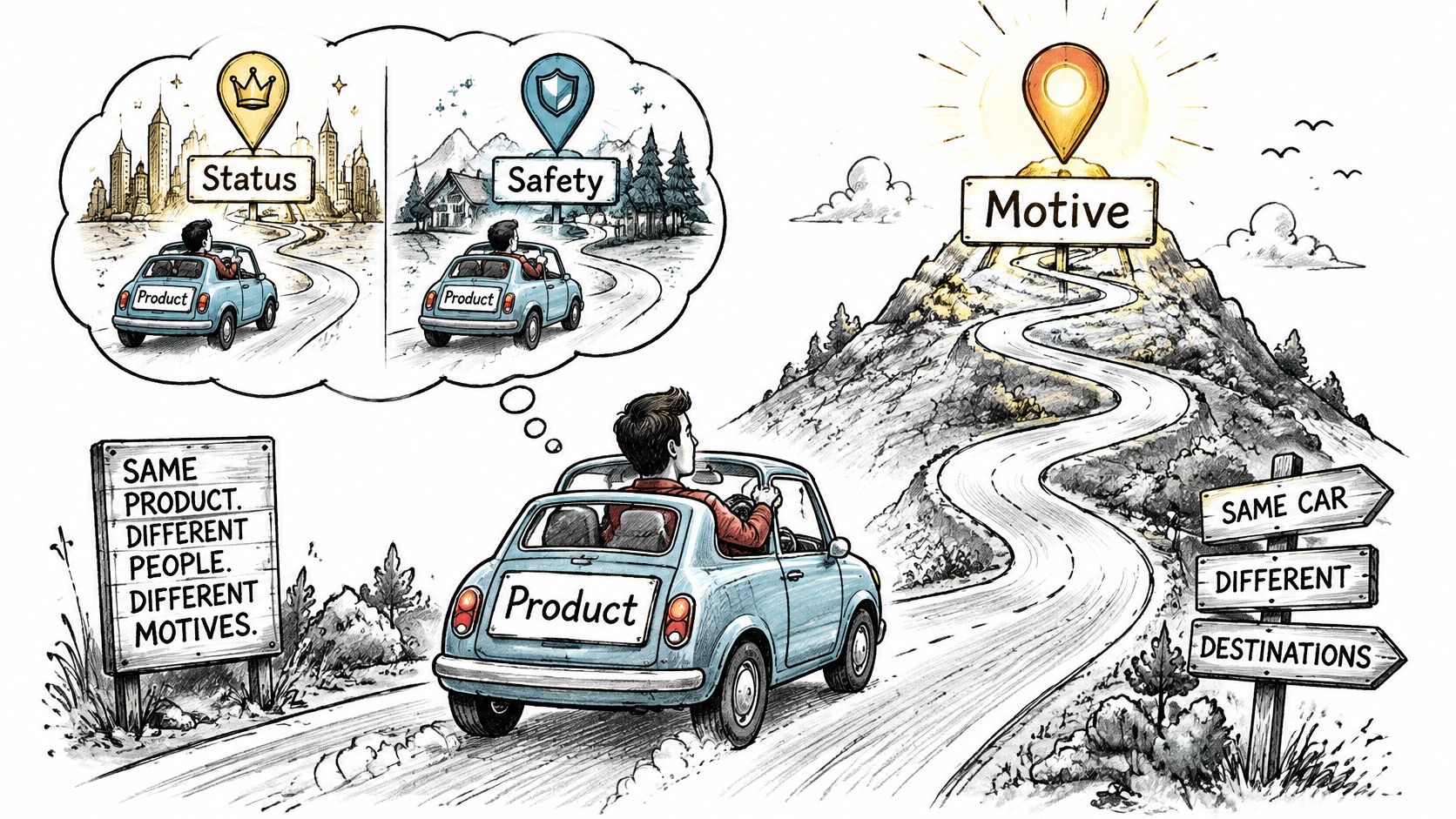
A shopper buying a $400 office chair might be heading towards a bad back, a new job, a spare room that finally looks finished, or a partner who has asked three times for a proper desk setup. Stated reasons are usually the safest version of the underlying motive. "I want a cheaper one" often means "I'm afraid of overspending on something I can't judge", and the second version tells you what to put on the page.
Price matters, but it isn't the whole motive
Price and perceived value sit near the centre of most decisions, and buyers increasingly evaluate value as more than the lowest sticker price. PwC's June 2021 Global Consumer Insights Pulse Survey found that 56% of consumers worldwide had become more price-oriented, while fast, reliable delivery and product availability also shaped purchase decisions (PwC Global Consumer Insights Pulse Survey).
That combination is the point. Buyers shifted from simple price competition towards value for money, an acceptable mix of performance, price, reliability and effort. A discount that ignores effort and risk doesn't move the number that matters.
A buyer completes a purchase when the perceived value of the outcome outweighs price, effort and risk combined.
A three-question test for any product
Run every product page and every cart through these three questions. Where you can't answer one, you've found a motive you're currently losing to.
- What does the buyer gain? Name the outcome, not the specification. "Charges a phone twice before it needs the wall" beats "5,000 mAh".
- What does it cost in money and time? Include shipping, waiting, assembly, and the effort of returning something that doesn't work.
- What could go wrong, and what happens then? Delivery timing, fit, warranty, and whether fixing a mistake means an email chain or a button.
Price, Delivery and the Total Cost Question
The number a shopper weighs is not the price on the product page. It's the total commitment: item, shipping, tax, the wait, and the odds that the whole thing gets returned. Baymard's cart abandonment research found that, excluding users who were merely browsing, 40% of US online shoppers abandoned checkout because extra costs such as shipping, taxes or fees were too high, 20% because delivery was too slow, and 12% because they could not calculate the total order cost upfront (Baymard Institute).
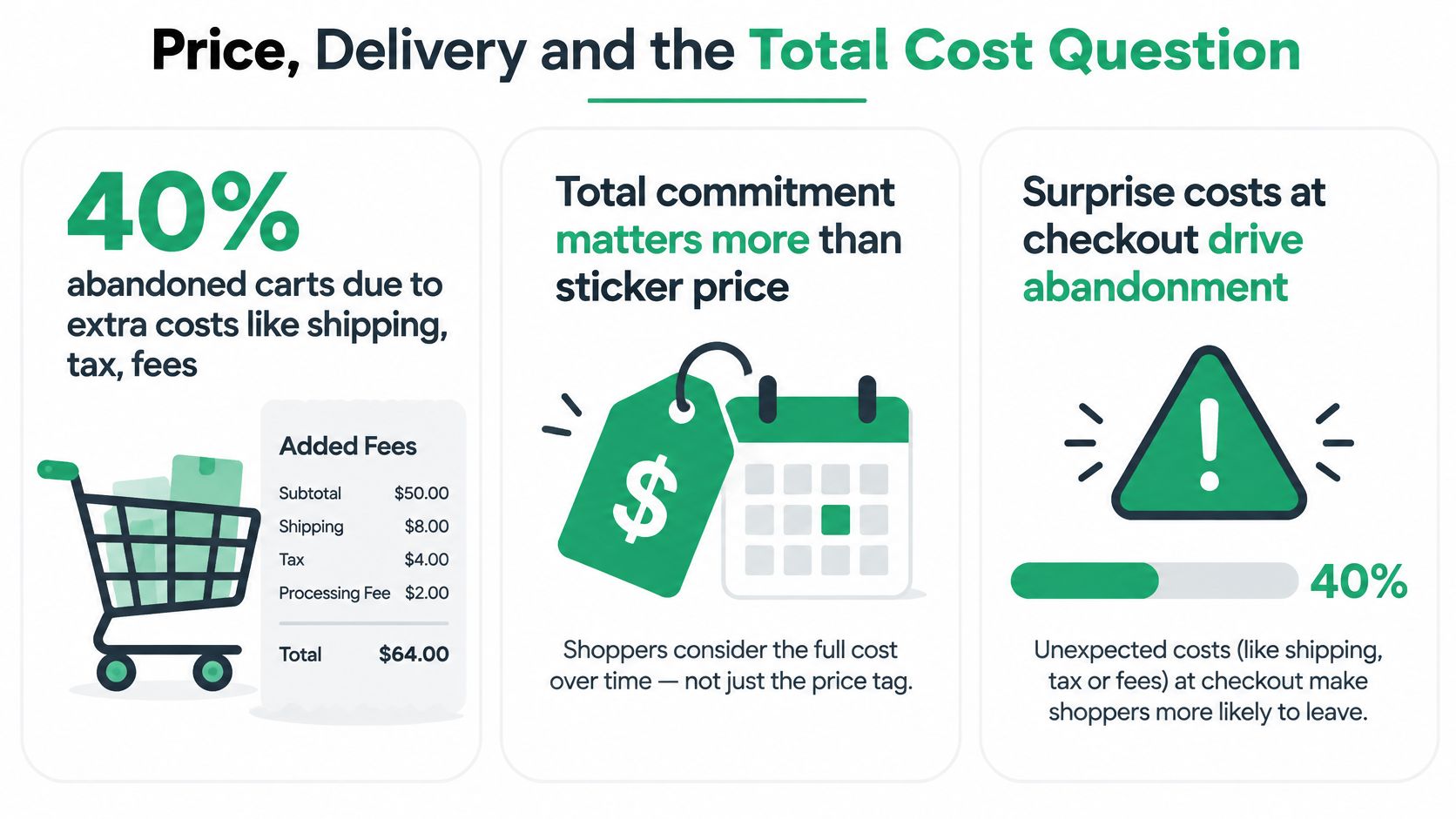
Those three answers are one problem wearing three coats. The shopper couldn't see the full picture before committing, so they kept their money and their certainty.
Free shipping carries weight on its own. Ipsos research commissioned by Temu found that 68% of surveyed consumers identified price as an important factor in online shopping decisions, while 55% cited free shipping (Ipsos). Both numbers are about the same anxiety: how much leaves my account in total.
Four cart changes that answer the cost objection
- Show the total early. Land the delivery cost, tax and expected date in the cart, not at the last step. A shopper who sees $58 with a Tuesday arrival is calmer than one who sees $44 and then $58.
- Make thresholds visible. A progress bar inside the cart drawer turns free shipping into a target rather than a surprise. If you're setting one up, this free-shipping bar setup for Shopify covers where it belongs and what it should say.
- Calibrate thresholds to profit. A free-shipping goal set below your true cost base buys revenue you can't keep. Work it out from your average parcel weight and margin, not from a competitor's banner.
- Answer the wait as well as the price. A delivery date on the product page does more for a hesitant buyer than a second discount.
Shipping economics decide what you can promise. Sendaparcel's courier pricing breakdown shows how weight, zone and surcharges stack, which is the number you're absorbing every time you advertise free delivery.
Cross-sell prompts fail here when they ignore the objection. Adding a bundle offer to a cart that's stalling on a $9 shipping charge increases cognitive load without resolving the cost question.
Test it against four numbers
Change one cost message at a time and hold it for two weeks against the baseline. Watch cart-to-checkout rate, checkout completion, average order value and abandonment by shipping destination. If completion rises while AOV dips, you've traded a fee for a sale, which is often the right trade.
The same motive extends past payment. Letting customers correct a quantity, variant, address or shipping method lowers the fear of being locked into an expensive mistake, and that fear starts doing damage before the order is even placed.
For a visual walkthrough of how abandonment gets measured and where the standard benchmarks come from, the video below is a reasonable starting point.
Trust, Information and Friction at Checkout
Online shoppers can't pick an item up, turn it over, or check the seam. So they collect evidence instead. PwC's 2023 Global Consumer Insights Pulse Survey, covering 8,975 consumers across 25 countries and territories, found that 54% ranked search engines as their top source of pre-purchase information, 35% cited Amazon, 33% used individual retailers' websites and 31% used those sites to examine customer reviews (PwC consumer insights).
That pattern describes comparison, not persuasion. Most purchases are preceded by active validation of quality, price and seller credibility, which means a single ad exposure rarely closes anything on its own.
What shoppers are actually afraid of
Delivery, returns, payment, and receiving something that doesn't match the description. Those four worries are the core of the trust motive, and each one has an operational answer.
DHL's 2025 survey of 24,000 online shoppers across 24 markets found that 81% would abandon a purchase if their preferred delivery option was unavailable and 79% would abandon if their preferred returns option was unavailable, while three in four said they would not buy from a retailer they did not trust to handle delivery and returns (DHL e-commerce trends report 2025).
Payment belongs in the same bracket. In DHL eCommerce's 2024 survey of 12,000 shoppers across 24 countries, 61% said they would abandon a basket if their preferred payment method was unavailable (DHL 2024 ecommerce trends report).
Friction is the quiet version of the same problem. Baymard reports that 17% of US online shoppers abandoned an order because checkout was too long or complicated, and its benchmark found an average of 23.48 checkout form elements displayed by default against an ideal flow of about 12 (Baymard checkout usability research).
Checkout rule: when product desire and operational confidence disagree, confidence wins. The shopper leaves with the item still in the cart and no intention of coming back to explain why.
The jacket that didn't get bought
Say a shopper finds a winter jacket she likes at a fair price, in her size, with good reviews. She reaches the returns line and reads that returning it would cost her the postage. She closes the tab, and the store concludes the price was too high.
It wasn't. The only return option carried a penalty she wasn't willing to risk on an item she couldn't try on. A visible free-return choice would have answered the question she was asking. A discount would have confirmed her suspicion that something was wrong with it.
Reviews do the same work earlier in the journey, which is why social proof tactics for Shopify belong on product pages rather than buried in a testimonials tab. Authentic ones, with the specific complaint and the specific fix, reduce perceived risk far more than a five-star average with no detail.
Which Motive Blocks the Sale at Each Stage
Every motive has a stage where it does the most damage. The mistake is fixing the one you read about last rather than the one stopping traffic where it leaks.
| Stage | Blocking motive | Diagnostic question | First fix |
|---|---|---|---|
| Attention | Relevance and fit | Does this product solve a need the shopper already has? | Contextual recommendations tied to cart or past orders |
| Evaluation | Trust and risk reduction | Can the shopper verify quality, price and seller credibility? | Precise product details and authentic reviews |
| Checkout | Cost and delivery certainty, convenience | Is the total cost and delivery date visible before payment? | Total cost, delivery dates and preferred payment shown early |
| Retention | Control after purchase | Can the buyer correct an order without losing it? | Self-service changes within clear rules and a visible return option |
Attention is the cheapest stage to waste. A shopper who arrived for a specific problem will ignore a recommendation that solves a different one, no matter how well it converts for someone else. Relevance has to be visible in the first screen.
Evaluation is where evidence does the work. Specifications, sizing, warranty terms and reviews that mention a flaw all act as proof that the seller can be relied on.
Checkout carries the most weight
Checkout concentrates cost, delivery and effort in one screen, which is why so much abandonment happens there. Delivery alone shapes behaviour long before payment: DHL eCommerce's 2024 survey of 12,000 shoppers across 24 countries found that 95% said delivery options influence where they shop (DHL 2024 online purchasing report).
Retention is the stage most stores never diagnose. A buyer who wanted a different size and couldn't change it learns something about the store, and that lesson survives the next visit.
Compare how your own flow behaves against stores that get these stages right; this collection of checkout examples worth studying is a practical way to see the difference in order and wording. Then follow one rule: find the stage with the largest drop-off before choosing which motive to address.
When Sustainability and Quality Decide
A shopper can care about materials and still leave when the greener option costs more or performs worse. DHL's 2025 e-commerce trends report found that 72% of global shoppers consider sustainability when buying online, and that one in three has abandoned a cart over sustainability concerns. Consideration is a weaker commitment than the final choice. That gap is where vague eco copy usually loses.
Quality and sustainability decide only after cheaper motives are already satisfied. Read the order as trade-offs, not as a scoreboard of virtue:
| Purchase factor | Where it typically sits |
|---|---|
| Cost | First, before any green claim is weighed |
| Longevity | Second, as proof the item will earn its price |
| Brand trust | Third, as proof the seller will stand behind it |
| Environmental impact | After cost, longevity and trust |
| Resale or reuse potential | Last among these five |
Motive stacking explains the ranking
Cost, then longevity, then brand trust. Environmental impact comes after those three. Resale or reuse potential comes last. Sustainability does not replace the motives above it. It rides on them.
Motive stacking works like loading a tray. A refillable cleaner that matches the disposable on price, cleans as well, and carries a warranty asks for no sacrifice. The environmental benefit is an extra item on an already sound purchase. Remove price parity or performance and the tray tips. The buyer question becomes, "What am I giving up?" The blocking signal is a higher price or a weaker result. The sale usually stops in evaluation, when the specs fail that test, or at checkout, when the total exceeds the alternative.
Sustainability loses the sale when caring means paying more for something that works worse, not because shoppers are indifferent.
What to test instead of eco language
Abstract claims give shoppers nothing to check, and unverifiable language can weaken trust. Put durability in a material spec or a repair policy, not in an adjective. Price a refill next to the disposable version so any saving is visible. Resale value needs a real route to resell or trade in. Offer consolidated delivery as a choice at checkout, not as a promise in the footer. Transparent returns make a durability claim believable, because the buyer can test the product and send it back.
Judge those tests on margin, return rate, delivery preference and repeat purchase. Clicks on a badge will not show the trade-off. A sustainability message that lifts engagement while raising returns has cost you money.
Motive Scenarios in Everyday Purchases
Four hypothetical situations show how the same framework behaves when the details change. In each one, note that the product wasn't the problem.
The hesitant coat buyer. A shopper loves a wool coat but can't decide between two sizes, and the return policy is a paragraph of conditions. The motive is risk reduction. The response is a visible returns window plus a fit guide with body measurements, and the metric is return rate and exchange rate, not conversion alone.
The parent buying school supplies. Someone works through a grade-level list and misses the one item the school requires for art class. The motive is relevance and fit. A contextual add-on at the moment the list is on screen solves it, and the metric is attachment rate and, later, complaints about missing items.
The repeat skincare buyer. She buys the same serum every ten weeks and has entered her address three times. The motive is convenience and low effort. Saved details and her preferred payment method shorten the path, and the metric is checkout completion among returning customers rather than all traffic.
The gift buyer with a deadline. A shopper needs a present delivered before a Saturday, and the site offers one shipping speed. The motive is delivery certainty. A date-based shipping choice shown before payment addresses it, and the metric is abandonment on the shipping step plus on-time delivery.
One more pattern is worth naming, because it burns budget. A store adds a 15% discount when the objection is doubt about delivery, and conversion barely moves. The motive was never price.
The wrong fix is usually a discount applied to a motive that was never about price.
Name the motive first, then choose the fix, then pick the one number that would move if you were right.
Audit Your Store Against Each Motive
A store losing most of its carts at the shipping line does not have a sustainability problem yet. Fix the motive behind the largest drop-off first, at the stage where shoppers leave. Finishing the list in a neat order will not recover those carts.
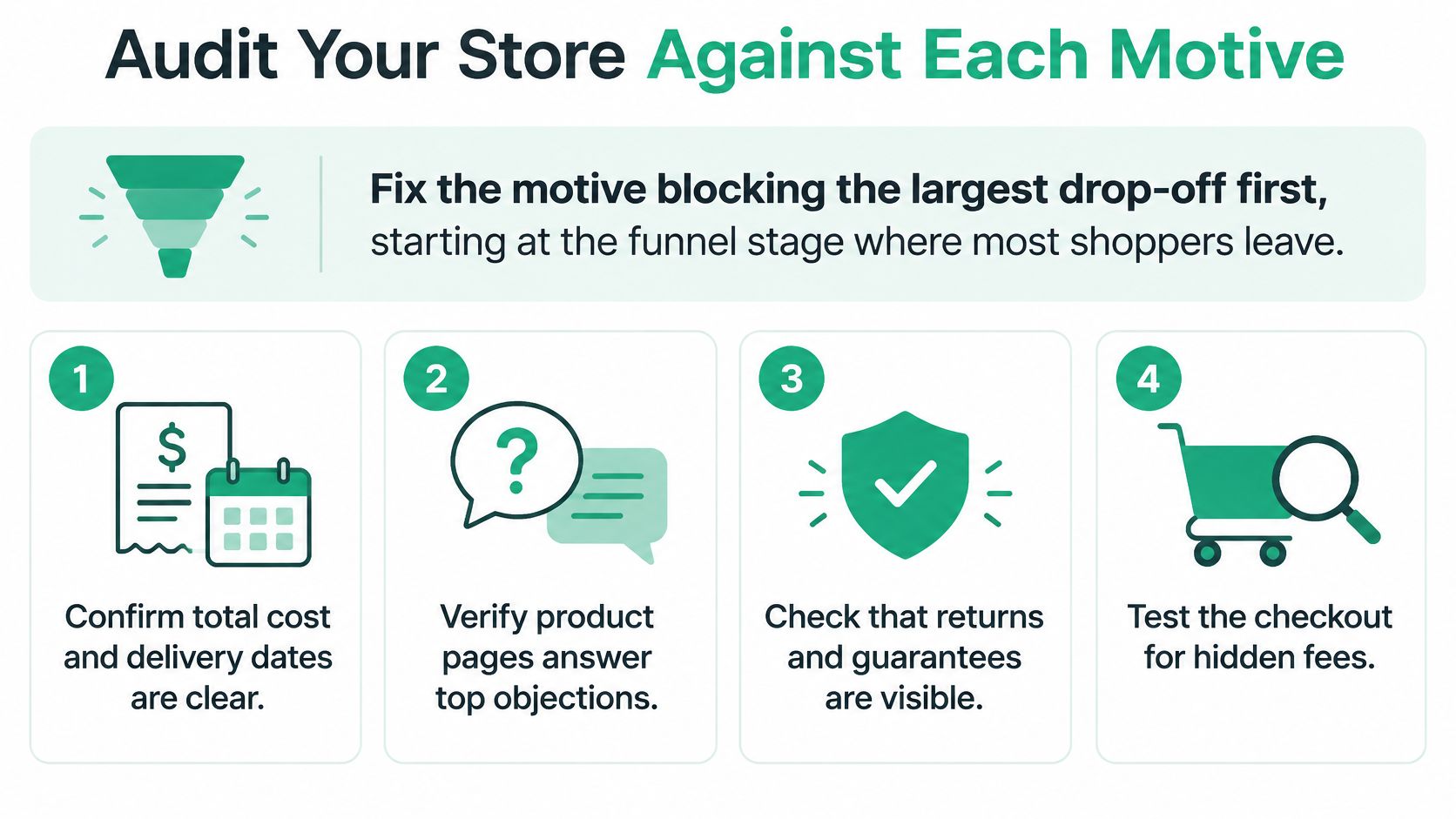
Treat each check as a trade-off. Name the buyer question, the signal that the sale has stalled, and the funnel stage where it stops. Then change one thing at a time.
- Total cost and delivery date before payment. The buyer asks what the order will really cost and when it arrives. The block is a shipping line that appears only at the last step. Metric: cart-to-checkout rate. Trade-off: showing shipping earlier can trim average order value while lifting completion.
- Returns and cancellation policy findable in two clicks. The buyer asks what happens if the item is wrong. The block is a policy buried past the point of payment. Metric: return rate and policy-related support tickets. Trade-off: a generous window costs margin on serial returners.
- Checkout length and payment coverage. The buyer asks whether paying will be quick on this device. The block is a long form or a missing payment method. Metric: checkout completion, split by device. Trade-off: fewer fields can mean less data for later personalisation.
- Recommendations that match context. The buyer asks whether this add-on belongs with what is already chosen. The block is a generic offer beside a specific cart. Metric: attachment rate and post-purchase refund rate. Trade-off: more offers per page can dilute the ones that work.
- Specific quality and sustainability claims. The buyer asks whether the claim is concrete enough to trust. The block is vague language on the product page, which shows up later as weak repeat buying. Metric: repeat purchase rate. Trade-off: stronger claims invite more scrutiny and more returns if you cannot meet them.
- Self-service changes within clear rules. The buyer asks whether a size, address, or quantity can be fixed without a ticket. The block is an edit path that is missing or stays open so long that fulfilment cannot plan. Metric: order-edit completion and support ticket volume. Trade-off: long edit windows complicate fulfilment.
Relevance starts before the product page. If your offers depend on local demand, this guide to reaching nearby buyers explains how audience and geography shape which message a shopper should see first.
If post-purchase offers or order editing run through ServeApps, hold them to the same standard. Grooby Shop recorded $55,171 in total additional revenue from post-purchase upsells, and a figure like that only means something next to a baseline for the same period, traffic, and product mix. Run the relevance and control tests as two-week experiments, one change at a time, and do not treat a revenue result as proven before you have measured one.
ServeApps builds the Shopify tools that sit at the two stages this audit keeps pointing to: a cart drawer with free-shipping and spend-tier goals, contextual upsells that fire where the shopper is already deciding, and self-service order editing inside rules the merchant sets so customers can fix a size, address, or quantity without opening a ticket. If the drop-off analysis lands on cost certainty and post-purchase control, those are the two places worth testing first. Visit ServeApps to see how the apps fit the way your store already sells.
What Is Upsell? Examples and How Shopify Stores Use It
What is upsell? Learn the definition, how it differs from cross-selling, and how Shopify stores use upsells to raise order value.
Read more →
Increase Conversion Rate on Website: 9 Proven Cart Tactics
Increase conversion rate on website with cart, upsell, and testing tactics. See what lifts AOV, cuts abandonment, and how to apply each one today.
Read more →
8 Self Service Store Examples: Benefits and Tactics
Explore 8 self service store examples, from cashierless checkout to post-purchase portals, with benefits, trade-offs, and tactics you can copy.
Read more →