
System reliability is the probability that your ecommerce platform performs its intended functions without failure over time. At 99.9% availability, a service still allows nearly 9 hours of downtime per year.
That sounds like a strong uptime promise until you map it onto a checkout, an order edit, or a return request. A store can have healthy servers while customers are unable to pay, update a shipping address, receive an order confirmation, or see an accurate order status. For a high-volume merchant, reliability isn't a server statistic alone. It's the dependable completion of the customer journeys that create and protect revenue.
Why System Reliability Matters for Ecommerce Revenue
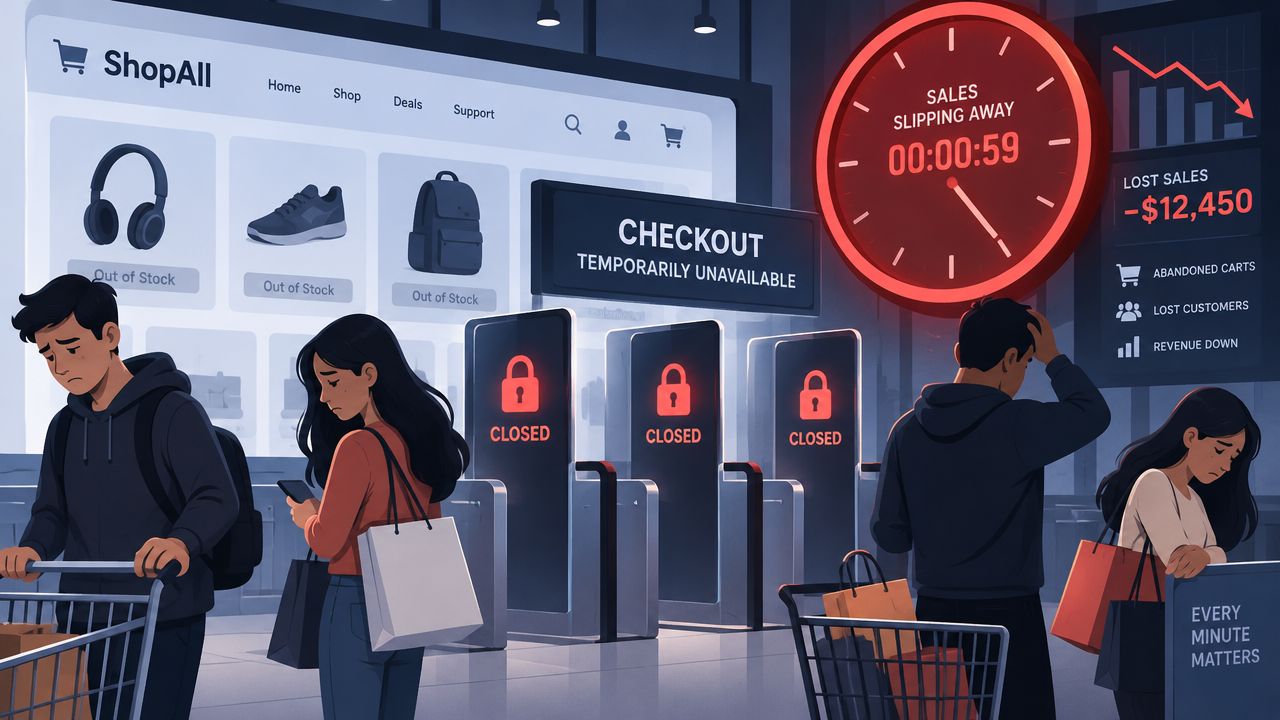
A flash sale is running. Traffic is arriving, inventory is available, and the storefront loads quickly. Then a checkout integration begins timing out. Customers reach the payment step, retry, and see inconsistent results. Some orders are created without a successful confirmation, while others never complete at all. The merchant's dashboards may show acceptable infrastructure health, but shoppers experience a closed digital store.
That distinction defines system reliability in practical terms. Reliability is the probability that a system performs its intended function without failure over a stated interval. Availability is related, but it also reflects how quickly a service can be restored after a failure. Maintainability focuses on how readily teams can diagnose, repair, and return the system to service. The three concepts belong together, but customers encounter them as one question: can I complete what I came here to do?
Checkout is only the first visible failure point. Post-purchase systems carry the next set of promises:
- Order confirmation: The customer should receive accurate confirmation after payment.
- Order editing: The shopper should be able to change permitted details before fulfillment closes the window.
- Address handling: Validation should prevent an avoidable delivery error without blocking every order when a provider is unavailable.
- Returns and cancellations: Requests should enter a controlled workflow rather than disappear into email threads.
- Order status: Customers and support agents should see consistent information across the storefront, fulfillment system, and carrier experience.
A useful performance measurement framework should therefore track completed journeys, failed actions, latency, and recovery, not just infrastructure status. Reliability affects revenue directly because every broken step can create abandonment, duplicate support work, manual corrections, and reduced confidence in the brand.
Operational rule: Measure the customer action first, then investigate the component that made it fail.
A reliable ecommerce stack doesn't promise that nothing will ever break. It limits the blast radius, detects customer impact quickly, preserves data, and gives operators a safe path to recovery.
Understanding Key System Reliability Metrics
Reliability becomes manageable when teams translate broad promises into measurable operating language. Availability describes the proportion of time a service is usable, while MTBF, or Mean Time Between Failures, indicates how often failures occur. MTTR, or Mean Time to Repair, describes how quickly the team restores service after a failure.
Availability is especially useful because percentages can hide operational consequences. An IT service at 99.9% availability can experience about 8.76 hours of downtime per year, while 99.99% availability reduces expected downtime to about 52.6 minutes. The 99.999% “five nines” benchmark reduces expected downtime to roughly 5.26 minutes annually, and the move from 99.9% to 99.99% represents nearly a tenfold reduction in downtime, as explained in this availability benchmark analysis.
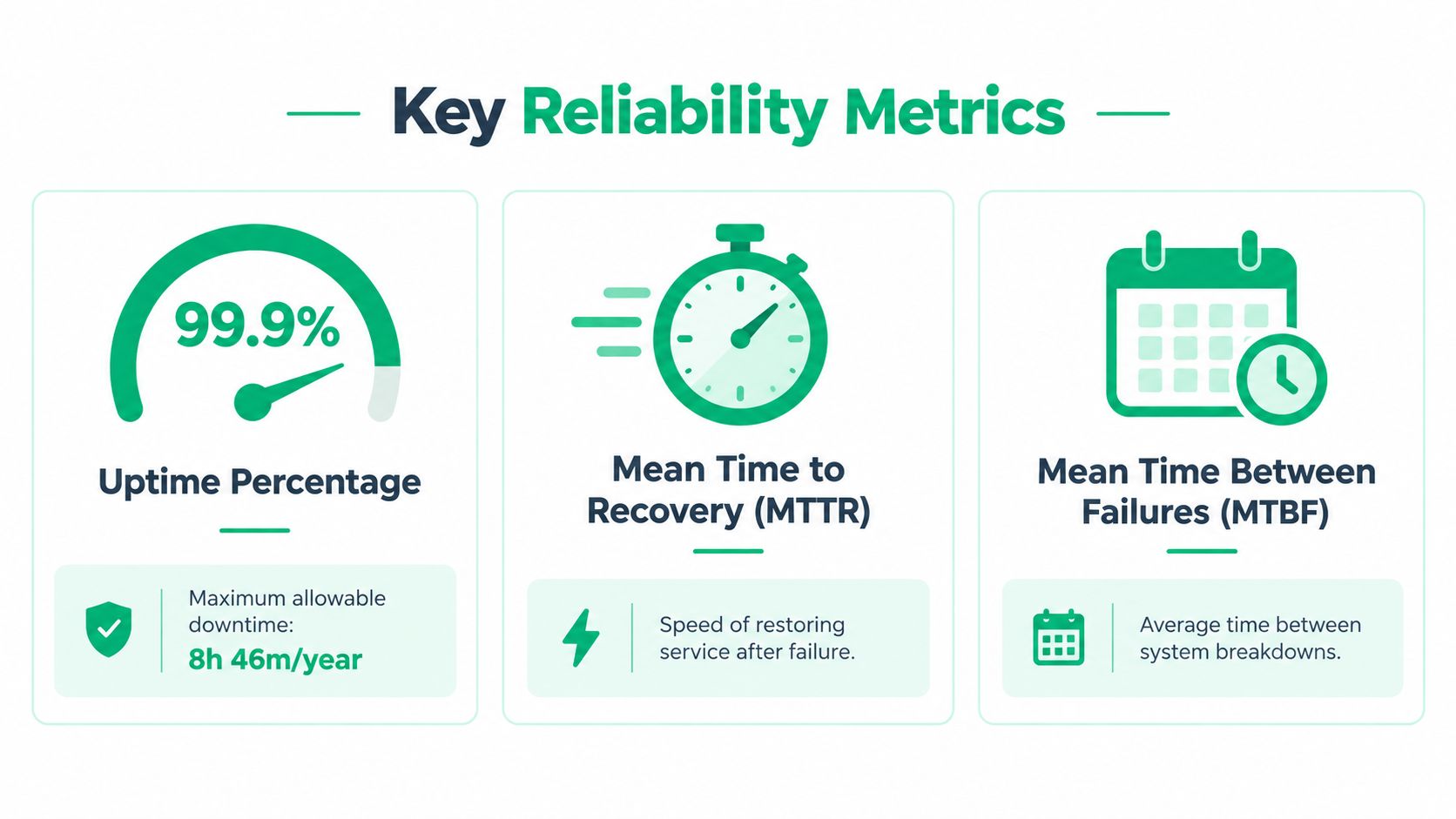
| Availability target | Expected annual downtime |
|---|---|
| 99.9% | About 8.76 hours |
| 99.99% | About 52.6 minutes |
| 99.999% | Roughly 5.26 minutes |
The table is a planning aid, not a complete reliability model. A merchant also needs to know whether downtime is concentrated during checkout, whether failed requests create duplicate orders, and whether recovery restores the full workflow or only the visible page.
MTBF and MTTR answer different questions
A high MTBF can indicate that failures are infrequent, but it doesn't tell you whether a single incident lasts seconds or hours. A low MTTR can show strong recovery discipline, but frequent incidents may still create a poor customer experience. Track both, then add journey-level indicators such as successful payment completion, valid order edits, and accurate status updates.
An SLO, or Service Level Objective, is an internal target for a defined service or journey. An SLA, or Service Level Agreement, is a formal commitment made to a customer or partner. An SLO might govern checkout completion or order-status accuracy, while an SLA may define support obligations, remedies, or service credits.
Use application performance monitoring guidance to connect these measures to actual user behavior. A dashboard that reports healthy servers while address validation blocks every order is measuring the wrong surface.
Common Failure Modes in Ecommerce and Post-Purchase Systems
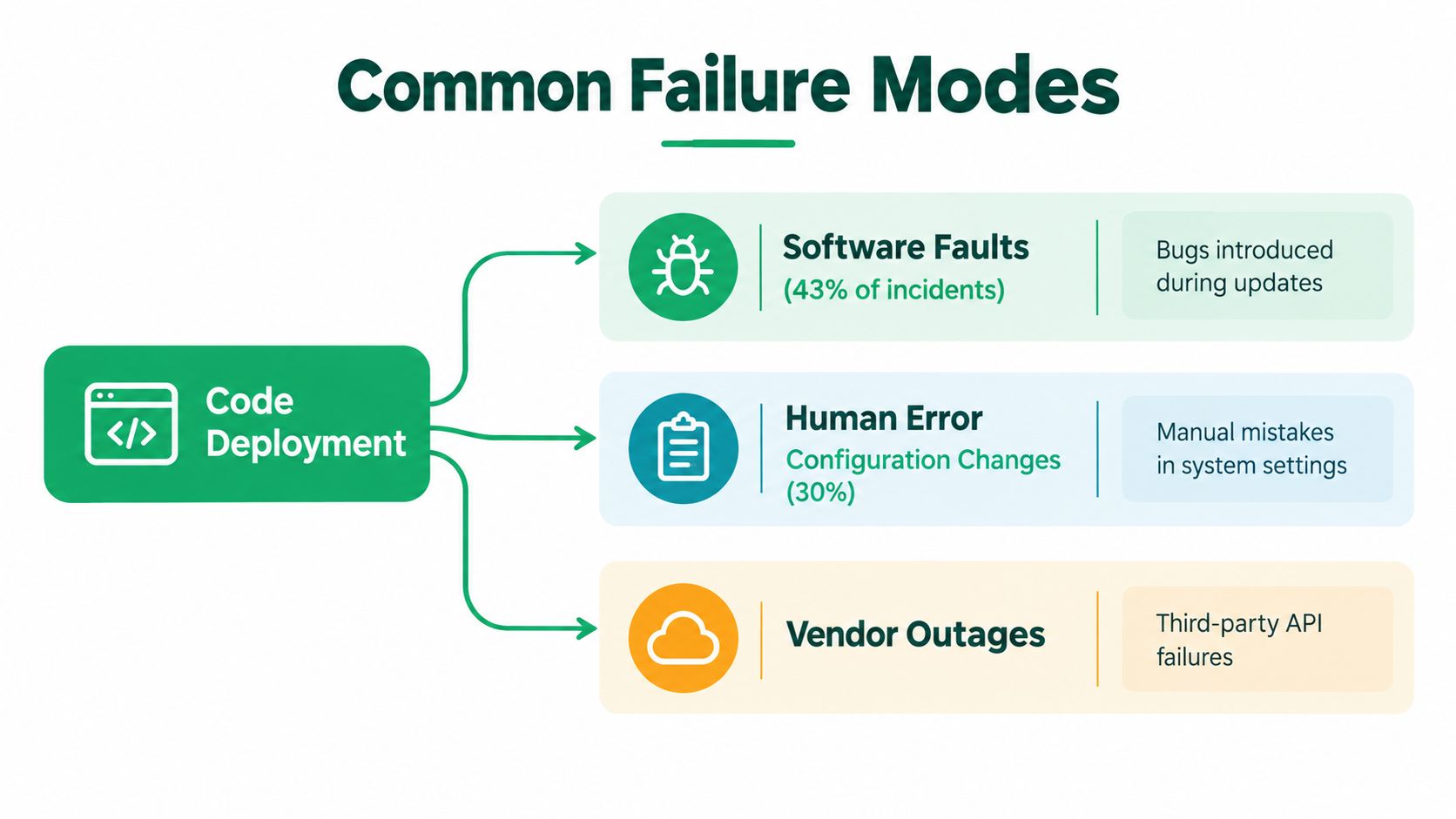
Hardware deterioration is an easy explanation for an outage because it sounds tangible. Modern ecommerce failures often emerge elsewhere, through software defects, configuration changes, upgrades, patches, permissions, and dependencies that operators modify while the platform is evolving.
Reliability engineering has long used the bathtub curve to describe this lifecycle. Introduced in 1953, the model represents high early-life failure rates, a useful-life period with relatively low and stable failure rates, and a later wear-out phase. The framework matters because a newly deployed integration and an aging component fail for different reasons, so the response shouldn't be identical. The system reliability, availability, and maintainability reference explains how these ideas connect to maintenance and replacement planning.
Change is a high-risk control surface
Uptime Institute's 2023 outage analysis reports that more than a third of operators experienced a major outage caused by a system or software problem. The analysis links many incidents to configuration changes, upgrades, patches, and related changes that introduce instability, as documented in its Annual Outage Analysis.
The broader evidence points in the same direction. Software faults account for approximately 40% of outages in well-managed commercial systems, while system administration contributed 42% of failures in a fault-tolerant environment and software faults contributed 25%, according to the cited reliability survey. Those figures don't mean every store has the same incident profile. They do show why adding hardware redundancy without improving operational controls leaves a major source of risk untouched.
In a Shopify stack, a small change can affect a large customer journey:
- Payment gateway updates: New behavior can produce timeouts, duplicate attempts, or mismatched order states.
- Address validation changes: A provider response format or availability issue can block shipping details.
- Order management updates: A changed field or webhook assumption can stop edits from reaching fulfillment.
- Third-party app releases: A version change can alter permissions, theme behavior, or downstream events.
- Manual configuration: An incorrect edit window or product rule can expose changes that operations intended to restrict.
The practical response is disciplined change management. Stage releases, validate dependencies, preserve rollback paths, and monitor the customer-facing flow after every material change. Treat configuration as production code, because customers experience its consequences in exactly the same way.
Best Practices for Designing Reliable Ecommerce Systems
Reliable systems don't depend on one impressive component. They combine observability, controlled change, graceful failure, and practiced recovery so that a problem in one dependency doesn't become a store-wide customer failure.
Monitor the journey, not just the machine
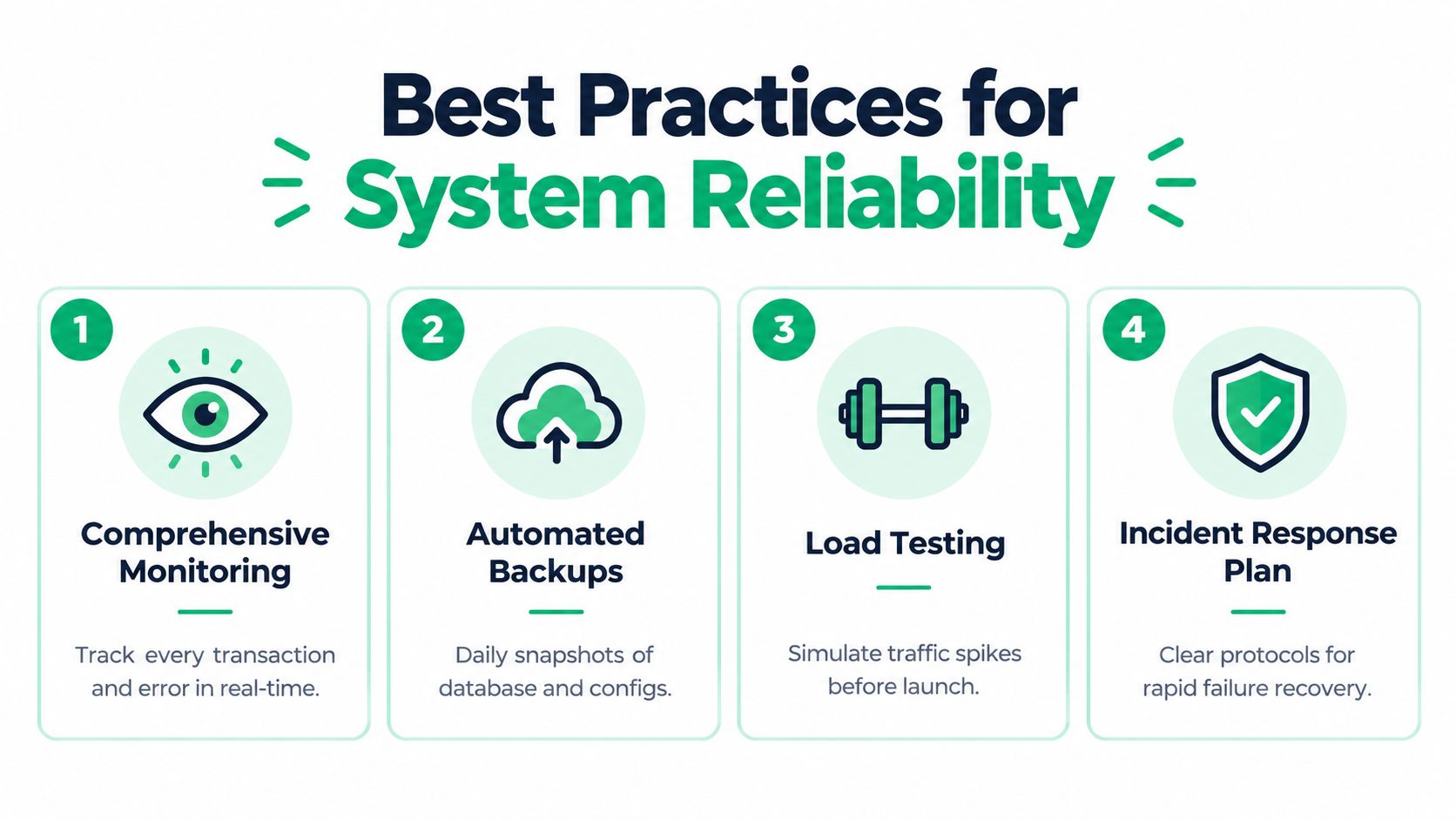
Start with synthetic and real transaction monitoring for checkout, payment authorization, order editing, address validation, cancellation, and order status. Record whether the action completed, how long it took, and what the customer saw. A CPU chart can't tell you that a shopper's order edit was accepted by the widget but never persisted in the order system.
Use a dependency map to connect each journey to the services it needs. When an address provider slows down, the team should know which customer action is affected and which fallback behavior applies. Alert on failed outcomes and unusual latency, not every harmless change in infrastructure utilization.
Build safe alternatives
Redundancy can mean a backup provider, a second service instance, a durable queue, or a controlled manual path. The right design depends on the workflow. If address validation is unavailable, you might allow the customer to continue with a warning and route the order for review, rather than rejecting every transaction. If an order-edit request can't reach fulfillment immediately, store it durably and prevent the customer from submitting conflicting changes.
Graceful degradation must protect data integrity. A fallback that keeps the page open but creates an incorrect order is not reliable. Define which actions can proceed, which must pause, and how operators reconcile them.
Test the failure path before launch
Load tests help reveal capacity problems, but reliability testing also needs dependency failures, delayed responses, malformed payloads, expired permissions, and interrupted webhooks. Validate integrations in staging before changing live settings. Test rollback procedures with the people who will use them during an incident, not only with the engineers who wrote them.
Failure test: Ask, “What does the customer see if this provider stops responding halfway through the action?”
Every important integration should have an answer that preserves a clear state. A queued request, an explicit retry message, or a support review can be safer than an ambiguous success screen.
Make response repeatable
An incident playbook should identify the owner, escalation route, rollback decision, customer communication path, and reconciliation steps. Include examples for payment latency, address-provider failure, order-edit conflicts, and fulfillment cutoffs. After recovery, compare system logs with customer-visible outcomes so the team can identify orders that need correction.
Setting Meaningful SLAs and SLOs for Post-Purchase Workflows
An SLA and an SLO serve different audiences. An SLA is a formal promise to a customer or partner, often with defined remedies. An SLO is an internal operating target that helps a team decide how reliable a particular service or journey needs to be.
A blanket uptime target can hide the priorities that matter most. 100% uptime is impossible, and even 99.99% availability still permits measurable downtime, as the availability figures above demonstrate. The more useful question is whether the checkout, order-status, and post-purchase actions customers rely on remain usable when a supporting component is degraded.
Recent guidance recommends tying SLOs to user-critical journeys and revenue or brand impact, rather than relying only on server health. The journey-focused reliability guidance makes the practical case for treating checkout availability as a more meaningful objective than an isolated infrastructure metric.
Rank workflows by customer consequence
Begin with the action that directly creates the order. Then evaluate workflows that protect delivery, reduce support friction, and preserve customer confidence. A temporary delay in a low-priority internal report isn't equivalent to an inability to pay or correct a shipping address before fulfillment.
| Workflow | Reliability priority | Useful SLO focus |
|---|---|---|
| Checkout and payment | Highest | Successful completion and accurate order state |
| Address editing | High | Valid updates before fulfillment cutoff |
| Order cancellation | High | Clear approval, execution, and confirmation |
| Order status | High | Accurate, timely customer-visible state |
| Internal reporting | Context-dependent | Data freshness and recoverability |
These aren't universal contractual targets. They're a prioritization model. Your team should set the actual objective after reviewing revenue exposure, customer harm, operational recovery effort, and dependency concentration.
Keep the SLA narrower than the operating model
A vendor may offer an availability commitment for its application, but that commitment won't automatically cover Shopify, payment providers, carriers, theme behavior, or your own configuration. Ask what the SLA measures, what exclusions apply, how incidents are reported, and what happens when a dependency fails.
Internally, define an error budget for each critical journey. When failures consume too much of that budget, pause discretionary releases and focus engineering effort on reliability. This creates a practical tradeoff between shipping changes and protecting the customer experience, without pretending that every workflow deserves identical investment.
How Shopify Merchants Can Evaluate System Reliability in Integrations
A Shopify app becomes part of your reliability boundary the moment it can change an order, influence checkout behavior, validate an address, or trigger fulfillment work. Evaluate it as an operational dependency, not as a feature list.
Start with four questions:
- Availability: Does the vendor publish service status and define what its uptime commitment covers?
- Recovery: What happens when Shopify, a payment service, an address provider, or the app itself becomes unavailable?
- Data integrity: Are requests recorded durably, retried safely, and protected against duplicate processing?
- Change control: How does the vendor test releases and maintain compatibility with Shopify platform updates?
A useful system integration benefits guide should be read alongside your own dependency map. The point isn't to choose the app with the longest feature list. It's to identify whether the integration reduces manual intervention or adds another opaque failure path.
Test the vendor's operating model
Ask for a status dashboard, incident history, escalation process, and recovery documentation. Confirm whether the vendor offers SLA credits, how it communicates an incident, and whether support can identify affected orders. Ask how it handles provider outages, webhook delays, partial updates, and permissions that expire or change.
For post-purchase workflows, inspect the boundaries closely. Can customers edit only the fields and windows you define? Does fulfillment status close or reroute edits? Does an address validation failure produce a clear next step? Can cancellation requests enter an approval queue instead of being rejected or applied without review?
SelfServe is one example of a Shopify post-purchase application that provides customer order editing within merchant-defined permissions and windows, multilingual widget behavior, Google Maps-powered address validation, cancellation approval queues, order tagging, and post-purchase upsell modules. Those capabilities still need staging tests, monitoring, and a documented fallback path before they become part of a production reliability strategy.
Use a simple scorecard when comparing integrations:
| Evaluation area | Evidence to request |
|---|---|
| Service health | Status page, incident notices, support escalation |
| Recovery behavior | Retry, queue, fallback, and reconciliation procedures |
| Data protection | Durable records, duplicate safeguards, audit history |
| Merchant control | Permissions, edit windows, fulfillment rules |
| Release discipline | Compatibility testing and rollback communication |
A vendor that answers these questions clearly gives your operations team something more valuable than a feature promise. It gives them a basis for managing risk.
Building a Reliability-First Post-Purchase Strategy
Reliability belongs in the commercial plan because it shapes what customers can do after payment, how much work support agents must perform, and whether operations can correct problems before they become refunds or failed deliveries. A dependable post-purchase experience can distinguish a merchant even when competitors offer similar products and storefront speed.
The strategy starts with a change in perspective. Don't ask only whether the app is online. Ask whether the customer can complete the intended action, whether the order remains accurate, and whether your team can recover without reconstructing events from scattered logs.
Put the operating model into practice
A practical roadmap is straightforward:
- Audit dependencies: Map checkout, payment, editing, address validation, cancellation, fulfillment, and status workflows.
- Set journey SLOs: Choose the three workflows with the greatest revenue or customer impact and define what successful completion means.
- Control changes: Use staged releases, pre-production validation, dependency checks, and rollback-ready procedures for code and configuration.
- Review integrations: Request evidence about recovery, data integrity, incident transparency, and Shopify compatibility.
- Run reliability reviews: Revisit incidents, near misses, customer complaints, and manual corrections with operations, support, and engineering together.
Don't optimize for a perfect dashboard while customers still encounter ambiguous states. A reliable system tells the shopper what happened, preserves the request, and gives the team a clear next action.
High-volume ecommerce brands can't treat post-purchase reliability as background infrastructure. It supports customer trust, protects operational capacity, and keeps revenue-producing journeys available when dependencies behave imperfectly. The strongest reliability programs make failure visible, recovery routine, and customer impact the measure that guides investment.
SelfServe gives Shopify merchants controlled post-purchase order editing, address validation, cancellation workflows, and upsell options that can be evaluated as part of a broader reliability strategy. Review your critical journeys, test the configuration in staging, and visit SelfServe to see whether it fits your store's operational requirements.

Order Confirmation Screen: What to Include and Templates
Learn what to include on an order confirmation screen, in what order, with tracking, cross-sell and support templates you can copy for your Shopify store.
Read more →
Best Up Sell App Picks for Shopify in 2026
Compare 10 Shopify up sell app options for 2026, with features, pricing, placements, and honest limitations to help you choose the right fit.
Read more →
Best Checkout Page: 7 Examples That Convert in 2026
Discover 7 best checkout page tools and examples for Shopify with pros, cons, and conversion tips to boost AOV without rebuilding checkout.
Read more →