
A customer says they sent a return. Your support team searches the order, finds a tracking number but no intake record, and asks the customer for proof. Before anyone can resolve the ticket, a chargeback arrives. The merchant now has shipment evidence, the customer has a claim, and neither side has a document that clearly connects the returned item to the refund decision.
That's where return receipt for merchandise becomes confusing. The phrase can refer to a discontinued USPS mailing service, or to the ordinary retail receipt that records a merchandise return. Those documents answer different questions. One was designed to evidence delivery. The other proves that a store accepted a return and processed, denied, or promised a refund.
A reliable workflow separates those meanings, captures the right fields at intake, and stores the evidence against the original order. That same discipline applies to proof-of-service workflows, where operational discipline with OnRoute helps clarify who performed an action, when it happened, and what evidence supports it. Shopify merchants can also review how refunds are handled on Shopify before connecting receipt creation to their own return and refund rules.
Why Return Receipts Decide Refund Disputes
A support agent receives a familiar message: “I returned the jacket two weeks ago. Why haven't I been refunded?” The order shows a return label, but the warehouse never recorded the parcel. There's no item-level inspection, no condition note, and no receipt showing whether the refund was approved. The customer believes shipment tracking should be enough. The merchant believes delivery to a carrier isn't the same as verified intake.
Both statements can be true, but neither resolves the dispute by itself.
A retail return receipt should answer four operational questions:
- What sale does this return belong to? The document should connect the return to an order, invoice, or transaction.
- What did the merchant receive? It should identify the product, quantity, and condition at intake.
- What decision did the merchant make? It should show whether the return was accepted, rejected, partially accepted, or placed under review.
- What happened to the money? It should record the refund amount, method, and status.
The USPS service with the similar name answered a different question. It was built around proof that a mailed item reached a recipient and that the recipient signed for it. That distinction matters in delivery disputes and mailing claims, but it doesn't replace a store's proof-of-purchase or warehouse intake record.
The document has to match the dispute
If a customer says, “I mailed the product,” a carrier tracking record may show movement or delivery. If the customer says, “Your warehouse received the product in good condition,” the merchant needs an intake record. If the merchant says, “We already refunded the order,” the relevant evidence is a retail receipt, payment record, and refund transaction.
These are separate events. Combining them into one vague “receipt” creates gaps that agents have to fill manually.
Practical rule: A receipt should prove one defined event. Label it clearly as proof of shipment, proof of delivery, proof of intake, or proof of refund.
The strongest workflows generate the retail receipt at the moment staff or a warehouse system verifies the returned merchandise. An email sent several days later may confirm a decision, but it doesn't recreate the condition, quantity, or identity of the items that arrived.
That timing also reduces support back-and-forth. An agent can search by order number, open the receipt, see the intake result, and explain the refund status without relying on a customer's memory or a disconnected carrier page.
USPS Service vs Retail Return Receipts
The old USPS Return Receipt for Merchandise service was a postal evidentiary service, not a store return document. USPS described it as providing the sender with both a mailing receipt and a postcard-style return receipt showing the recipient's signature. It could also identify the recipient's actual delivery address when that address differed from the one the sender used, as described in the USPS service documentation for return receipts.
That made the service useful for a narrow problem: proving that a particular mailed item reached a recipient. A merchant sending valuable merchandise might use it as supporting evidence in a delivery dispute, claim, or chargeback response. It didn't record whether the recipient later returned the product, whether the product was resalable, or whether a refund was issued.
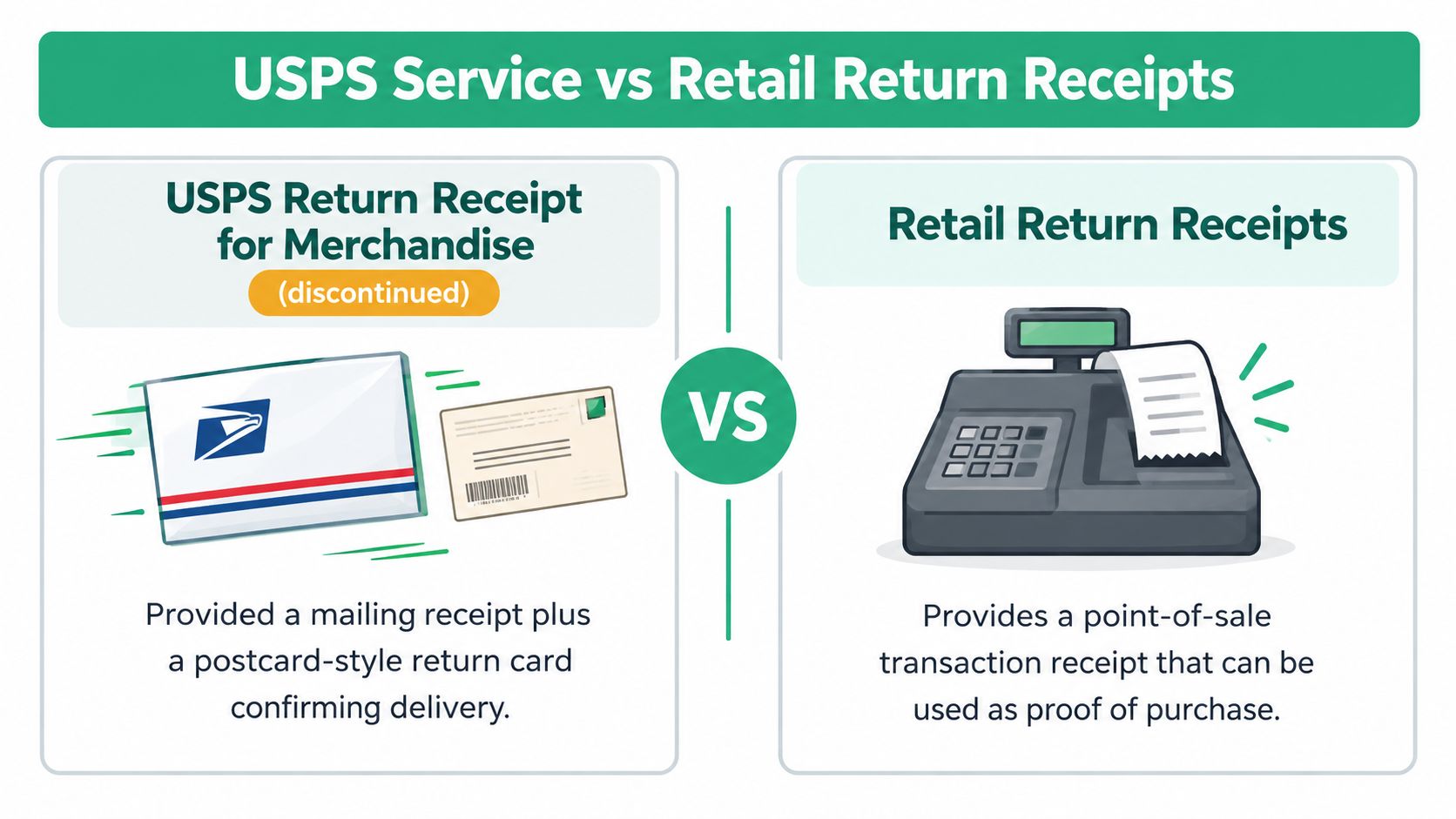
A standard retail return receipt belongs to the sales and returns system. It normally records the original transaction, returned merchandise, accepted quantities, refund decision, and payment method. It answers, “What did the merchant accept and what financial action followed?”
| Document | Primary question | Useful evidence | What it doesn't prove |
|---|---|---|---|
| USPS Return Receipt for Merchandise | Did the mailed item reach the recipient and receive a signature? | Mailing receipt, delivery record, recipient signature | Product condition, warehouse intake, refund approval |
| Retail return receipt | Did the merchant accept a particular return and record a financial outcome? | Order match, SKU, quantity, condition, refund status | Carrier delivery by itself |
| Shipment tracking | Where did the parcel travel? | Scans, delivery status, carrier reference | That the correct item was inside or passed inspection |
| Original sales receipt | What did the customer buy? | Transaction, items, purchase amount | That the customer later returned those items |
USPS formally removed Return Receipt for Merchandise from its systems, software, manuals, and forms effective July 1, 2020. USPS announced the elimination on June 22, 2020, after the Postal Regulatory Commission approved the change on January 16, 2020, in Order Number 5408, according to the USPS announcement about the service's elimination.
Merchants shouldn't use the discontinued service name as shorthand for every receipt involved in a return. A business that only needs parcel visibility may find ordinary tracking sufficient. A business that needs proof of purchase needs its point-of-sale or ecommerce transaction record. A business handling a delivery dispute needs delivery evidence. The practical comparison is similar to the distinction between USPS and FedEx shipping workflows, where the right evidence depends on the event being investigated.
What Every Merchandise Return Receipt Must Include
A receipt that holds up in a dispute needs more than “return accepted.” It should let a person who wasn't present at intake reconstruct the transaction without guessing. Use the original order as the anchor, then attach item, condition, decision, and staff data to it.
Start with identity and item matching
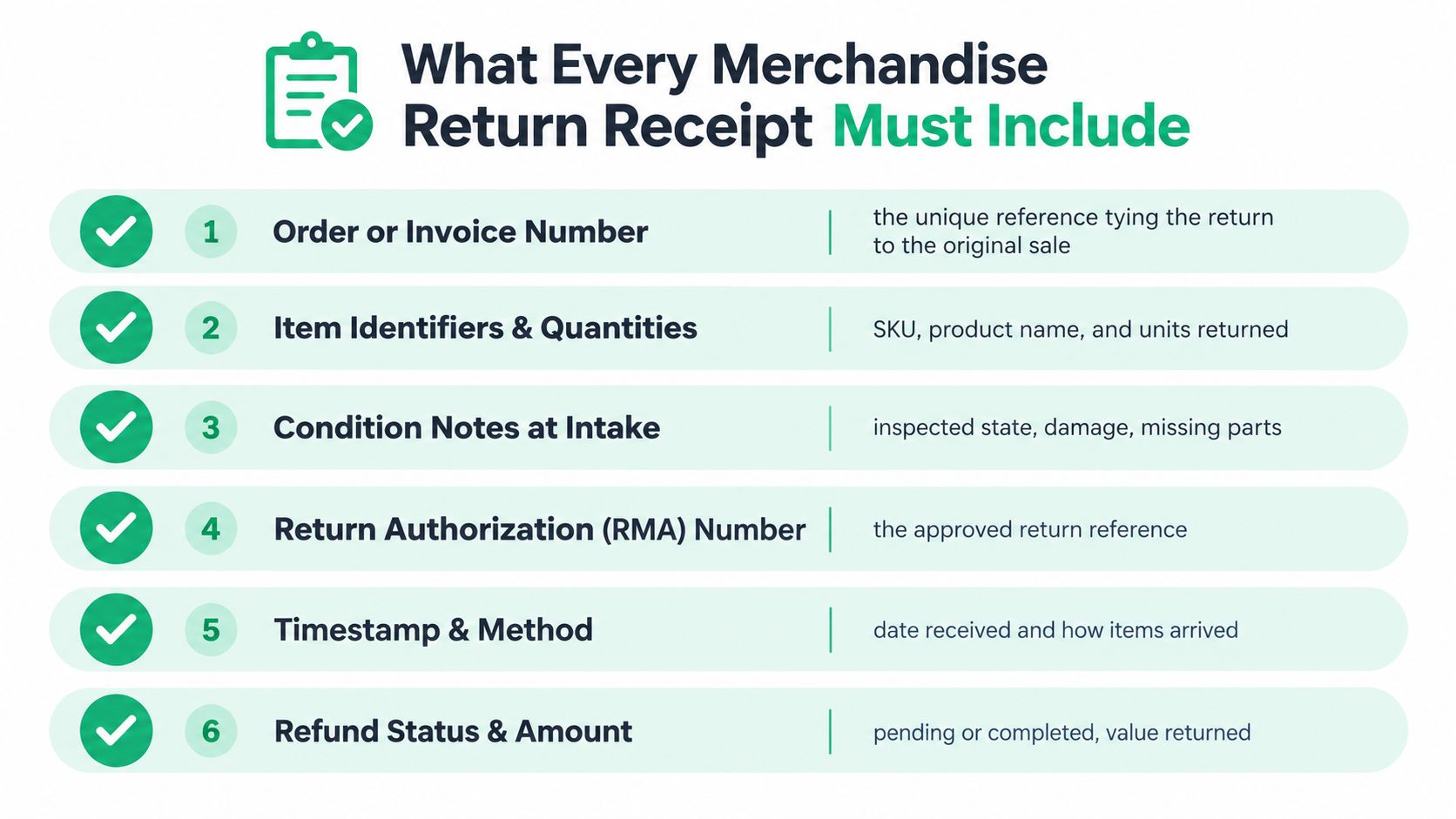
Order or invoice number connects the return to the original sale. Add the customer name or account identifier, but don't rely on a name alone. Names can be misspelled, shared across accounts, or absent from a guest checkout.
Item identifiers and quantities should include the SKU, product name, variant, and units received. For serialized, high-value, or regulated products, include the serial number or another unique identifier. If a customer sends three units and the warehouse finds two, the receipt should show that difference rather than accepting the order line without noting it.
The RMA number gives the approved return its own reference. It lets staff match an arriving parcel to the authorization even when the carrier label is damaged or the parcel contains multiple products. The return label workflow should pass this reference into the warehouse or returns platform wherever possible.
Record what staff actually saw
Condition notes protect both sides. “Received” isn't an inspection result. Use controlled values such as unopened, resalable, used, damaged, incomplete, or unable to inspect, then add a short free-text note for unusual details.
A note like “one sleeve missing from box” can prevent a later argument about whether the merchant caused the shortage. A note like “visible wear on sole at intake” gives the refund reviewer a factual basis for a deduction or rejection under the published policy. Photographs can supplement the receipt, but the receipt should point to the images or inspection record instead of leaving them in a warehouse chat.
Finish with decision and accountability fields
Capture the return reason code exactly once per line item, not as a single order-wide label when several products have different reasons. Codes such as wrong size, damaged on arrival, changed mind, or product mismatch support operational analysis without forcing agents to interpret inconsistent notes.
The receipt should also show:
- Return date and location, including the warehouse, store, or intake station.
- Staff member or system identity, so a reviewer knows who performed the verification.
- Refund amount and method, such as original payment method, store credit, exchange, or pending review.
- Refund status, including the time the decision was recorded.
- Customer acknowledgment, where a signature or digital confirmation is appropriate.
The document doesn't need to be visually elaborate. It needs immutable, searchable fields that line up with the order, the item, and the financial record.
How to Create and Issue a Return Receipt
The workflow starts before the parcel arrives. A customer requests a return, the merchant checks eligibility, and the system creates an RMA or return authorization. The customer receives the approved instructions and, where applicable, a trackable return label. That reference should follow the parcel into intake rather than being recreated by warehouse staff.
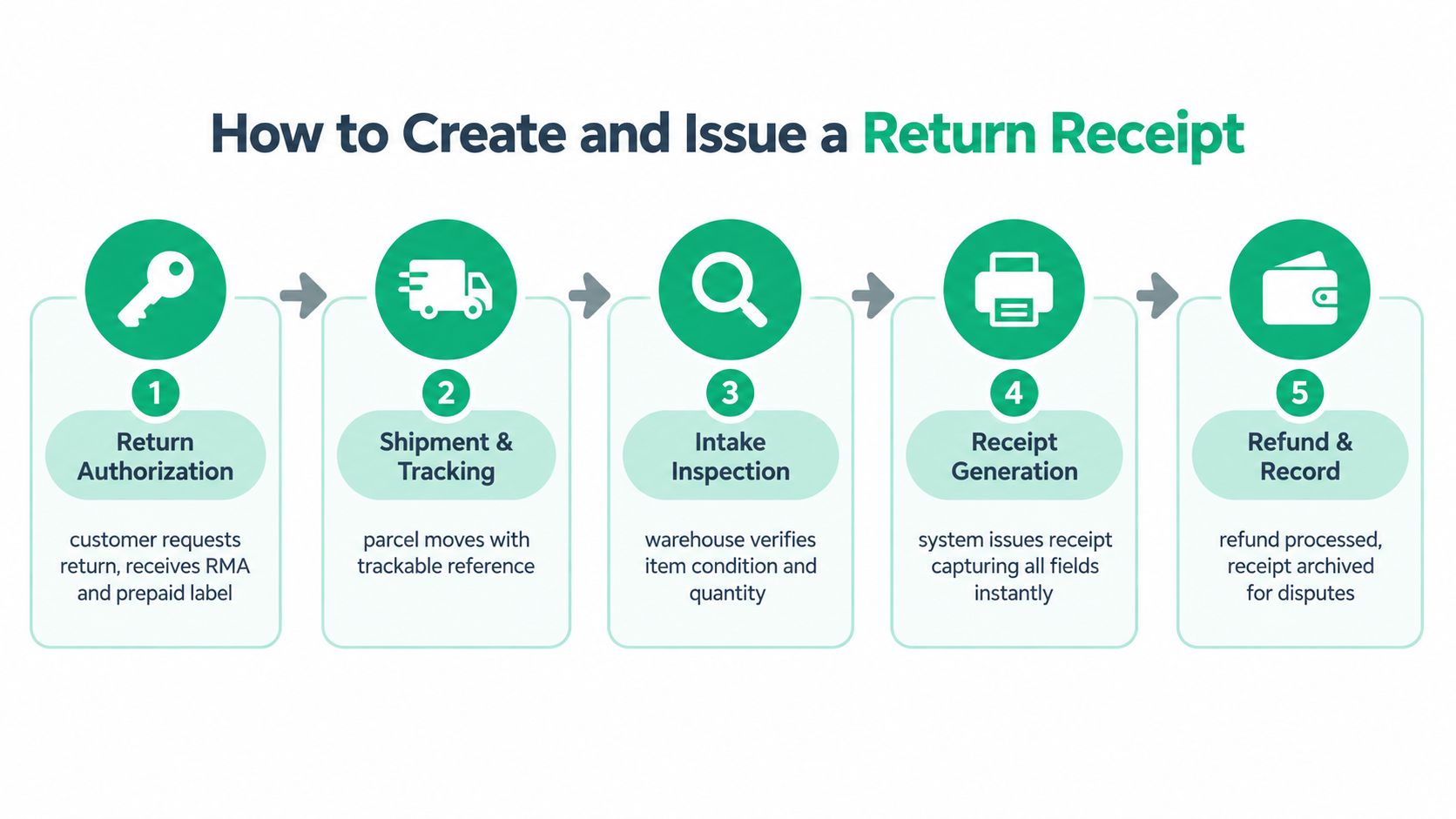
At intake, staff scan the RMA, order number, or parcel reference and compare the contents with the authorized return. They verify the product identifiers and quantity, then inspect condition against the policy. The system should keep the original customer request visible, but staff must record what physically arrived.
Consider a mid-size apparel store receiving a parcel with two shirts and a pair of trousers. The return authorization lists all three items. Intake confirms both shirts, finds the trousers, and records that one shirt has its tags attached while the other has visible wear. The receipt should show all three line items, the received condition for each, the reason code supplied by the customer, and any difference between the requested and approved outcome.
Generate the receipt at the decision point
Receipt generation should happen immediately after verification. The system creates a unique document tied to the order and RMA, adds the inspector or system identity, records the timestamp, and sends the customer a digital copy. Internally, it archives the same record so an agent doesn't have to search an inbox for the version sent to the customer.
This is better than sending a generic confirmation after a refund clears. A post-refund email can confirm money movement, but it can't reliably document what arrived at the warehouse or why one line was accepted and another was held.
Make the refund depend on the record
The receipt and refund should be related, but they don't have to happen at the same instant. For an accepted return, receipt generation can trigger the approved refund action. For a damaged, incomplete, or uncertain return, the receipt can record “manual review” and prevent an automatic refund until a reviewer decides.
That separation prevents a common failure: the payment system refunds the full order before anyone notices that an item is missing. It also gives support a defensible explanation when only part of a multi-item return qualifies.
The customer-facing document should be plain enough to understand. The internal record can carry additional inspection details, images, permissions, and review notes. Both records should preserve the same order, RMA, item, and outcome references.
Wiring Return Receipts Into Your Shopify Returns Workflow
Shopify merchants should treat the receipt as an output of verified intake, not as a manually composed customer-service email. The store's returns process needs a reliable path from the original order to the RMA, carrier reference, inspection result, refund status, and searchable receipt.
Order-editing and post-purchase apps can preserve the order context while customers request changes or returns. Automated order tags can route return orders to the correct warehouse queue, product team, or approval path. Cancellation queues with permission controls can stop refunds from firing before staff record the evidence required by the policy.
The fraud-control case for receipt verification is practical. In 2023, only 22.1% of retail returns were accepted without a receipt, down by roughly half from the prior year, and 17% of non-receipted returns were estimated to be fraudulent, according to the 2023 consumer returns research. Those figures support a two-stage policy, require receipt or verification data at intake, then route exceptions into constrained rules or manual review.
| Return type | Fraud risk signal | Recommended handling | Refund rule |
|---|---|---|---|
| Receipted return matched to order | Order, item, and purchase evidence align | Inspect, issue receipt, archive record | Refund according to condition and policy |
| No-receipt return with customer verification | Sale may be recoverable through account, payment, or order lookup | Require manual review and document the evidence | Limit to an approved method, such as store credit, where policy allows |
| No receipt and no reliable verification | No dependable link to a completed sale | Hold, reject, or escalate according to policy | Don't issue an automatic refund |
| Quantity or SKU mismatch | The parcel doesn't match the authorization | Create an exception receipt and investigate | Refund only accepted lines or approved amount |
| Condition dispute | Product state conflicts with the stated return reason | Preserve intake notes and supporting images | Route to an authorized reviewer |
In Shopify, the exact implementation depends on the apps and permissions in use. A sound configuration gives warehouse staff permission to create or update intake records, limits refund permissions to approved roles, and uses tags or statuses to distinguish accepted, pending, partial, and rejected returns.
Don't let a no-receipt policy become an automatic denial when other verification exists. An order lookup, payment reference, customer account, or carrier record may resolve a legitimate case. The important control is that an exception follows a deliberate rule and leaves an auditable reason.
When Receipts Go Missing or Get Refused
Receipt failures are rarely limited to a lost email. A recipient may refuse delivery, fail to claim the item, or sign in a way that leaves the signature unreadable. A card may never reach the sender, while the underlying delivery record still exists. The address associated with delivery can also differ from the address the sender entered, which matters when a dispute turns on who received the merchandise.
The old USPS process required close attention to timing. Before the service was eliminated, USPS maintained a delivery record but no record at the office where the item was mailed. If the paid receipt didn't arrive, the mailer could request information from the delivery record at no additional charge, but the request had to be filed within two years of the mailing date, as described in USPS Publication 370.
A separate USPS operational notice described a 90-day window for requesting delivery-record information with PS Form 3811-A when the return receipt didn't arrive. That deadline is the important workflow lesson, even though the underlying USPS service is no longer available.
Use an escalation clock
Modern merchants should create their own internal deadline rather than waiting indefinitely for a confirmation. When a return is marked delivered but no intake receipt exists, the system should create an exception. An agent or warehouse lead then checks the order, carrier event, receiving dock, and any image or scan record.
Record every action:
- Delivery review: Confirm the carrier status and the destination shown in the record.
- Customer contact: Ask for the return label, tracking reference, and mailing date if the merchant lacks them.
- Warehouse search: Check receiving exceptions, unprocessed parcels, and unmatched RMAs.
- Decision log: State whether the return is accepted, held, denied, or refunded under an exception rule.
- Evidence archive: Attach the relevant records to the order and preserve the date of each review.
If a signature is missing or illegible, don't treat the shipment as verified intake. Delivery evidence can support a claim that a parcel arrived, but it doesn't establish the product's condition or quantity. Those facts require a warehouse record or another documented inspection.
A refusal or unclaimed parcel also needs a policy-driven outcome. The merchant should distinguish “customer shipped the parcel,” “carrier attempted delivery,” “merchant received the parcel,” and “merchant verified the merchandise.” Each status supports a different customer message and refund decision.
Best Practices and Final Takeaways
Receipts work when they appear at the moment the business verifies an event. They fail when a team creates them later from memory, copies a generic template, or treats shipment tracking as proof that the correct item arrived.
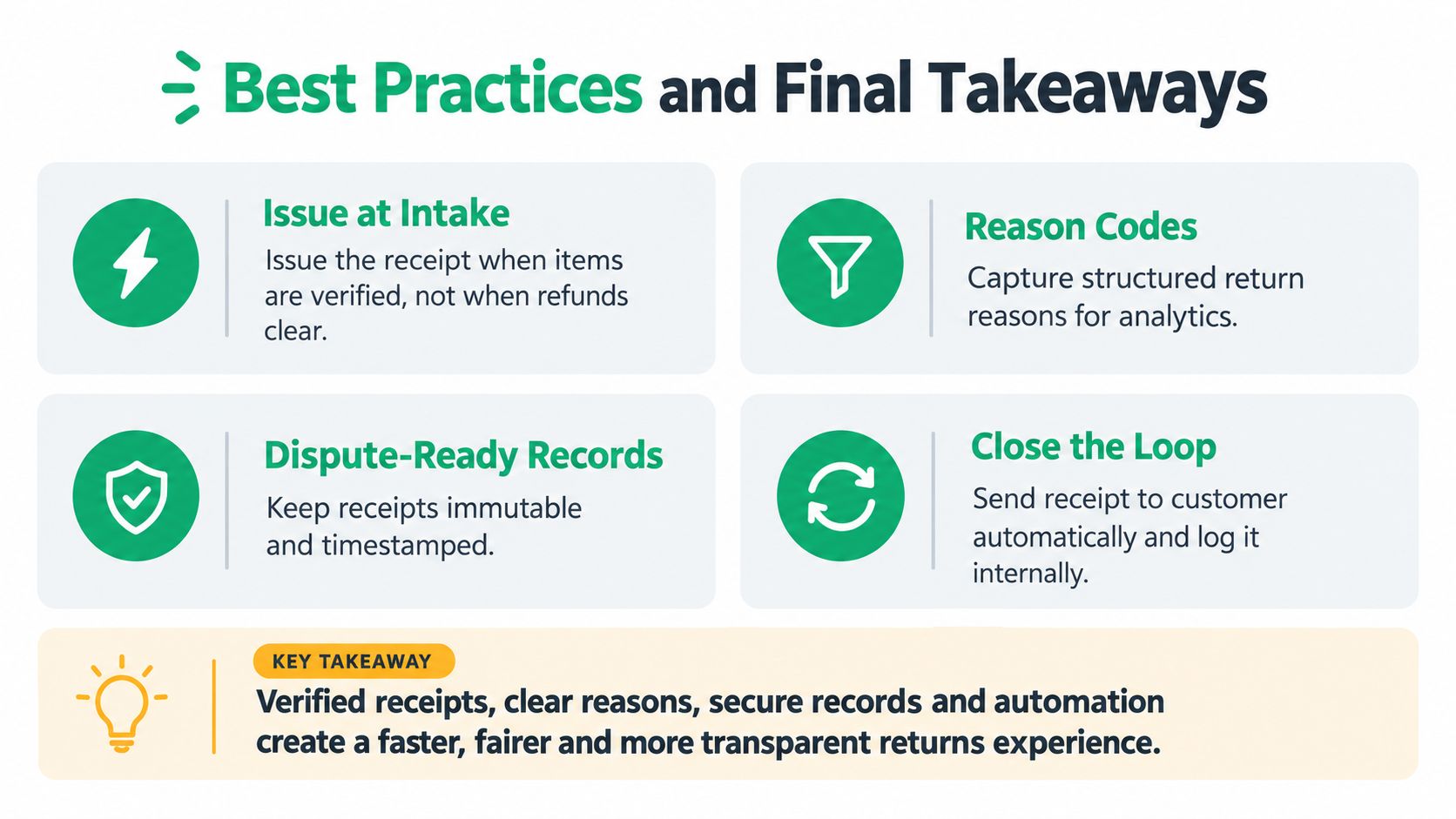
Issue the return receipt when intake is complete, before the refund clears when the workflow permits. Use consistent reason codes, preserve condition notes, and keep the record searchable by order number, RMA, SKU, and customer account. A chargeback response becomes much easier when the agent can open one immutable record instead of assembling screenshots from several systems.
Keep the policy usable for exceptions
No-receipt returns deserve a constrained path, not necessarily an outright refusal. Require verification data, restrict refund methods where your published policy allows it, and send uncertain cases to a named reviewer. That protects legitimate customers while avoiding an automatic refund when the merchant can't connect the merchandise to a sale.
Reason codes should serve more than fraud control. If “wrong size” dominates for one product, the merchandising team can investigate fit information. If “damaged in transit” appears repeatedly for one packaging format, operations can test the packing process. The receipt becomes useful business data when staff capture the same fields consistently.
Before issuing a refund, verify:
- Order matched: The return connects to the original transaction.
- Items confirmed: SKU, variant, serial number where applicable, and quantity are recorded.
- Condition documented: Staff record what they observed at intake.
- Reason captured: Each returned line has an appropriate reason code.
- Receipt issued: The customer receives the document and the internal system archives it.
- Refund logged: Amount, method, status, and reviewer are visible.
The return receipt isn't paperwork. It's the merchant's evidence.
Audit the workflow once each quarter. Sample accepted, partial, no-receipt, damaged, and missing-confirmation returns. If an agent can't explain the refund decision from the stored record, the process needs another field, permission control, or escalation rule.
SelfServe gives Shopify merchants a branded self-serve returns portal with integrated refunds and exchanges, including RMA-based return handling that can connect customer requests to receipt-backed intake records. Visit SelfServe to review how it can fit into your post-purchase workflow and start the available free trial.

Merchandising for Ecommerce: Tactics, Metrics and Tools
Learn merchandising for ecommerce: collection pages, cart drawers, personalized banners, the metrics that prove lift, and tools to run them.
Read more →
Order Confirmation Screen: What to Include and Templates
Learn what to include on an order confirmation screen, in what order, with tracking, cross-sell and support templates you can copy for your Shopify store.
Read more →
Best Up Sell App Picks for Shopify in 2026
Compare 10 Shopify up sell app options for 2026, with features, pricing, placements, and honest limitations to help you choose the right fit.
Read more →