

An order placed just before a holiday can take several different paths. The carrier may stop retail service while a premium product still moves, a parcel may leave your warehouse but miss final-mile delivery, or an international shipment may face customs and transport disruption unrelated to the destination's holiday calendar. Treating every closure as a simple yes-or-no mail question creates avoidable promise-date and support problems.
This guide compares seven carrier sources by the operational decision they support, from retail closure and pickup planning to delivery exceptions, final-mile visibility, regional coverage, and escalation planning. Use the entries to set warehouse cutoffs, revise storefront promises, update checkout messaging, and prepare customer-service replies. Always verify the current carrier schedule and market-specific details before publishing customer-facing commitments. For broader preparation, see this guide on how to handle holiday shipping chaos.
1. USPS
For U.S. merchants, USPS is the baseline source for mail delivery holidays. Its official schedule lists 11 annual federal holidays, including New Year's Day, Martin Luther King Jr. Day, Presidents Day, Memorial Day, Juneteenth, Independence Day, Labor Day, Columbus Day, Veterans Day, Thanksgiving Day, and Christmas Day. USPS says regular mail delivery resumes the day after a holiday, so a closure should affect both the promised arrival date and the next available operating day. See the official USPS holiday schedule before changing storefront copy.
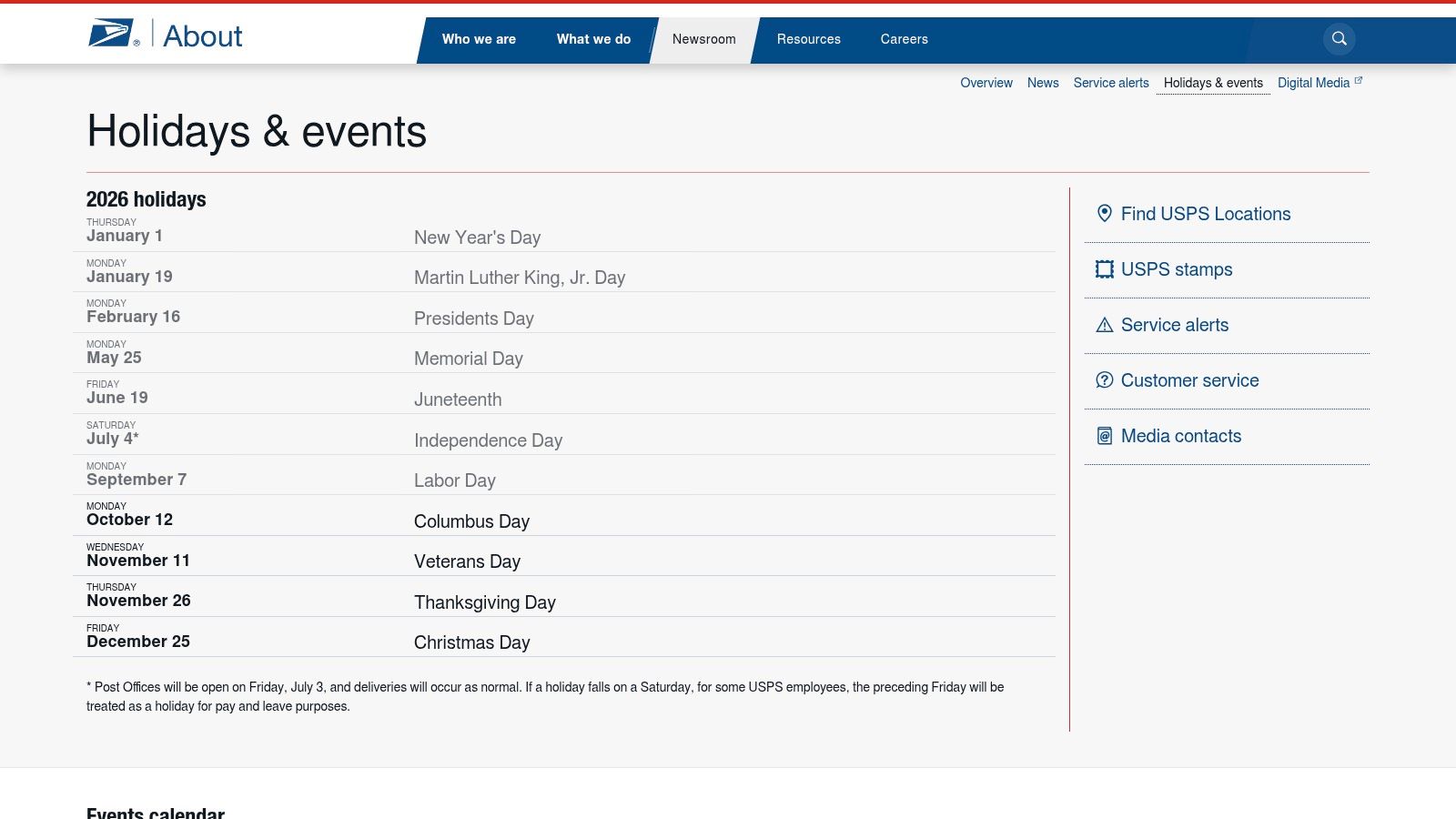
The schedule supports three separate decisions:
- Retail planning: Post Office locations close on listed holidays, though merchants should check individual locations for nearby schedule changes.
- Collection planning: Regular collection and delivery pause, so a label created on a holiday doesn't mean the parcel has entered the network.
- Service exceptions: USPS can continue limited premium services, including Holiday Premium Priority Mail Express and Holiday Same Day Package delivery in applicable situations. The USPS service rules archive shows why service class matters.
Practical rule: Never label an order “shipped today” merely because a postage label was created. Confirm that the relevant collection and transportation service is operating.
For Shopify teams, the USPS Post Office holidays guide can complement the carrier schedule when you're translating closures into customer-facing cutoff messages. USPS is the strongest source for federal observance, but it won't answer every local retail-hours question. Use the official calendar for national planning, then verify the specific facility and service tier before promising movement.
2. UPS
UPS is most useful when the decision is which service level can still pick up or deliver. Its U.S. holiday shipping schedule separates operations by Ground, Air, international, and other service categories. That distinction matters because a holiday closure for standard Ground doesn't automatically describe every prearranged or premium movement.
Download the annual operations schedule and give it to warehouse, transportation, and support leads. It should drive more than a calendar annotation. Your fulfillment team can use it to decide whether to release orders before a closure, your merchandising team can adjust delivery language by service, and your support team can identify orders that won't receive a normal scan until the next operating day.
Match the promise to the service
UPS schedules can include limited operations or prearranged Air pickups on days when ordinary Ground activity pauses. Don't turn that exception into a general promise. A merchant offering an expedited option should confirm that the service is available for the shipment's origin, destination, and pickup arrangement.
A useful internal rule is to store the carrier, service code, destination region, and last planned pickup date together. That prevents a generic “UPS ships on holidays” message from appearing beside an order that uses a service with different operating rules.
- Ground orders: Move the cutoff earlier when the schedule shows no ordinary pickup or delivery.
- Air orders: Confirm whether the pickup is prearranged and whether the destination accepts delivery.
- International orders: Check the destination network separately rather than relying on the U.S. calendar.
- Rate planning: Review the UPS charge calculation guidance before holiday pricing and service rules are finalized.
UPS gives operations teams a downloadable planning artifact and useful service granularity. The trade-off is that Ground service generally pauses on major federal holidays, while peak-period operational adjustments can make a simple date list insufficient. Build promises from the specific service, not the carrier logo.
3. FedEx
FedEx works best as a service-by-service operating matrix. Its holiday shipping and last-days-to-ship hub combines holiday guidance with information about shipping deadlines and retail locations. The accompanying schedule distinguishes services such as Ground, Express, Home Delivery, Freight, and FedEx Office activity.
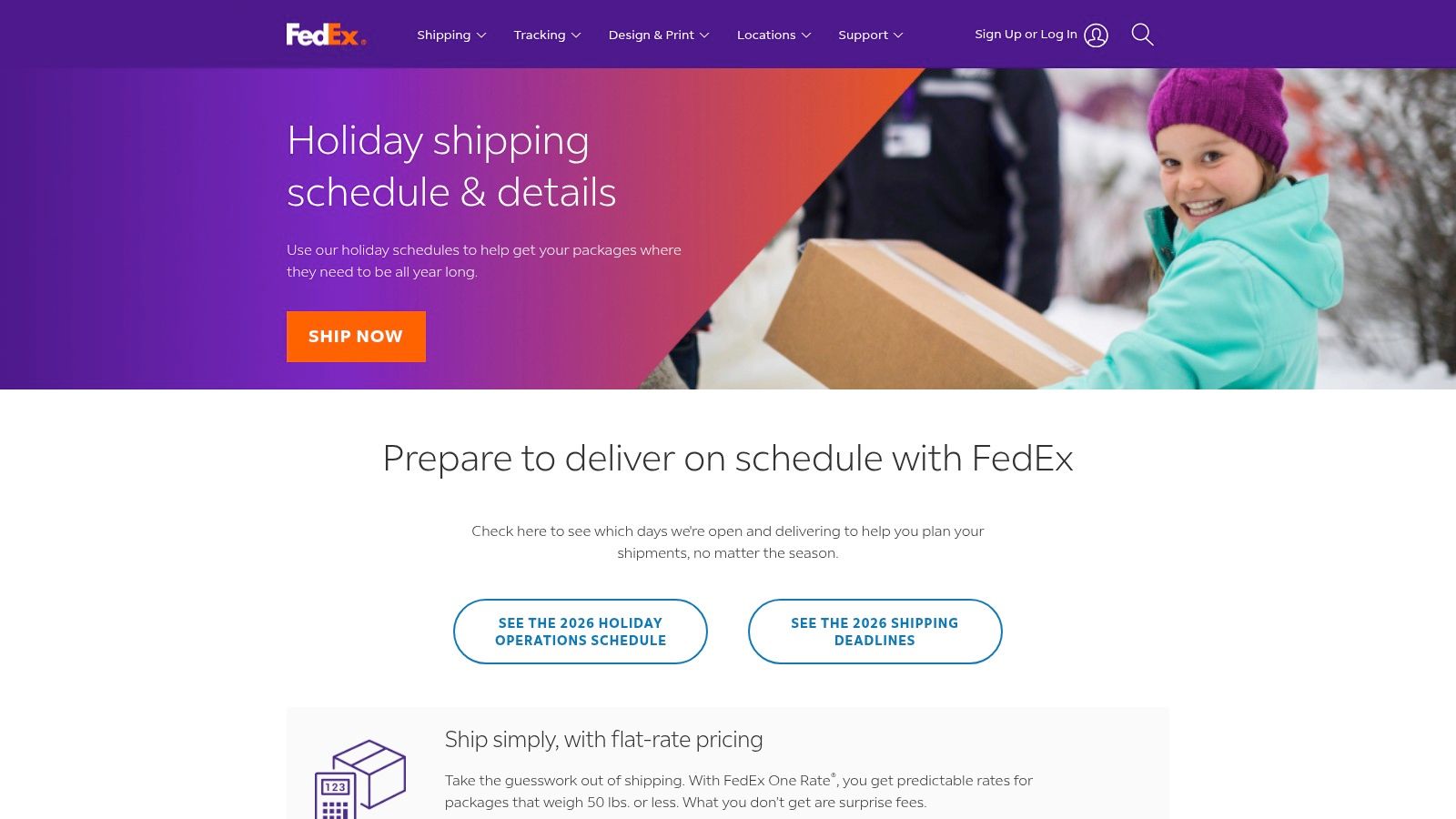
That granularity is valuable for merchants routing orders dynamically. A shipping rule can select an alternative service when Ground pauses, but only if the replacement operates for that lane. The same review should cover FedEx Office hours, since a customer drop-off option may not match the network's collection schedule.
Read the matrix across columns
FedEx documentation takes more attention than a basic national holiday list. Operations managers should inspect the exact row for the holiday and the exact column for the service. A service marked open may still have a modified timetable, while a retail location may have hours that differ from standard pickup operations.
The correct question isn't “Does FedEx deliver?” It's “Does this FedEx service accept, transport, and deliver this shipment on this date?”
Your checkout logic should avoid treating an expedited label as a guaranteed holiday solution. FedEx notes that money-back guarantees and commitment times can be modified or suspended during peak windows. That makes a transparent delivery range safer than an absolute promise when a shipment sits near a closure.
Use FedEx when your operation needs detailed service selection and retail-hour visibility. It's less convenient for teams that want a single quick answer, because the matrix requires careful reading across services and operating conditions.
4. DHL Express
DHL Express is the most relevant comparison when the order is international or time-definite. Its U.S. Express support and contact page provides holiday-related operating information, while DHL's service and rate documentation explains the products merchants use for international planning.
A U.S. public holiday can affect a shipment before it reaches the destination country. The U.S. facility may be closed, a pickup may not occur, or a time-definite commitment may need to be recalculated. International delivery also depends on the destination's own holidays, customs processing, transport availability, and local last-mile operations.
That's why DHL Express belongs in an escalation plan, not just a holiday calendar. If a customer asks why an international parcel hasn't moved, support should check the shipment's last physical scan, the origin operation, the destination operation, and any current service alert. A holiday label alone doesn't explain a cross-border delay.
- Origin check: Confirm whether the U.S. facility accepted the shipment.
- Destination check: Review the destination market's operating calendar.
- Service check: Separate standard international products from time-definite options.
- Customer message: Explain the next expected operating step rather than promising movement during a closure.
DHL may offer same-day options and other network solutions in particular markets, but those options shouldn't be treated as universal holiday exceptions. The carrier's international reach is useful, while U.S. facility closures can still limit pickup and delivery. Rates are also typically positioned above domestic alternatives, so the service choice should follow the customer promise and shipment value. For cost planning, review the DHL courier rates guide.
5. DHL eCommerce Solutions
DHL eCommerce Solutions supports a different operational question: when does the final mile happen? Its U.S. ecommerce service page describes domestic and international parcel products, while its U.S. operating model uses USPS for nationwide final-mile delivery. DHL and USPS have also confirmed a long-term exclusive USPS last-mile agreement, so USPS holiday rules can govern the customer-facing delivery stage.
That creates a common fulfillment trap. A parcel can move through DHL's first or middle mile and still wait because the USPS final mile isn't operating on the holiday. If the tracking page shows transportation activity, customers may assume delivery is imminent. Your promise logic needs to account for the handoff, not just the most recent carrier scan.
Separate network movement from doorstep delivery
For DHL eCommerce shipments, map the order through at least these stages:
- Warehouse handoff: Was the parcel collected before the closure?
- Middle mile: Is DHL transporting it during the holiday period?
- Postal handoff: Has USPS accepted the parcel for final-mile delivery?
- Doorstep delivery: Is regular USPS delivery operating in the destination area?
The service is attractive for ecommerce networks that want USPS reach and a cost-conscious parcel model. Its weakness is public holiday detail. Compared with UPS or FedEx, merchants may find less publicly accessible service-matrix information, so account-specific confirmation becomes more important for unusual lanes or peak periods.
Set customer messaging around the final-mile event. “In transit” shouldn't be presented as “out for delivery,” especially when the postal partner is observing a closure. That distinction reduces avoidable tickets and gives support agents a clearer explanation when DHL activity continues but the parcel doesn't arrive.
6. OnTrac
OnTrac is a practical option for merchants evaluating regional speed, cost, and seven-day coverage, but its holiday planning requires more direct confirmation. The OnTrac website provides access to service information and alerts, while support notices can indicate contact-center closures and operational changes around major holidays.
OnTrac's growing network can give ecommerce teams another routing option, particularly on lanes where a regional carrier offers a better fit than a legacy Ground product. Its ecommerce-oriented programs include seven-day options and economy tiers. Those features can help preserve delivery capacity, but they don't remove the need to verify holiday operating conditions by market.
Confirm the lane before changing the promise
Public information may not provide a complete holiday matrix for every origin, destination, pickup arrangement, and service tier. Ask your OnTrac account manager or support contact to confirm:
- Pickup availability: Whether the warehouse receives a scheduled collection.
- Delivery availability: Whether the destination ZIP code receives final-mile service.
- Service tier: Whether a seven-day or economy product follows a different calendar.
- Escalation route: Who handles a missed scan or delayed delivery during a support closure.
OnTrac differs from USPS, GLS US, and the larger integrators in this respect. The network may be attractive operationally, but merchants should avoid inferring a national rule from a regional notice. A support-center closure also doesn't necessarily describe every transportation or delivery operation, so treat it as an escalation signal rather than proof of a complete network shutdown.
OnTrac works best inside a multi-carrier plan. Keep an approved fallback for destinations outside reliable coverage, and make the delivery promise conditional on the actual service selected. When the public schedule is incomplete, written confirmation for the holiday window is more useful than a generic banner on the storefront.
7. GLS US
GLS US is the clearest source when the decision is which holidays create a documented no-service blackout. Its GLS US website and tariff resources publish a parcel tariff that identifies no pickup or delivery on New Year's Day, Memorial Day, Independence Day, Labor Day, Thanksgiving, and Christmas.
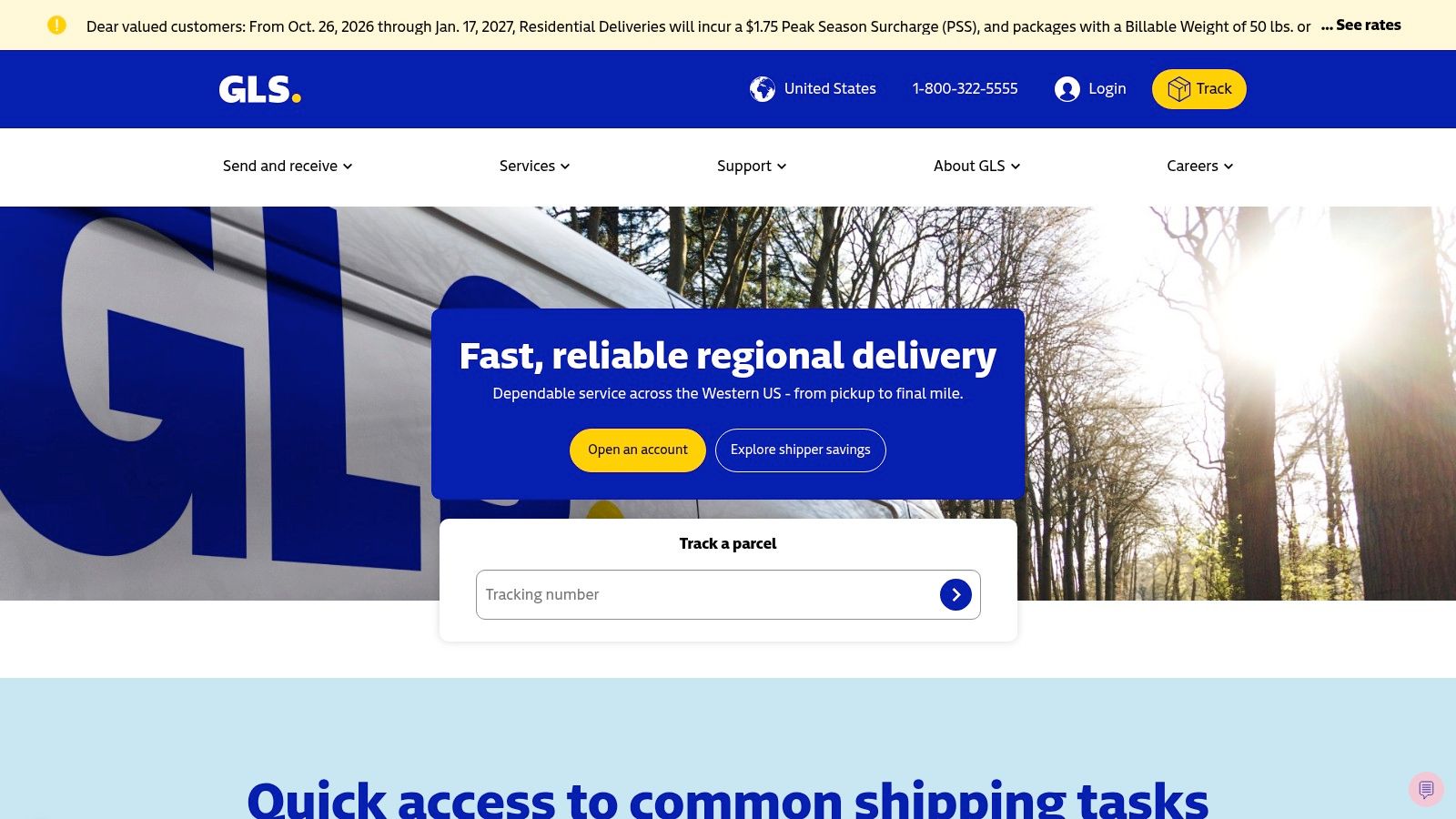
That tariff-based approach is useful for standard operating procedures. A warehouse can record the listed blackout dates, remove those dates from transit-day calculations, and set an internal rule that parcels released immediately before a closure may not receive their next operational scan until service resumes. The source is easier to incorporate into an SOP than an informal support answer.
GLS US also documents Saturday delivery by request in some ZIP codes outside holiday conditions. Don't treat that option as a holiday exception. Saturday availability depends on the destination and arrangement, so it needs separate confirmation before appearing in a checkout promise.
A regional carrier's published tariff can set the rule, but the service footprint still sets the boundary.
GLS US offers competitive regional coverage, but it doesn't provide national parity with USPS. Merchants serving the entire country may need another carrier for destinations outside the GLS footprint or for lanes where holiday operations differ. Confirm local details when a shipment is high-value, time-sensitive, or routed near a service boundary.
The right use case is a merchant with a defined GLS operating region and a desire for transparent blackout rules. Build the tariff dates into the shipping calendar, then pair them with a fallback carrier and a support script for customers whose orders fall across the closure.
7-Carrier Holiday Delivery Comparison
| Service | Implementation complexity (🔄) | Resource requirements (⚡) | Expected outcomes (📊) | Ideal use cases (💡) | Key advantages (⭐) |
|---|---|---|---|---|---|
| USPS (United States Postal Service) | 🔄 Low, authoritative federal holiday rules, simple to follow | ⚡ Low, minimal integration; follow published dates & cutoffs | 📊 Predictable delivery blackouts and clear peak‑season cutoffs | 💡 Baseline compliance, planning ship‑by dates, last‑mile baseline | ⭐ Authoritative federal guidance; explicit shipping cutoff guidance |
| UPS, U.S. Holiday Operations Schedule | 🔄 Medium, service‑level schedule requires reading per service | ⚡ Medium, ops planning, staffing and possible peak surcharges | 📊 Granular predictability for pickups, deliveries and exceptions | 💡 Align staffing, pickups and promises during holidays | ⭐ Detailed downloadable ops schedule; strong national footprint |
| FedEx, Holiday Service Schedule | 🔄 Medium‑High, multi‑service matrix can be complex to parse | ⚡ Medium, coordinate across services; guarantees may change | 📊 High alignment between service choice and holiday availability | 💡 Time‑sensitive shipments requiring service selection by holiday | ⭐ High granularity; some services may run when others pause |
| DHL Express (U.S.) | 🔄 Medium, consult holiday/contact pages and service guides | ⚡ Medium, international/time‑definite planning; premium rates possible | 📊 Predictable impact on international/time‑definite shipments | 💡 International or global time‑definite deliveries affected by U.S. holidays | ⭐ Strong international reach and comprehensive documentation |
| DHL eCommerce Solutions (US) | 🔄 Low‑Medium, USPS‑integrated last‑mile simplifies holiday rules | ⚡ Low, ecommerce cost focus; relies on USPS for final‑mile | 📊 Cost‑effective national reach but subject to USPS holiday blackouts | 💡 High‑volume ecommerce needing economical final‑mile delivery | ⭐ Cost‑efficient ecommerce network with clear peak‑season notices |
| OnTrac | 🔄 Medium, regional variations require account/market confirmation | ⚡ Low‑Medium, faster/cheaper on many lanes; variable coverage | 📊 Improved regional speed/cost; holiday ops vary by market | 💡 Regional ecommerce lanes prioritizing speed and cost | ⭐ Competitive regional transit times and ecommerce tiers |
| GLS US | 🔄 Low, transparent public tariff explicitly lists no‑service holidays | ⚡ Low‑Medium, easy SOP integration but regional footprint limits reach | 📊 Clear holiday blackouts in tariff; coverage gaps vs national carriers | 💡 Regional distribution where tariff clarity aids SOPs and planning | ⭐ Transparent tariff policy and predictable holiday blackouts |
Build a Holiday-Safe Shipping Calendar
A usable holiday plan starts with carrier evidence, not a generic list copied into a storefront banner. Record every relevant closure date, then classify it by retail service, pickup, linehaul movement, final-mile delivery, and service-level exception. USPS provides the U.S. federal baseline, while UPS and FedEx require service-specific reading. DHL Express adds international operating context, DHL eCommerce requires final-mile awareness, and OnTrac or GLS US may need market-level confirmation.
Create a carrier matrix for each warehouse and destination region. Include the service code, last planned pickup, expected next operating day, customer promise, and escalation owner. Don't assume that a premium product overrides every closure. USPS guidance allows limited exceptions for selected express products, while other postal and carrier services may remain paused. The Canada Post holiday operating guidance also illustrates why country and regional rules need separate treatment.
International orders need another layer of review. A holiday calendar can't capture every disruption. USPS service alerts can identify temporary international suspensions caused by transportation constraints, service disruptions, or labor action, so support teams should check current alerts before explaining a stalled cross-border shipment. The key question is whether the parcel can be accepted, transported, cleared, handed to the destination network, and delivered.
Use this workflow before each peak period:
- Record closures: Capture current dates from each carrier's authoritative page.
- Map exceptions: Note which products still operate and which require prearranged pickup.
- Calculate cutoffs: Work backward from the promised arrival date, including warehouse processing and the next operating day.
- Update promises: Change checkout, product pages, order confirmations, and tracking-page language.
- Prepare support: Give agents responses for delayed scans, missed pickups, final-mile pauses, and international alerts.
- Confirm regional gaps: Ask OnTrac and GLS US for market-specific details when public schedules don't answer the lane-level question.
USPS reported that during the 2025 holiday season, it delivered mail and packages in an average of 2.5 days across 16 billion pieces, compared with 2.8 days in the prior holiday period. The same USPS performance report says customer-care calls fell 23%, package-related inquiries fell 44%, and inquiry-related customer experience scores improved by 6.4 percentage points. Those figures provide a useful benchmark for support planning, but they don't replace proactive cutoff and closure messaging.
SelfServe can complement this process without replacing carrier checks. Its configurable post-purchase editing windows, address validation, cancellation queues, multilingual widget, and order-status upsell modules help merchants manage customer changes around fulfillment cutoffs. A customer who can correct an address or request a permitted change before warehouse release is less likely to create a preventable support escalation during a holiday closure.
Review the carrier pages before each peak season, refresh your shipping rules, and test the customer messages from checkout through tracking. Then confirm uncertain OnTrac and GLS US lanes directly instead of converting incomplete public information into a hard delivery promise.
SelfServe gives Shopify merchants configurable post-purchase editing windows, address validation, cancellation workflows, multilingual customer messaging, and order-status upsell modules that support holiday fulfillment operations. Use it to manage eligible order changes around carrier cutoffs, then visit SelfServe to review how it fits your store.

Merchandising for Ecommerce: Tactics, Metrics and Tools
Learn merchandising for ecommerce: collection pages, cart drawers, personalized banners, the metrics that prove lift, and tools to run them.
Read more →
Order Confirmation Screen: What to Include and Templates
Learn what to include on an order confirmation screen, in what order, with tracking, cross-sell and support templates you can copy for your Shopify store.
Read more →
Best Up Sell App Picks for Shopify in 2026
Compare 10 Shopify up sell app options for 2026, with features, pricing, placements, and honest limitations to help you choose the right fit.
Read more →