
A first order proves very little. In one analysis of more than 156,000 direct-to-consumer customers, the average repeat-purchase rate was 18.8%, meaning roughly four in five customers never placed a second order during the measured period, according to benchmarks on repeat-purchase measurement and cohort windows. That is the retention problem. You don't have a loyalty problem yet. You have a second-order problem, and most of it is created or solved in the messy days between checkout, delivery, and the first moment something goes slightly wrong.
Table of Contents
- Why E-Commerce Customer Retention Starts After the First Order
- The Four Retention KPIs That Actually Move the Needle
- The Personalization Trap and the Trust Trade-Off
- The Post-Purchase Playbook That Preserves the Order
- Loyalty Programs, Email and SMS, and On-Site Merchandising Compared
- A Merchant Story Stitching the Levers Together
- Your 90-Day Retention Rollout and the Mistakes to Skip
- Retention Questions Worth Answering Before You Spend Another Dollar
Why E-Commerce Customer Retention Starts After the First Order
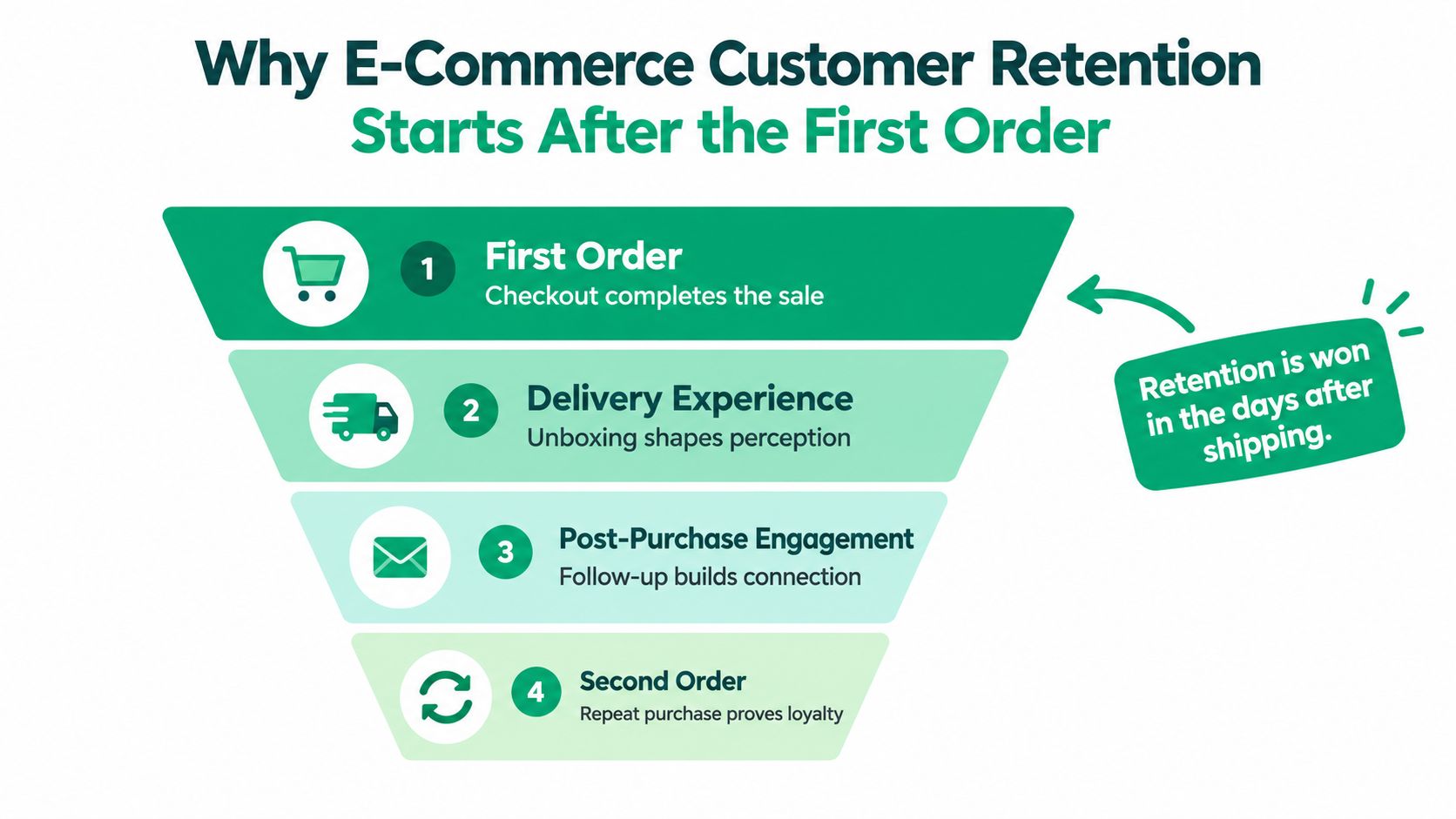
After a first purchase, a customer has about a 27% probability of buying again. After a second purchase that rises to roughly 49%, and after a third it reaches about 62%, based on industry analyses citing Smile.io data on repeat-purchase probability. Those jumps are the whole argument for e-Commerce customer retention as an operational discipline. The move from order one to order two adds 22 percentage points. Reaching order three adds 35 percentage points over the starting point.
Treat that progression as a funnel, not a slogan. Each stage answers a different customer doubt. Was the product right, did delivery match the promise, and did you fix problems without making the customer beg for help?
Non-contractual buying changes everything
Most online retail is non-contractual. Nobody has promised you a next order, and switching to a competitor costs the customer almost nothing. A subscription business can coast on inertia. You can't.
That's why vague averages mislead. One benchmark puts average e-commerce retention at about 38%, while category data in that same reporting shows consumables at roughly 22% to 44%, fashion at 10% to 17%, and durable and home-goods brands at 7% to 18%, as summarized in reporting on retention benchmarks by category. Your category sets a plausible ceiling and cadence. It doesn't excuse a broken post-purchase experience.
What to optimize first
Stop spreading effort evenly across every buyer. Your most effective job is moving a first-time buyer to a clean second order.
- Remove post-purchase friction: Let customers correct obvious mistakes before those mistakes become cancellations or returns.
- Resolve routine issues instantly: Save human agents for judgment calls, not address typos and size swaps.
- Offer the next relevant thing: Use the current order as context for replenishment or a sensible cross-sell, not as an excuse for generic discounting.
Practical rule: If a tactic doesn't help a customer complete a successful first experience and place a second order, it's not a retention priority yet.
Retention is won in small, controllable moments after checkout. Get those right and later programs have something worth amplifying.
The Four Retention KPIs That Actually Move the Needle
Most merchants track a single retention percentage and learn nothing from it. That number hides the definition, the observation window, and the cohort behind it. A store selling consumables shouldn't judge itself like a furniture brand, and a 90-day window tells a different story from a year.
Build a small dashboard instead. These four cohort-based KPIs tell you where customers drop and which lever to pull. They also give you the baseline you need before you judge any guide on increasing customer lifetime value against your own data.
The decision matrix
| KPI | What it measures | Primary lever it informs | Common pitfall |
|---|---|---|---|
| Second-order rate | Share of first-time buyers who order again within a fixed window | Post-purchase fixes, replenishment timing | Using a window that doesn't match product cadence |
| Repeat-purchase rate by category | How often each product group produces another order | Product sequencing, cross-sell, category strategy | Blending consumables and durables into one average |
| Order-preservation rate | Share of change requests resolved without cancelling the original order | Self-service edits, escalation rules | Counting a cancel and reorder as a save |
| Support contacts per 100 orders | How much friction customers hit after buying | Automation, clearer notifications, better product information | Cutting contacts by hiding support instead of fixing causes |
Measure second-order rate at 30, 60, 90, and 365 days. Then segment by first product, acquisition channel, geography, and first-order value. You'll usually find that retention isn't uniformly weak. One entry product or channel is dragging the average down.
Vanity averages hide the work
Don't celebrate a rising repeat rate if it's driven only by discount subscribers while full-price cohorts decay. Likewise, referral activity means little unless referred buyers reach a second order at healthy margin. If you're researching that lever, compare referral program examples for ecommerce brands against your cohort economics, not against headline participation.
Assign each KPI an owner and a review cadence. Second-order rate belongs to whoever controls post-purchase and lifecycle timing. Order-preservation rate belongs to operations and support. If nobody owns the number, it becomes decoration.
The Personalization Trap and the Trust Trade-Off
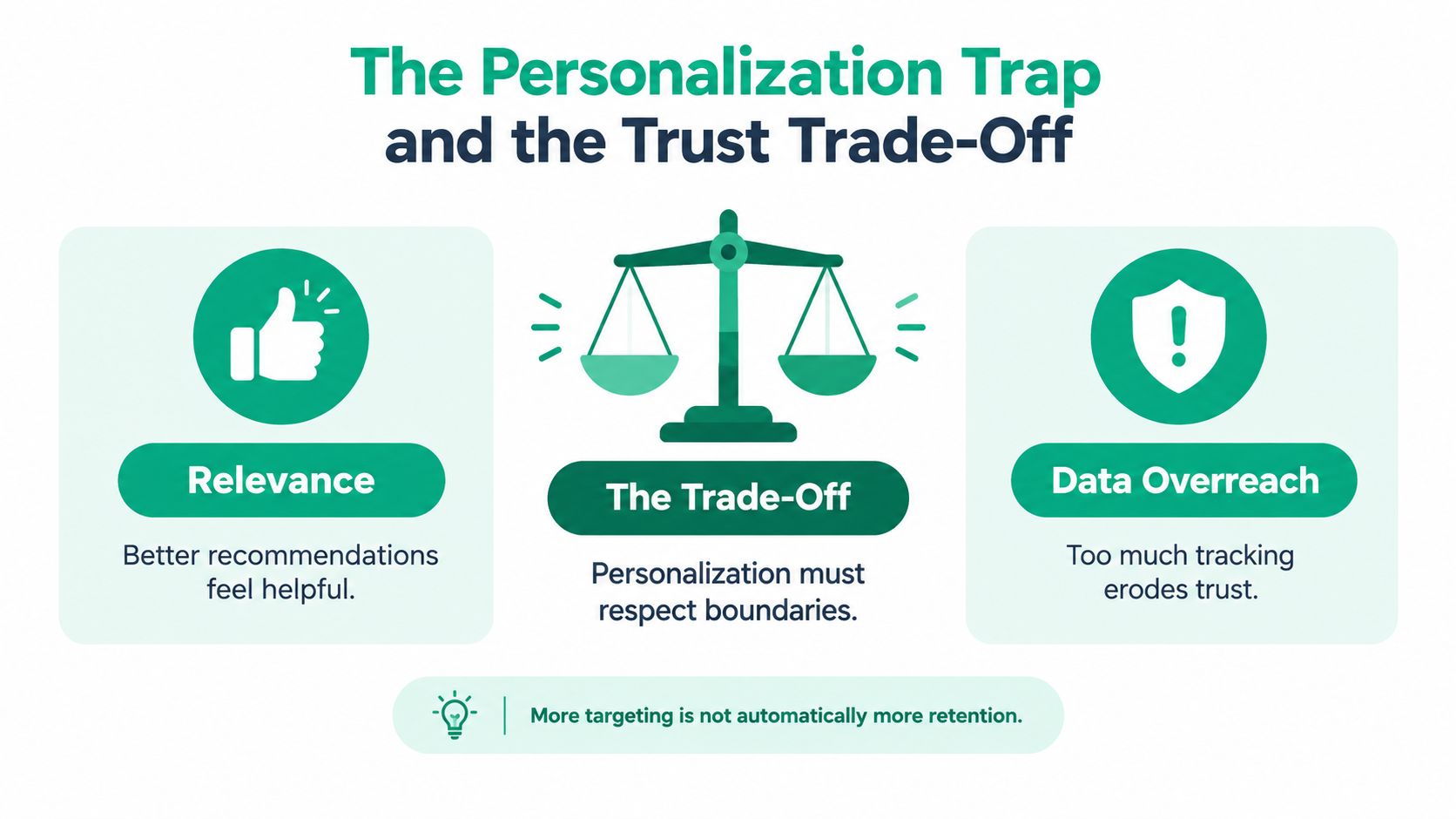
More targeting is not automatically more retention. I've seen stores add recommendation engines, identity graphs, and aggressive popups, then wonder why repeat purchase stays flat while unsubscribes and refund complaints climb. The customer didn't feel understood. The customer felt watched.
The tension is real. Adobe reports that 69% of consumers want retailers to anticipate needs with timely offers or information, but only 35% believe brands succeed, while 87% expect responsible and secure handling of personal data and 74% want disclosure when retailers use AI-generated content or recommendations, according to Adobe's retail digital trends research on personalization and disclosure. Relevance is welcome. Opaque surveillance isn't.
Earn value per unit of data
Judge every tactic by perceived value per unit of customer data and attention. A bundle suggestion based on what's already in the cart needs almost no personal history. A replenishment reminder based on the product just bought is easy to explain. A creepily specific offer built from stitched browsing behavior has to work much harder to justify itself.
Use this test before you ship anything:
- Can you explain it plainly: Would a customer thank you if you described why they saw this offer?
- Does context beat identity: Can the current order, cart, or product do the job without deeper profiling?
- Are you measuring backlash: Are opt-outs, complaints, refunds, and repeat purchase tracked beside conversion?
If you would be embarrassed to explain a targeting rule to the customer, don't run it.
Low-data, high-context interventions usually win on trust. A clearly explained bundle, a threshold incentive in the cart, or a relevant add-on at checkout respects the customer's immediate intent. Excessive discounting does the opposite. It trains buyers to wait, erodes margin, and tells you nothing about whether the product experience earned another order.
Personalization should reduce effort, not increase suspicion. Start with the order in front of you. Earn permission for anything deeper.
The Post-Purchase Playbook That Preserves the Order
A customer who picks the wrong size doesn't want to cancel. They want the right size. A customer who mistypes an address doesn't want a refund and a reorder. They want the package to arrive. When you force those people into a ticket queue, you turn a solvable mismatch into a retention failure.
Speed matters because delay creates more work. Live-chat responses within one minute convert 15% better than responses within five minutes, and slow first responses trigger follow-up contacts, according to benchmarks on e-commerce customer service response time. Don't read that as a hiring plan. Read it as a mandate to remove deterministic requests from the queue entirely.
The four-stage order-preservation workflow
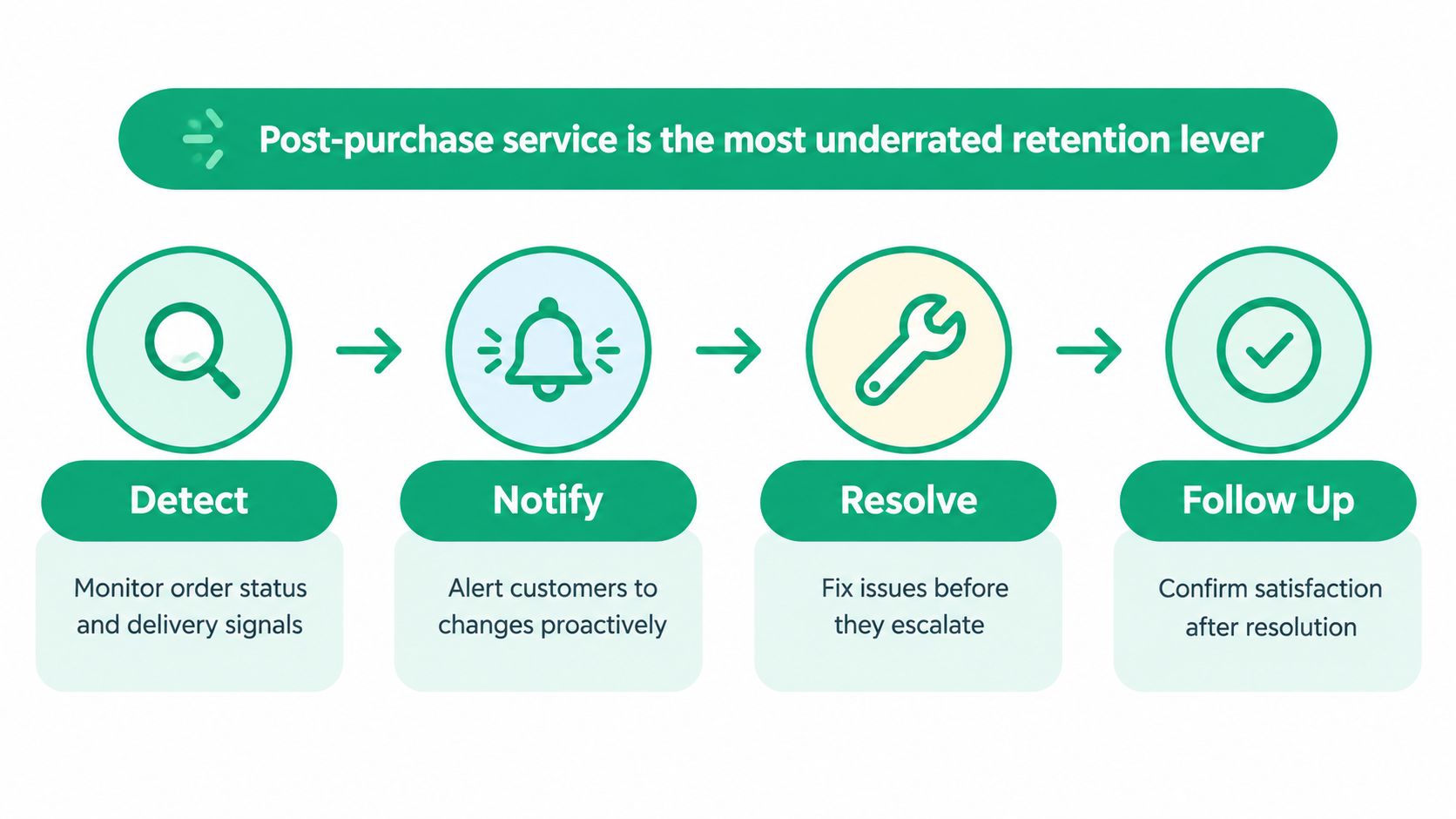
Start by detecting the request where the customer already is, typically the order status page. Then expose only actions your rules allow. Eligibility can depend on elapsed time since purchase, order tags, product type, fulfillment state, and payment status.
- Detect: Surface edit options before the customer opens a ticket or cancels.
- Allow: Permit only safe changes to variant, quantity, address, contact details, or shipping method.
- Reconcile: Collect a price difference or issue a partial refund automatically, then sync inventory, shipping, and order tags in Shopify.
- Revert: Block or reverse the change if payment isn't completed, so you don't create fulfillment exceptions or refund leakage.
This is the operational heart of a strong post-purchase customer experience. The promise is simple, but the plumbing has to be exact. An edit that changes the product without updating inventory or shipping creates a worse problem downstream.
Use email carefully inside this workflow. Confirmation and payment-completion messages must reach the inbox, which is why understanding the email deliverability definition matters before you blame customers for ignoring notices they never received.
The short walkthrough below shows how a controlled self-service flow differs from a manual cancel and reorder process.
Measure the result with tickets per 100 orders, median time to resolution, first-contact resolution, cancellation rate, and repeat purchase by treatment cohort. Compare customers exposed to self-service with a comparable control group. The win you're looking for is specific: fewer avoidable cancellations without more fulfillment errors, failed payments, or negative feedback.
Keep humans in the loop for exceptions. Self-service should handle routine, rule-based changes, and agents should handle damaged items, complex returns, and anything involving judgment or empathy. That's not removing support. That's spending support where it matters.
Loyalty Programs, Email and SMS, and On-Site Merchandising Compared
Merchants often ask which retention lever to buy first. My answer is unglamorous. Buy the one that fits your product cadence and that you can measure against second-order rate without torching margin.
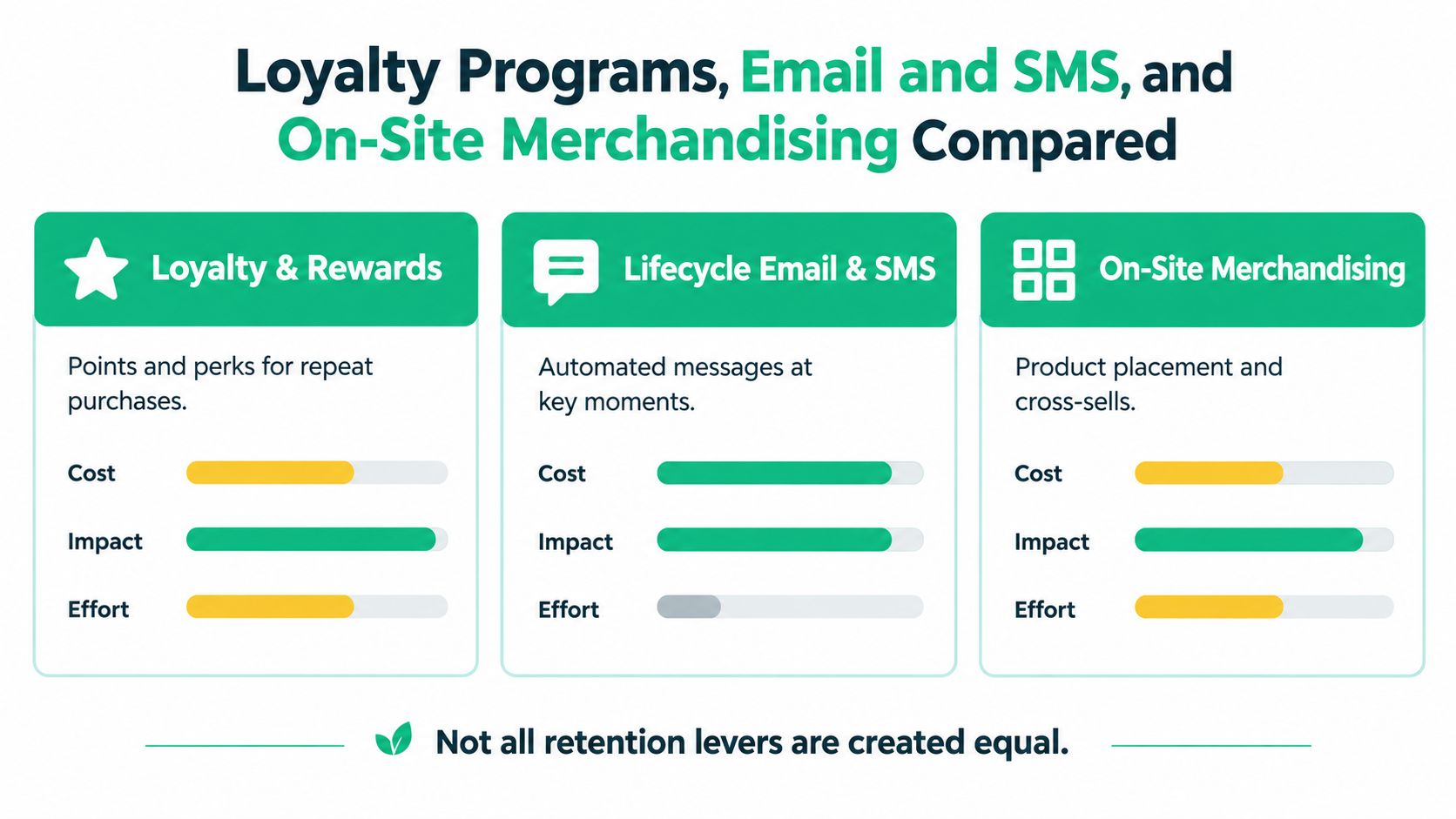
Loyalty and rewards
Loyalty works best when customers already have a natural reason to buy again soon. Consumables, replenishment products, and repeatable categories can support points or tiers because the next purchase occasion arrives on its own. For infrequent durables, points often become a delayed discount on a purchase that may never happen.
Structure matters more than branding. Set redemption thresholds from contribution margin and normal purchase cadence, not from what a competitor advertises. If members would have bought anyway, you haven't bought retention. You've donated margin.
Lifecycle email and SMS
Email and SMS are the workhorse, but they're only as good as their timing and segmentation. A replenishment message tied to a realistic usage window helps. A generic winback blast sent to everyone who hasn't bought recently teaches customers to ignore you. This is also where creative testing on increasing repeat purchases without discounting is more useful than adding another percentage-off flow.
SMS deserves extra restraint. It's interruptive, so reserve it for time-sensitive, clearly useful moments. If every message is a sale, the channel stops being a service and becomes noise.
On-site merchandising
Cart drawers, threshold goals, and contextual add-to-cart upsells operate at the moment of intent. They need little personal data, they're easy to explain, and they can lift the value of the current order while setting up the next one. A frequently bundled accessory shown when it's useful is merchandising. The same item pushed in three popups is harassment.
| Lever | Cost to launch | Data and trust burden | Time to impact |
|---|---|---|---|
| Loyalty and rewards | Moderate to high, plus ongoing reward liability | Moderate, requires identifiable repeat behavior | Slower, depends on natural repurchase cadence |
| Email and SMS | Low to moderate, mainly creative and segmentation work | Moderate to high, consent and frequency are critical | Moderate, tied to send timing and usage windows |
| On-site merchandising | Low to moderate, especially with no-code tools | Low, based mainly on current cart or order context | Fast, measurable on current sessions and orders |
Choose by category economics, not hype. If customers rarely return because the first experience breaks, none of these levers will save you. Fix order preservation first, then amplify what already works.
A Merchant Story Stitching the Levers Together
Consider a representative mid-market Shopify apparel brand. Its problem isn't traffic. First orders arrive steadily, but support inboxes fill with size swaps, address corrections, and customers asking to add an item they forgot. Too many of those requests end as cancellations because fulfillment moves faster than the reply.
On day one after delivery, a customer realizes she ordered the wrong size. Instead of emailing support and waiting, she opens the order status page and requests a variant swap inside the merchant's editing window. The rules check fulfillment state and product type, show only the permitted change, and reconcile the price difference automatically. Inventory and shipping data update with the order. The original transaction survives.
That single interaction moves three KPIs at once. Order-preservation rate improves because the order wasn't cancelled. Support contacts per 100 orders falls because no ticket was created. Median time to resolution drops because the customer fixed the issue immediately.
What happens next in the sequence
Two weeks later, the same customer returns to buy a second color. As she adds it to the cart, a contextual upsell suggests the care accessory frequently bundled with that product. The offer is based on the item in front of her, not on a hidden profile. She can decline it in one click and checkout stays clean.
Later, a replenishment-style follow-up for a consumable add-on lands near its typical usage window. It doesn't lead with a discount. It reminds her what she bought, why it pairs with the original product, and how to reorder quickly. The brand tracks whether this cohort reaches a second and third order more often than customers who went through manual support.
Not everything gets automated. When another customer reports a damaged item with photos, the flow routes her to a person. That's deliberate. Human interaction still matters, and 86% of surveyed consumers said it remains moderately or very important to brand experience, while 29% had stopped buying from a brand after poor customer experience, according to PwC research on customer experience and human interaction. Automate the routine. Escalate the ambiguous.
Public merchant feedback for the SelfServe app includes 33 five-star Shopify App Store reviews, which reflects merchant-side value from post-purchase self-service workflows of this kind. The lesson isn't that one tool creates loyalty. It's that sequencing does. Preserve the order, make the next relevant offer in context, follow up at a sensible time, and keep a human ready when the rules run out.
Your 90-Day Retention Rollout and the Mistakes to Skip
You don't need a year-long loyalty replatform to start. You need a tight sequence with a metric attached to each step. Broader frameworks such as the retention strategies from Class A Media can help you sanity-check priorities, but your own cohort data should decide the order of work.
The sequence
- Weeks 1 to 2, instrument: Baseline second-order rate by window, repeat rate by category, order-preservation rate, cancellation rate, and contacts per 100 orders.
- Weeks 3 to 6, preserve orders: Launch a rule-based self-service edit window for your highest-volume change requests, with payment reconciliation and automatic reversion.
- Weeks 7 to 10, add context: Introduce one cart incentive and one contextual upsell. Test them on incremental revenue, refunds, and repeat purchase, not clicks alone.
- Weeks 11 to 12, prune: Compare treatment and control cohorts. Kill anything that doesn't move second-order rate or that buys revenue with margin you can't afford.
The mistake I see most: Teams launch points, flows, and popups in the same month, then can't tell which change did anything.
Skip three habits. Don't over-discount loyalty members who would buy anyway. Don't send lifecycle emails without segmentation by product and timing. Don't chase personalization features that increase data burden while repeat purchase stays flat.
Each action should end with a decision. Keep it, change the rule, or remove it. A checklist that never deletes tactics is just a wish list with dates.
Retention Questions Worth Answering Before You Spend Another Dollar
Is retention a better spend than acquisition
Usually, once you have a working product and a measurable second-order problem. Acquisition feeds the funnel, but if first-time buyers rarely return, more traffic mostly buys more one-time revenue. Fix the biggest post-purchase leak first, then scale acquisition into a funnel that holds.
Do you need a loyalty program
No. You need customers to complete a successful first experience and find a clear reason to buy again. Points can help repeatable categories later. They won't compensate for slow support, forced cancellations, or irrelevant follow-ups.
How quickly should you see movement
Operational signals such as contacts per 100 orders, cancellation rate, and order-preservation rate should move first. Judge repeat purchase only after a full cohort passes through your chosen second-order window.
If avoidable order changes are turning into tickets, cancellations, and lost second orders, ServeApps offers Shopify-native tools for self-service order editing, configurable cart drawers, and contextual upsells that you can measure against the KPIs above. Visit the site to see how those workflows fit your store and start with the highest-volume change requests your team handles today.
Best Up Sell App Picks for Shopify in 2026
Compare 10 Shopify up sell app options for 2026, with features, pricing, placements, and honest limitations to help you choose the right fit.
Read more →
Best Checkout Page: 7 Examples That Convert in 2026
Discover 7 best checkout page tools and examples for Shopify with pros, cons, and conversion tips to boost AOV without rebuilding checkout.
Read more →
Shopify Checkout Customization: Options Compared
Compare Shopify checkout customization options: Checkout Extensibility, checkout.liquid, and apps. Learn plan limits and which approach fits your store.
Read more →