
The popular advice is to choose the most visible agency, but visibility doesn't tell you whether a partner can solve your commerce problem. An e commerce company in the US might specialize in Shopify Plus design and conversion rate optimization, B2B purchasing workflows, replatforming, growth marketing, or ERP and 3PL integration. Those capabilities aren't interchangeable.
This comparison evaluates seven agencies by the problem they're best equipped to address. It considers documented services, useful evidence, likely strengths, practical limitations, platform fit, project complexity, post-launch support, integration requirements, and scoping considerations. The aim isn't to declare one universal winner. It's to help a merchant identify which partner deserves a serious investigation.
The benchmark also extends beyond the storefront. Merchants managing post-purchase edits, address quality, cancellations, and upsells may want to evaluate operational tools such as SelfServe alongside agency selection. For broader context on choosing an agency beyond paid acquisition, see this guide to going beyond ads with an ecommerce agency.
1. Avex Designs

Avex Designs is a strong candidate for a fashion, beauty, or lifestyle merchant whose central problem is turning brand expression into a higher-converting Shopify Plus storefront. Its positioning combines design, development, and CRO, so the relevant evaluation isn't only whether it can launch a theme. The more important question is whether its UX decisions, custom theming, and integrations support the commercial behavior the brand needs.
The agency's public positioning points toward Shopify Plus builds and replatforms, mobile-focused performance work, enterprise-grade integrations, and ongoing optimization after launch. Its published client work, testimonials, and recognizable DTC references provide useful evidence, although a prospective client should still ask for references involving a similar catalog, international footprint, and operational stack.
Where Avex fits best
Avex is most compelling when the storefront itself is the primary growth constraint. A brand with strong creative direction but an inconsistent mobile journey, weak merchandising hierarchy, or underdeveloped product pages may benefit from a partner that treats design and conversion as connected disciplines.
The trade-off is capacity and cost. The supplied project signals place typical minimums around $25,000 or more, so smaller merchants should confirm scope before investing heavily in discovery. A boutique team may also have less room to run several large programs in parallel than a larger systems integrator.
Practical rule: Ask Avex to separate the launch scope from the post-launch CRO program. That makes it easier to compare the initial build with the continuing optimization commitment.
Investigate the agency through its Shopify Plus design and development services. Validate the proposed team, integration ownership, analytics setup, testing process, and response model after launch. Avex should move near the top of the shortlist when premium UX and conversion-led storefront work matter more than broad enterprise program management.
2. BlueSwitch
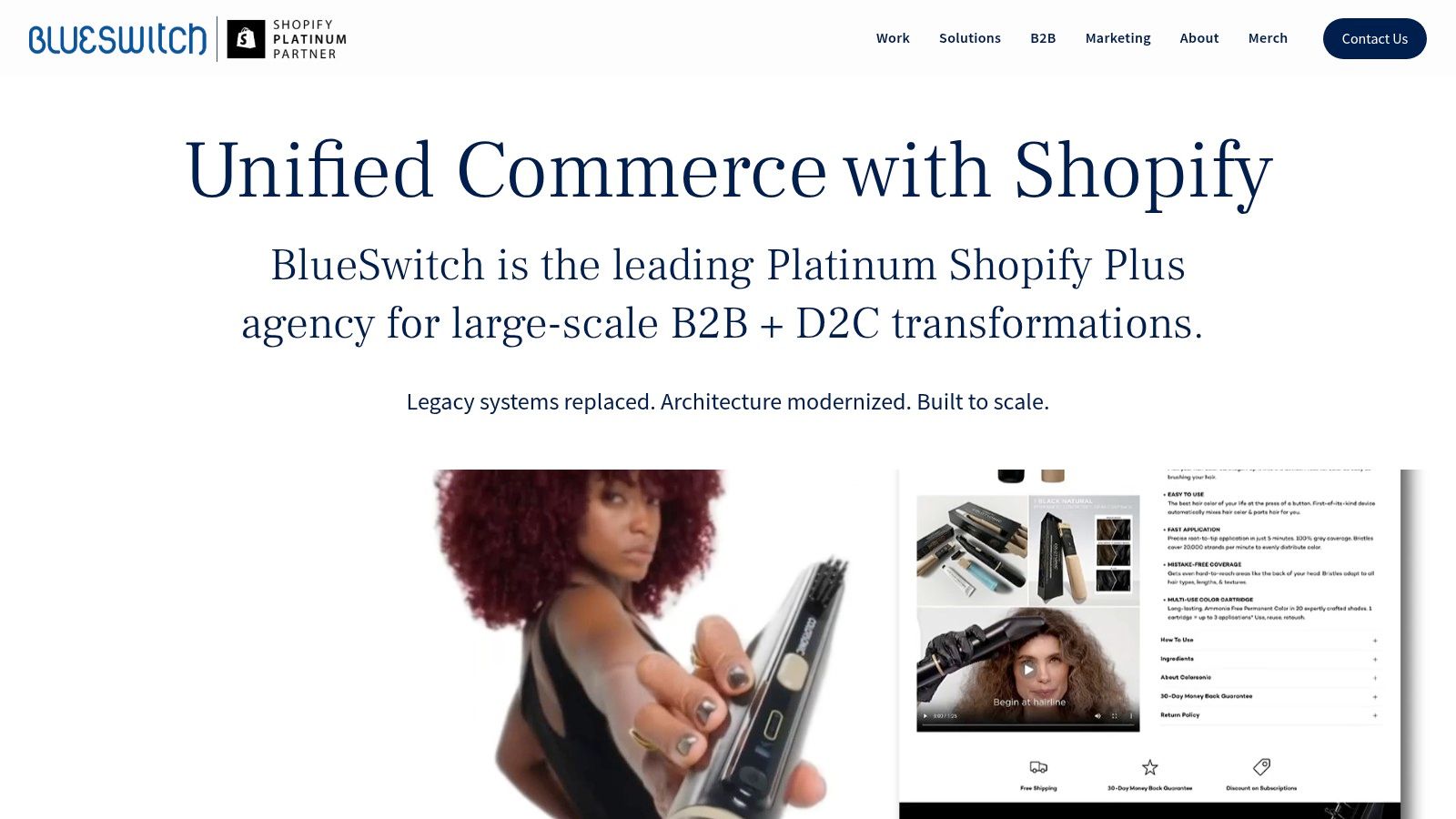
BlueSwitch is better understood as a Shopify partner for complex storefront and B2B requirements, rather than only as a visual design agency. Its public material describes Shopify and Shopify Plus development, custom experiences for complicated catalogs, wholesale workflows, and integrated marketing support. That combination matters for merchants whose customer types, price rules, or account structures make a standard DTC build inadequate.
The Shopify Partner Directory provides a concrete signal, with a 4.9 out of 5 rating across more than 50 reviews, as listed in the supplied agency information. That evidence supports credibility, but it doesn't replace a reference call. Reviews can establish a pattern of client experience, while a reference should test whether BlueSwitch has handled the exact ERP, account-pricing, catalog, and approval requirements in the brief.
A fit for wholesale complexity
BlueSwitch's B2B orientation makes it worth investigating for a merchant selling to retailers, distributors, or account-based buyers. The relevant capabilities include Shopify Plus development for constrained user experiences, wholesale setup, ERP and pricing playbooks, and marketing services such as paid media and SEO.
Its in-house marketing support can reduce coordination overhead when a merchant wants development and acquisition work under one relationship. That benefit also creates a scoping question. A business should decide whether it needs one integrated partner or whether specialist development and marketing providers would produce clearer accountability.
Pricing is listed as contact for pricing, so the buying process may require more discovery before the merchant can compare offers. Complex customization may also need a phased roadmap rather than a single launch.
Review BlueSwitch's Shopify and ecommerce services with a specific request for B2B references. Ask how the team models account-based pricing, customer permissions, ERP synchronization, and post-launch support. BlueSwitch is especially relevant when Shopify must serve both operationally demanding wholesale buyers and a polished customer-facing storefront.
3. Absolute Web
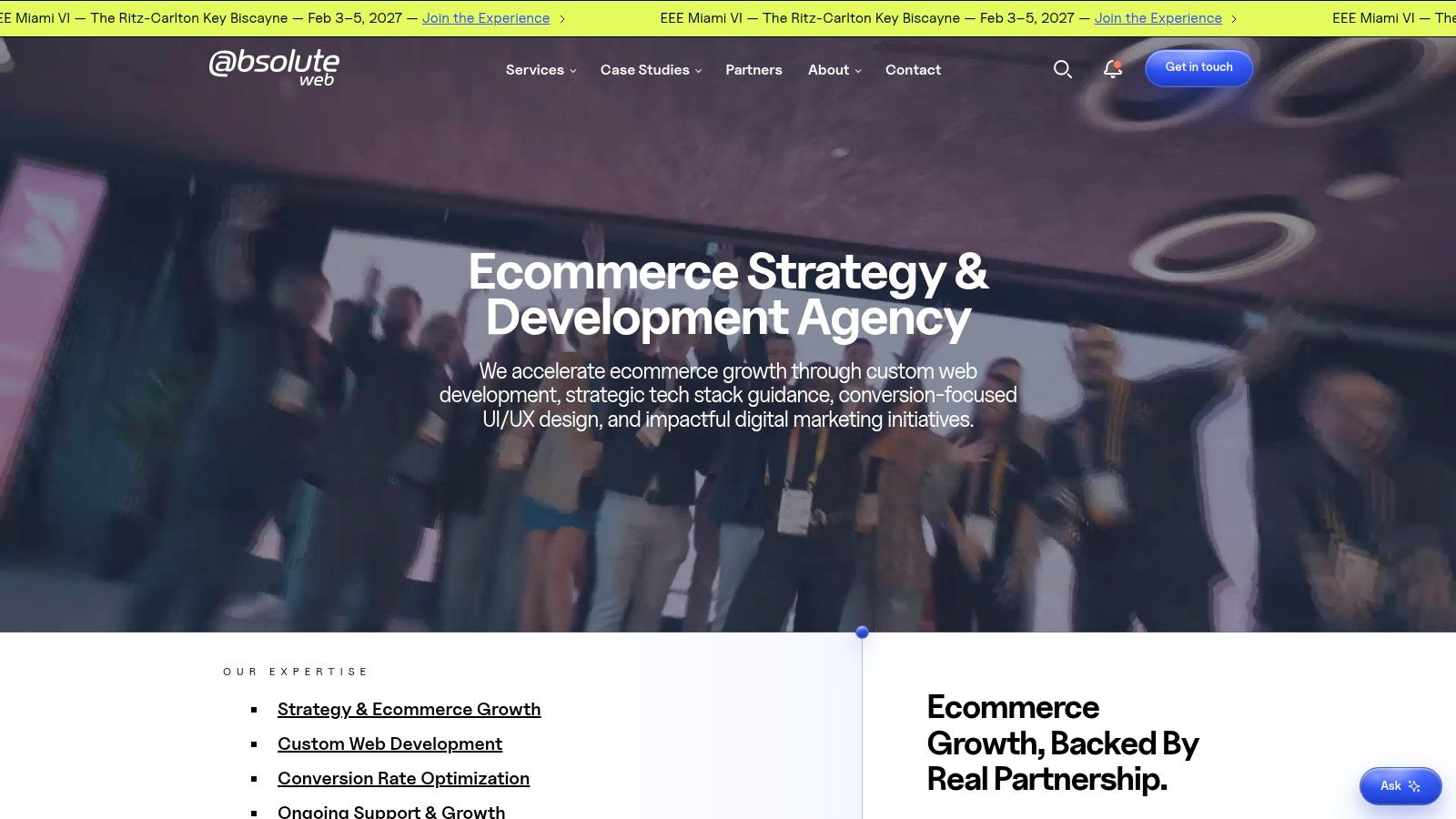
Absolute Web stands out when the commerce problem is migration or technology-stack consolidation, not merely a new front end. The agency has operated in ecommerce since 1999, according to the supplied company information, and works across Shopify, Adobe Commerce, and BigCommerce. That multi-platform background is useful when a merchant is deciding whether Shopify Plus is the right destination, or when the project must preserve business logic built on another platform.
Its stated capabilities span strategy, UX, development, integrations, growth, and CRO. More significantly for a replatforming brief, the agency describes experience moving from Adobe Commerce or Magento to Shopify Plus while preserving SEO, alongside ERP and 3PL integration work. Those are the areas where an attractive redesign can still fail if data, redirects, fulfillment events, or canonical signals aren't handled precisely.
The migration lens
A serious Absolute Web evaluation should focus on the migration plan rather than the visual portfolio alone. Request the proposed sequence for catalog mapping, customer and order data, redirects, analytics, integrations, testing, and cutover. The agency's multi-platform experience may reduce the risk of assuming that every business process can be reproduced through a standard Shopify configuration.
The supplied profile describes an 80-plus specialist team and more than 25 years in ecommerce. Those figures are quantitative claims from the provided agency signals, so they should be validated directly during procurement. They indicate potential breadth, but breadth can also create more discovery and strategy overhead before delivery.
A merchant seeking a Shopify-only boutique may find that process heavier than necessary. Conversely, a company replacing a fragmented stack may value that broader perspective.
Operational details belong in the migration brief too. If customers need controlled order edits after checkout, review the Shopify app integration guidance alongside the agency's systems plan. Then assess Absolute Web's ecommerce services against the actual integration map, not a generic platform comparison.
4. Coalition Technologies
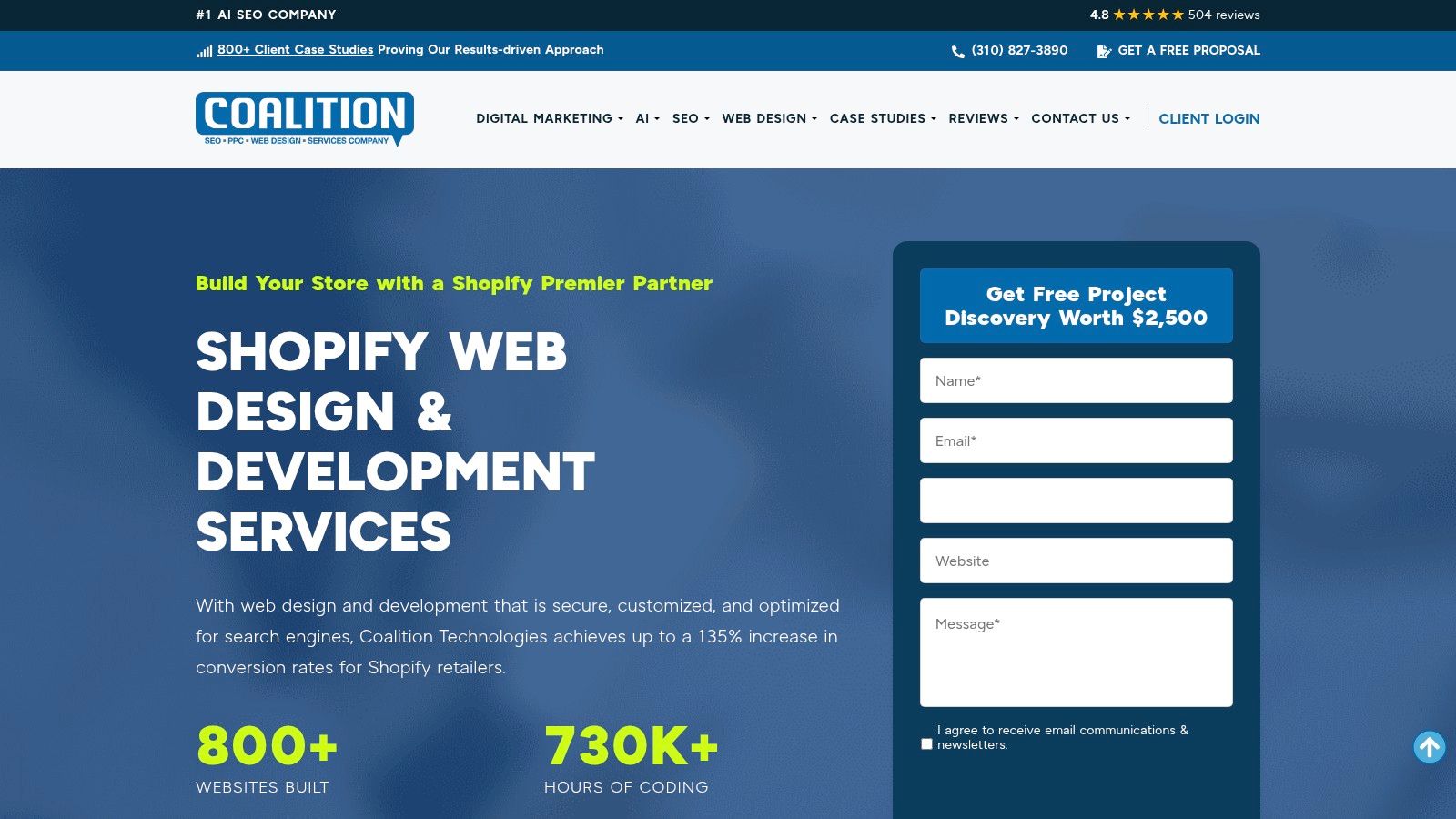
Coalition Technologies is designed for merchants that don't want to separate Shopify development from growth operations. Its stated offer combines Shopify and Shopify Plus development with custom theme and app work, technical SEO, paid media, and CRO. That structure is valuable when the storefront is only one part of the commercial problem and the merchant wants a continuing program tied to acquisition and conversion metrics.
The agency's supplied profile cites a portfolio of 800-plus sites and many five-star reviews. Those are company claims that should be checked against current references and the scope of comparable projects. The important analytical point isn't the raw volume. It's whether the agency can show that its development process works with the merchant's analytics, attribution model, merchandising priorities, and testing cadence.
Integrated growth, with controls
Coalition may suit a brand that needs a scalable retainer covering technical improvements, SEO, paid acquisition, and conversion work after launch. A single partner can simplify coordination between landing pages, technical SEO, campaign requirements, and onsite experimentation.
That model isn't automatically better. Large-agency processes can feel less nimble when a team needs a short sprint, a quick merchandising change, or direct access to senior specialists. Integrated marketing also raises measurement questions. A merchant should define which outcomes the agency controls, which depend on media spend or inventory, and how incrementality will be assessed.
Don't accept a performance narrative without an analytics plan. Ask which events, revenue sources, attribution rules, and testing baselines will support the claim.
The agency's Shopify web design and development offering deserves consideration when ongoing growth is part of the mandate, not an optional add-on. For the organic-search side of that decision, use the ecommerce SEO integration guide to frame questions about technical ownership, internal linking, structured data, and post-launch monitoring.
5. Redstage
Redstage is the most natural fit on this list when Shopify must coexist with enterprise systems and demanding B2B processes. The firm presents itself as a platform-agnostic ecommerce engineering partner working across Shopify, Adobe Commerce, Salesforce Commerce Cloud, and BigCommerce. That breadth matters when the storefront is only the visible layer over quoting, contract pricing, ERP, OMS, identity, fulfillment, and security requirements.
The supplied profile emphasizes Shopify Plus builds and replatforms, systems integration, enterprise support, security, and compliance. It also points to documented Plus replatforming work. A merchant should ask for references where Shopify was required to fit an existing enterprise architecture, rather than relying on DTC examples that don't test the same constraints.
Engineering before aesthetics
Redstage's B2B relevance comes from workflows such as quoting, contract pricing, ERP and OMS flows, and account-specific purchasing. Those requirements can alter the platform design from the beginning. They affect data ownership, permissions, checkout behavior, order routing, and the way customer service teams resolve exceptions.
The risk is a mismatch in operating style. A process-driven enterprise methodology may be appropriate for a complex transformation, but it may feel excessive to a fast-moving DTC team that needs iterative storefront releases. The firm's multi-platform background also means a buyer should verify how much of the proposed solution is Shopify-specific and how much depends on external systems or partners.
Use Redstage's commerce engineering services as the starting point for a technical discovery conversation. The headless commerce platform guide can help frame questions about whether a headless approach is justified by the business requirements or would add unnecessary operational complexity.
Redstage belongs on a shortlist when integration risk, B2B rules, security, and long-term enterprise support outweigh the appeal of a small, design-first engagement.
6. Shero Commerce
Shero Commerce focuses on complex commerce built on a Shopify foundation, especially B2B and B2B2C models. Its Shopify Premier positioning and ecosystem-led approach make it relevant for a brand extending an existing DTC store into wholesale, gated catalogs, account-based pricing, or other buyer-specific experiences.
The agency's stated services include design, development, growth, and technical support. Its integration experience includes B2B tools such as SparkLayer and marketing systems such as Klaviyo. Those partnerships can help a merchant assemble capabilities without developing every function from scratch, but they also introduce dependencies that need to be documented before delivery begins.
When DTC becomes wholesale
Shero is a particularly useful candidate when the merchant already has a consumer storefront and wants to add wholesale without creating a disconnected commerce experience. The evaluation should cover customer segmentation, catalog visibility, price lists, approval flows, account permissions, checkout rules, and how wholesale orders move into fulfillment and finance systems.
The B2B emphasis can be unnecessary for a purely DTC brand. It can also extend delivery timelines compared with a simple theme refresh because wholesale requirements affect information architecture, data modeling, testing, training, and support.
Scope before selection: Require a workflow map showing the difference between guest DTC buyers, approved wholesale accounts, sales representatives, and internal administrators.
Shero's ecosystem-led model may accelerate implementation when the selected tools fit the merchant's needs. It can also create a more complicated support chain if an issue crosses Shopify Plus, SparkLayer, Klaviyo, and an ERP. Ask who owns diagnosis, what happens when an integration changes, and whether the agency provides ongoing technical support.
Review Shero Commerce's complex commerce services with those questions in hand. Shero should rank highly for a DTC brand adding wholesale capabilities, but less highly for a merchant that has no account-based or B2B requirement.
7. Netalico Commerce
Netalico Commerce is a strong option for merchants that see migration risk and continuous optimization as the central issue. Its supplied profile describes a Shopify Plus Premier Partner focused on Magento and BigCommerce migrations, performance tuning, and retainer-based development, CRO, and technical support. That focus is narrower than a full enterprise integrator's, which may be useful for a mid-market or Plus brand that wants senior attention without a broad transformation program.
The agency's stated migration discipline includes structured redirects and data validation for SEO-safe replatforming. Those details deserve more weight than generic claims about a new storefront. A migration can fail through lost search equity, incomplete product data, broken customer records, or fulfillment errors even when the front end looks polished.
Transparent scope and ongoing ownership
Netalico publishes pricing bands and positions its services for brands with $2 million to $50 million in GMV, according to the supplied agency information. Those bands should be confirmed because pricing, staffing, and inclusions can change. Their presence is still useful during early comparison because it gives a buyer more context before requesting a detailed proposal.
Flexible retainers may suit a merchant that expects continuous development rather than a one-time launch. Performance-first builds and a multi-location US presence can also support time-zone coverage, although the buyer should confirm which senior specialists will be assigned.
The main limitation is boutique scale. Netalico may not run as many simultaneous initiatives as a larger agency, and heavier ERP or 3PL work may require partner support beyond its core team. Ask for a responsibility matrix covering data migration, redirect validation, integrations, QA, launch support, and post-launch monitoring.
Investigate Netalico Commerce's Shopify services if a controlled replatform and sustained optimization matter more than a large menu of agency services. Its fit is strongest when the merchant wants a disciplined migration partner and a practical retainer after launch.
Top 7 U.S. E-commerce Agencies Comparison
| Provider | 🔄 Implementation complexity | ⚡ Resource requirements | 📊 Expected outcomes | 💡 Ideal use cases | ⭐ Key advantages |
|---|---|---|---|---|---|
| Avex Designs | 🔄 Medium–High, enterprise theming & integrations | ⚡ Mid–High budget; typical minimums ~$25k+ | 📊 Conversion‑driven UX and measurable CRO improvements | 💡 DTC fashion/beauty/lifestyle brands on Shopify Plus needing conversion lift | ⭐ Proven Plus experience, published client results |
| BlueSwitch | 🔄 High, complex catalogs & B2B flows | ⚡ High; detailed scoping and phased roadmaps common | 📊 Scalable B2B/B2C storefronts with robust catalog handling | 💡 Brands with complex catalogs, wholesale or ERP needs | ⭐ Strong review profile; in‑house marketing + development |
| Absolute Web | 🔄 Medium–High, multi‑platform migrations & integrations | ⚡ High, larger discovery and specialist team involvement | 📊 End‑to‑end replatforms with SEO preservation and integrations | 💡 Brands migrating from Magento/Adobe or needing full‑service agency | ⭐ 25+ years ecommerce, multi‑platform expertise |
| Coalition Technologies | 🔄 Medium, large‑agency process with custom dev | ⚡ High, retainers for ongoing optimization & growth services | 📊 Integrated development + SEO/paid/CRO with measurable KPIs | 💡 Brands wanting development and growth under one roof | ⭐ Strong performance‑marketing and retention capabilities |
| Redstage | 🔄 High, enterprise systems integration & security focus | ⚡ High, enterprise engineering and integration resources | 📊 Secure, integrated commerce solutions for complex stacks | 💡 Enterprises requiring Shopify to coexist with ERP/OMS/legacy systems | ⭐ Deep B2B and enterprise integration expertise |
| Shero Commerce | 🔄 Medium–High, B2B/wholesale feature builds | ⚡ Mid–High; leverages ecosystem partners to accelerate delivery | 📊 Gated catalogs, account pricing and wholesale experiences on Plus | 💡 DTC merchants adding B2B/wholesale layers to Shopify | ⭐ Ecosystem‑led approach and strong wholesale focus |
| Netalico Commerce | 🔄 Medium, migration and performance‑first builds | ⚡ Mid, published pricing bands and flexible retainers | 📊 SEO‑safe migrations, performance tuning, ongoing retainers | 💡 Mid‑market to Plus brands seeking transparent pricing and migrations | ⭐ Clear pricing bands and disciplined migration practice |
Turn the Shortlist Into a Defensible Decision
The right choice starts with the constraint, not the agency name. A conversion-led fashion brand may need Avex, a wholesale expansion may point toward Shero or BlueSwitch, and a replatform with major integration exposure may justify Absolute Web or Redstage. Coalition is more relevant when development and growth operations belong in one program, while Netalico fits a merchant prioritizing migration discipline and continuing optimization.
Separate must-have capabilities from optional services before requesting proposals. Must-haves might include Shopify Plus experience, B2B pricing, SEO preservation, ERP or 3PL integration, multilingual support, analytics ownership, or a defined post-launch support model. Optional services could include paid media, content production, email marketing, or broader brand strategy. This distinction prevents a large service catalog from obscuring a capability gap.
Request references that match the project, not just the platform. Ask each agency to provide relevant Shopify or Shopify Plus examples involving similar catalog complexity, customer types, integrations, and migration conditions. Test assumptions with concrete questions:
- Migration control: How will the team map data, build redirects, validate SEO signals, and stage cutover?
- Integration ownership: Which systems will the agency configure, which will partners handle, and who diagnoses failures?
- B2B behavior: How will account permissions, contract pricing, gated catalogs, quoting, and approval flows work?
- Measurement: Which CRO, performance, SEO, revenue, and operational metrics will the agency report after launch?
- Delivery model: Who is senior, who is hands-on, how are changes prioritized, and what happens when scope shifts?
Prepare a short vendor brief covering catalog structure, B2B requirements, SEO preservation, ERP or 3PL dependencies, CRO goals, delivery model, internal resources, timeline, and budget expectations. Give every agency the same brief, then compare exclusions and assumptions as carefully as the headline price.
Post-purchase operations should also be part of the evaluation. Baymard's benchmark of 343 ecommerce sites found that 47% lacked an address validator, while 86% used generic validation errors such as “Invalid [field name],” according to its checkout address-validation benchmark. Those findings point to a practical question for any storefront project: what happens after a customer enters an incorrect address or needs to change an order?
The support burden matters too. Industry coverage cited in the supplied research places WISMO at up to 30% of incoming support volume, and benchmarks place ecommerce support demand between 200 and 500 tickets per 1,000 orders. Treat those figures as directional industry context and validate them against your own support data. A storefront agency may not solve those workflows by itself, so merchants should review the tools surrounding the storefront.
SelfServe can help Shopify brands manage permitted post-purchase edits, validate addresses, coordinate cancellation workflows, and create order upsell opportunities. That makes it a relevant complement when an agency is planning broader customer-experience or operations improvements, particularly as Shopify merchants assess changes to Thank You and Order Status page workflows.
Choose the agency that can explain your operating model in detail, not the one with the broadest list of services. Then make the contract reflect that decision, with named deliverables, integration responsibilities, acceptance criteria, launch support, and measurable post-launch ownership.
SelfServe gives Shopify and Shopify Plus merchants controlled post-purchase editing, address validation, cancellation workflows, and upsell options for existing orders. If those operational needs belong in your agency evaluation, visit SelfServe to review how it can complement a more capable ecommerce storefront.

Order Confirmation Screen: What to Include and Templates
Learn what to include on an order confirmation screen, in what order, with tracking, cross-sell and support templates you can copy for your Shopify store.
Read more →
Best Up Sell App Picks for Shopify in 2026
Compare 10 Shopify up sell app options for 2026, with features, pricing, placements, and honest limitations to help you choose the right fit.
Read more →
Best Checkout Page: 7 Examples That Convert in 2026
Discover 7 best checkout page tools and examples for Shopify with pros, cons, and conversion tips to boost AOV without rebuilding checkout.
Read more →